May 2025
High red dunes, dead trees and a windy Sesriem
Warning: This is going to be a long post, but please stay with us. There are many photos we want to share with you and also a challenging camp story towards the end.
You may remember our amazing late afternoon at NamibRand Family Hideout where we saw a large herd of oryx and springboks while it was raining in the desert (read here).
In today’s post, we visit red sand dunes that rise up to 300m into the sky and are rank among the biggest in the world – yes, it’s the famous Sossusvlei. And we’re going to show you Deadvlei with dead trees that are probably more than 1,000 years old. Oh, and we try to camp in a gale force wind!
We left NamibRand Family Hideout before sunrise because we wanted to arrive early at Sossusvlei to walk among the dunes.
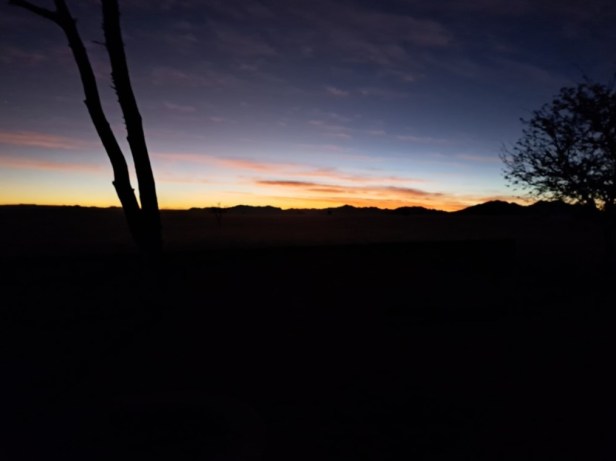
Early morning at the farmhouse
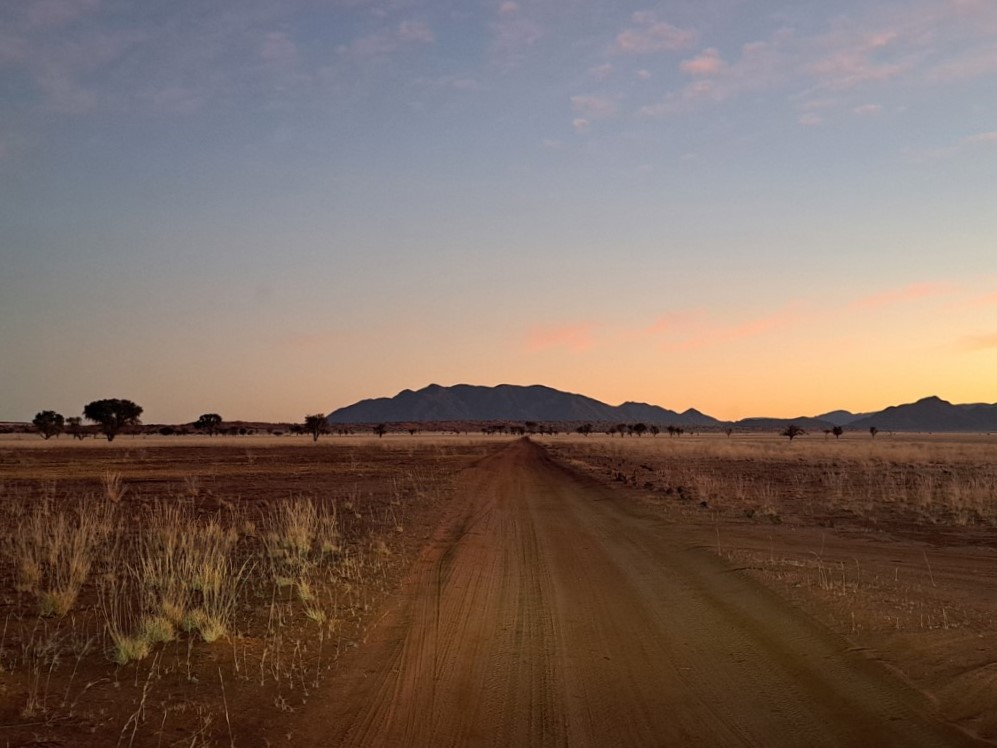

Leaving NamibRand Family Hideout
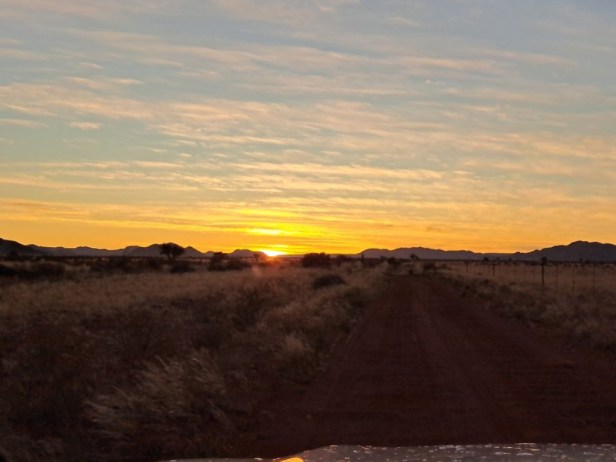
Beautiful sunrise
We only had to drive 128km/79 miles to get to Sesriem, where we booked a camp site for one night. From Sesriem, it’s still 60km/37 miles to Sossusvlei. The road to Sesriem is a dirt road, while the road between Sesriem and Sossusvlei is tarred. So, we hoped to cover the distance relatively quickly.
However, it soon became clear that we were on the worst road since we entered Namibia. It was very corrugated – so much so that the alarm on our tire pressure monitor went off and we had to stop to inspect the tires. Fortunately, there were no problems, but we drove this stretch quite slowly to prevent any damage to our ‘bakkie’s’ tires.

A very corrugated dirt road
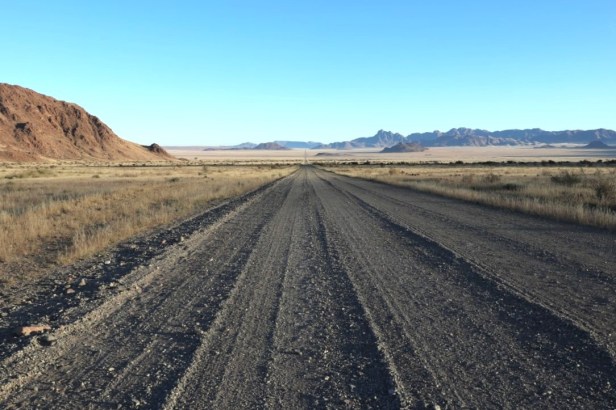
The road stretched into infinity
We could see the distinctive red sand dunes many kilometers before we even reached Sossusvlei. We were also lucky to see another herd of springboks. These views made up for the bad road we had to drive.

We start seeing the red sand dunes of Sossusvlei
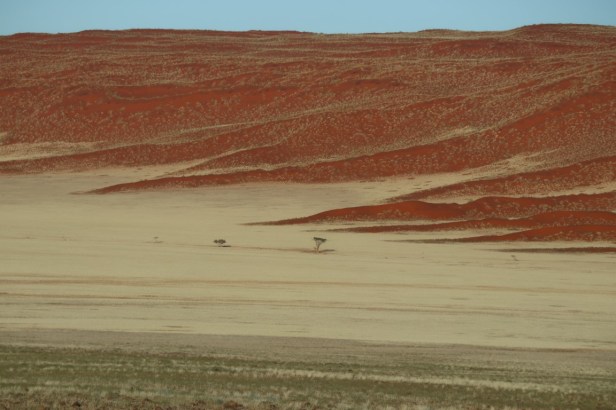
After good rainfall, the grass was growing on the dunes

Grass covered sand dunes


Herd of springboks
We reached Sesriem just after 09:00 and first stopped at the garage to refuel our ‘bakkie’. There is also a small café where we could buy water and sandwiches. The owner of the garage mentioned that they were expecting a very strong wind later in the afternoon. He just smiled when he heard we were going camping – it seemed that we were in for a rough night of camping.
During our visit to Namibia, we noticed how many rented 4×4 ‘bakkies’ there were on the roads. It seems that many of the younger tourists from other countries (especially Europe) prefer to drive and camp rather than stay in lodges or make use of tour agencies. We wondered if it was because they can see more of the country this way or because accommodation (especially lodges) is so expensive. In any case, it was just interesting to see.

Tourists in rented 4×4 vehicles, equipped with camping gear
Sossusvlei & Deadvlei:
As I have mentioned before, the Namib Desert is the oldest in the world and its sand dunes are also among the biggest. The name ‘Sossusvlei’ roughly means ‘dead-end-marsh’. Vlei is the Afrikaans word for ‘marsh’, while ‘sossus’ is Nama for ‘no return’ or ‘dead end’. Sossusvlei is in the Namib-Naukluft National Park and the gate opens at sunrise and closes at sunset.
At the end of the tarred road, is a large parking area. If you do not have a 4×4 vehicle or are not comfortable driving in thick sand, you can leave your vehicle here and use the shuttle services to drive the last 5km/3 miles to Sossusvlei. At the time of our visit, the shuttle costs were R150/USD8.46 per person for a return trip. After switching our ‘bakkie’ to 4WD, we had a lot of fun driving this last stretch.


Sandy road
After parking our ‘bakkie’ at Sossusvlei, it’s about 2km/1.2 miles of walking through thick sand to Deadvlei and the highest dune. Here it truly feels like one is walking in a desert.
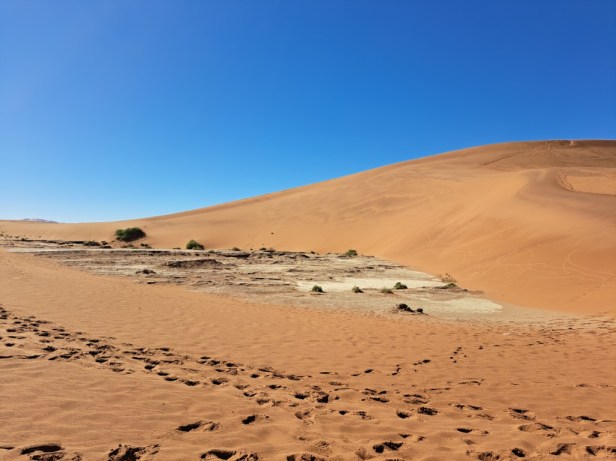
Sossusvlei

Walking through thick sand to Deadvlei
There were quite a lot of tourists here, as expected, but after we had been walking around Deadvlei for quite a while, most of the people turned back (I think the heat was perhaps too much for most of them). This meant that we almost had the pan at Deadvlei to ourselves.
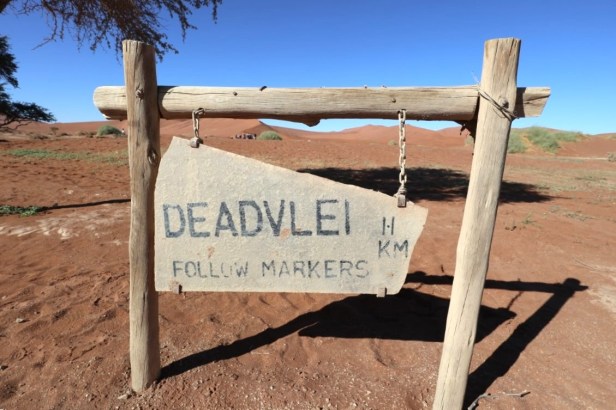
Almost at Deadvlei
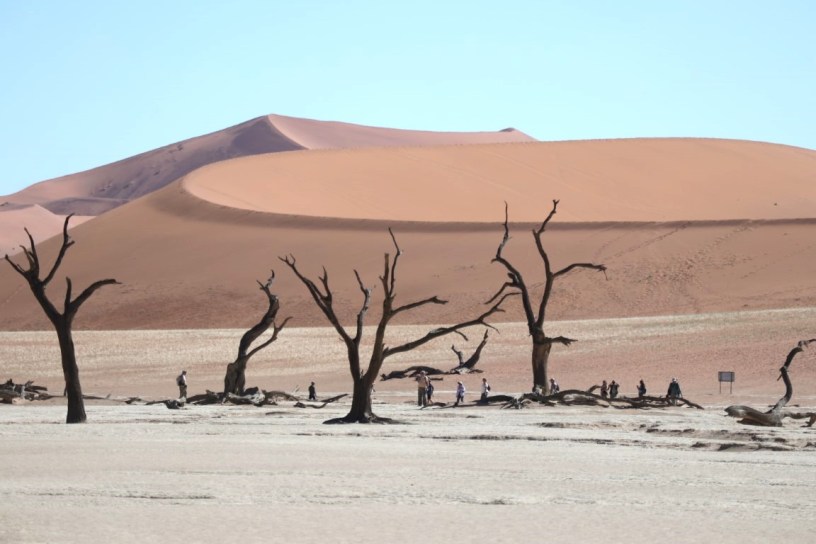
Deadvlei (‘Dooievlei’ in Afrikaans) is a claypan. This is where the iconic skeletons of the camel thorn trees are that survived for a few hundred years after the dunes blocked the Tsauchab River.
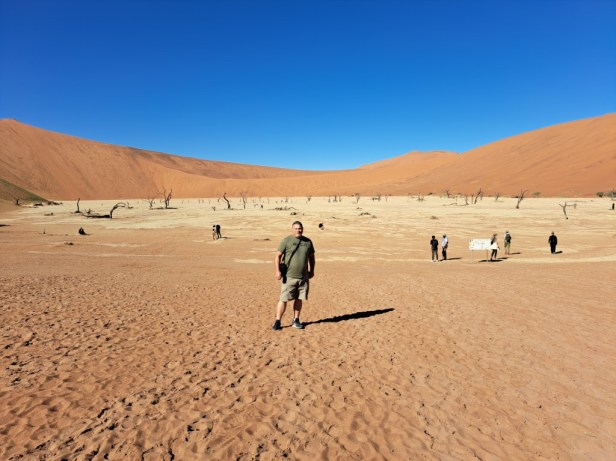
Deadvlei surrounded by high dunes
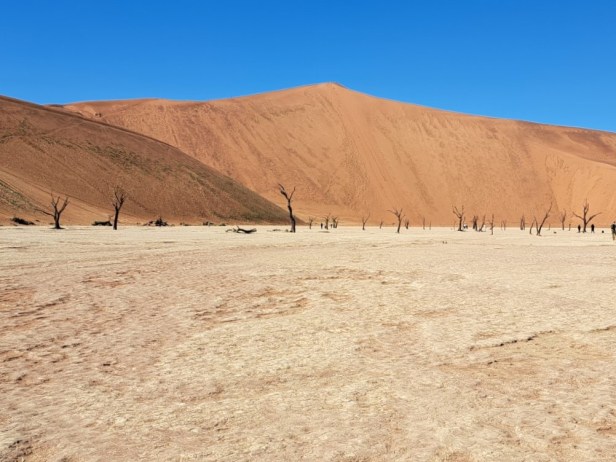
View of the camel thorn trees
The trees died as there was no longer enough water to survive – it became too dry in Deadvlei for the trees to even decompose. It is believed that some of these trees are over 1,000 years old and it forms a barren forest, now black and scorched by the intense heat.
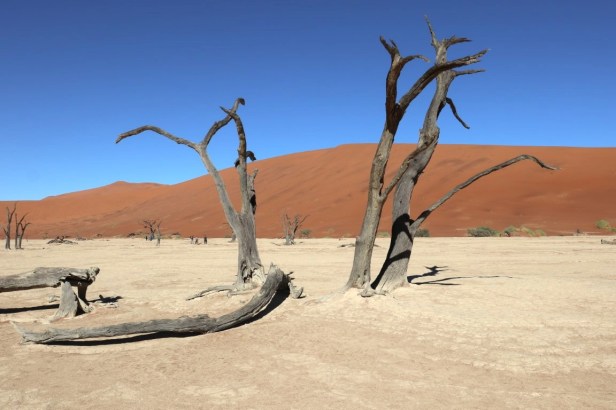
Dead trees at Deadvlei

Dead trees at Deadvlei
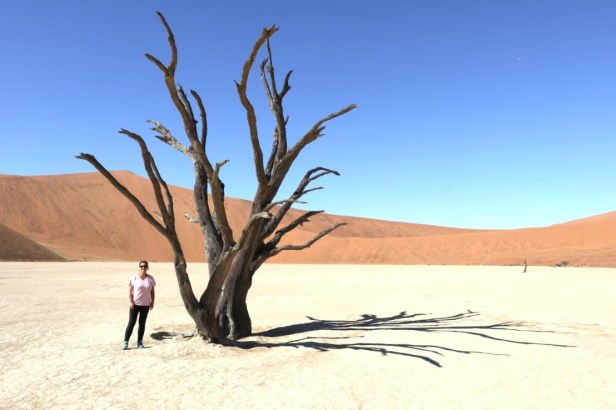
I’m standing next to one of the dead trees
We walked through the forest of dead trees to the highest dune in Sossusvlei. People are allowed to climb to the top of Big Daddy (325m) and then slide or run down the steep side into Deadvlei.
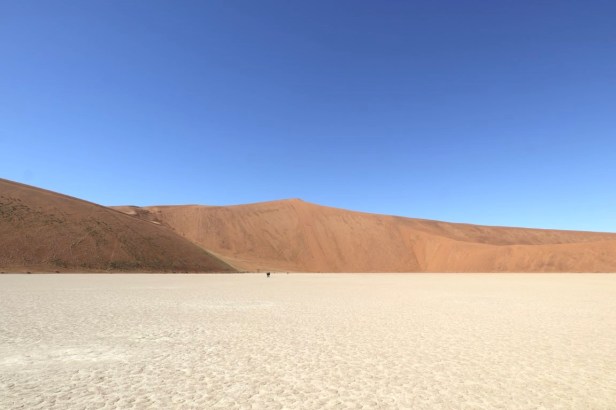
Big Daddy in the middle
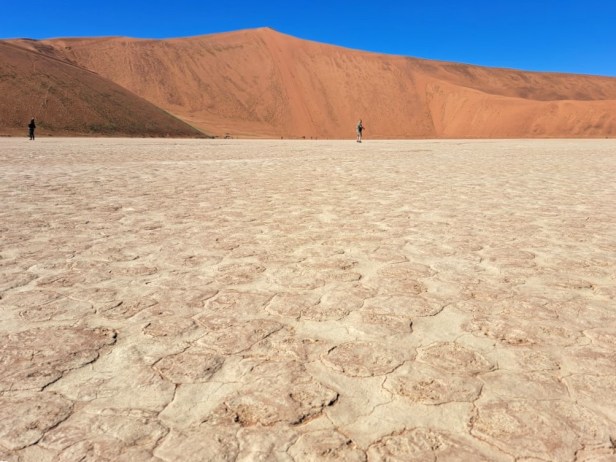
The salt pan of Deadvlei

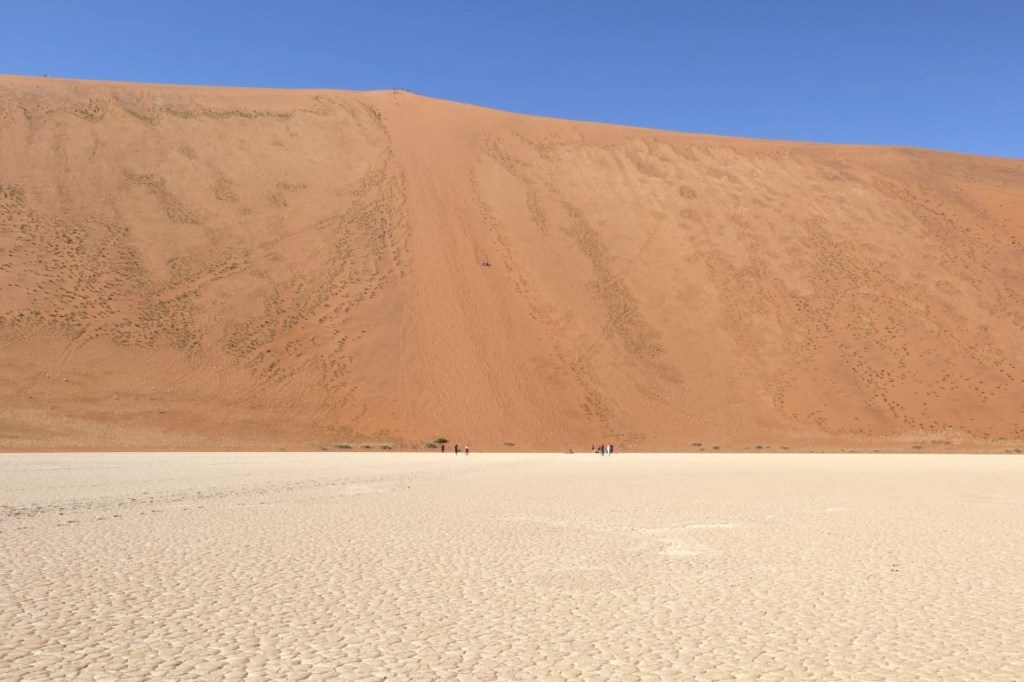
Getting closer and closer to Big Daddy
We chose not to climb the dune, but rather to stand at its foot and admire its grandeur.
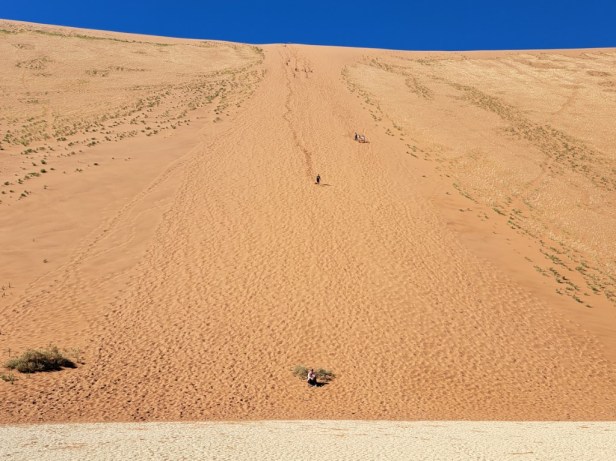
I’m sitting at the foot of Big Daddy

It may not look that steep, but it is for sure
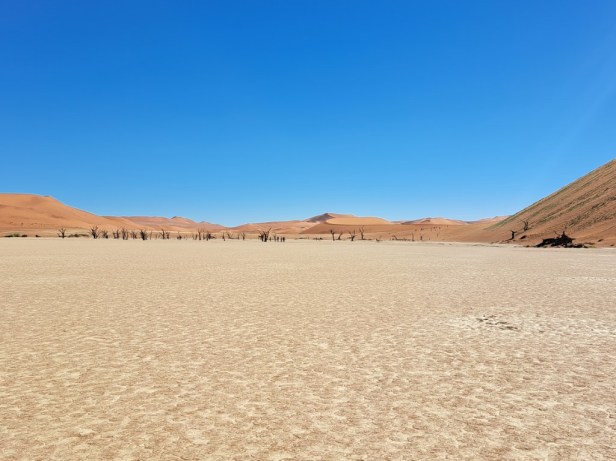
Looking back towards Deadvlei
After about half an hour, we slowly made our way through the dead trees of Deadvlei back to Sossusvlei. We have always wanted to see these and can now check it off our list. When you’re in Namibia, you must come to Sossusvlei – even though the likelihood is great that you will encounter many tourists here.

Dead trees and high sand dunes

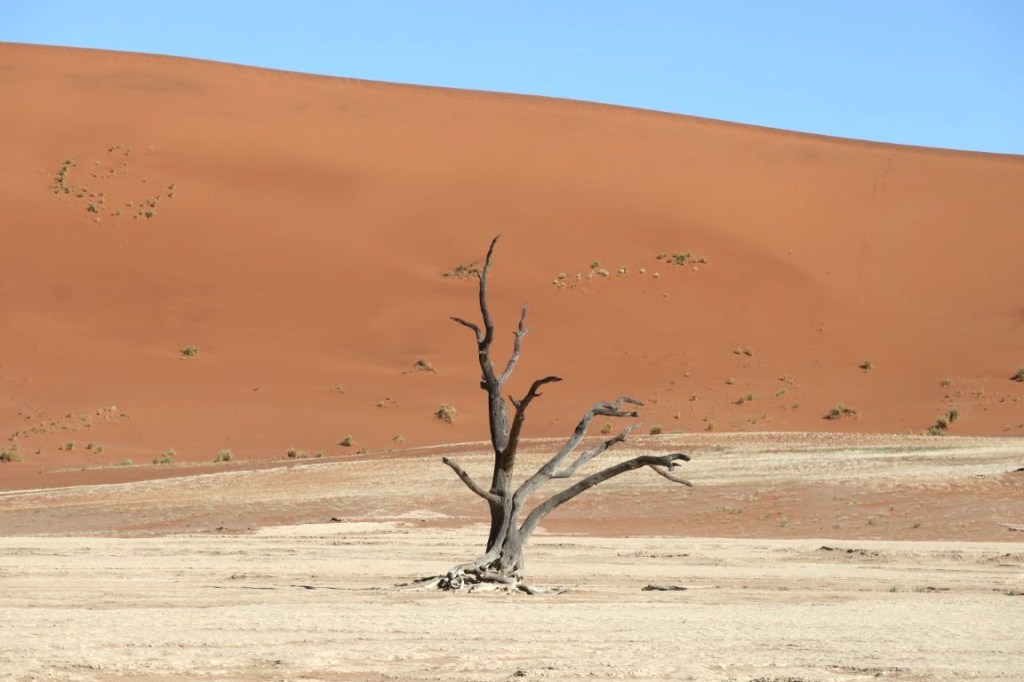
Dead trees

Goodbye to the dead trees of Deadvlei

Leaving Deadvlei behind
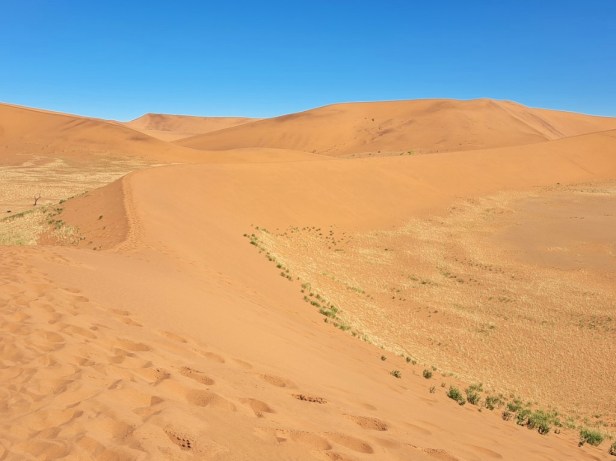
Walking back through the thick sand to Sossusvlei
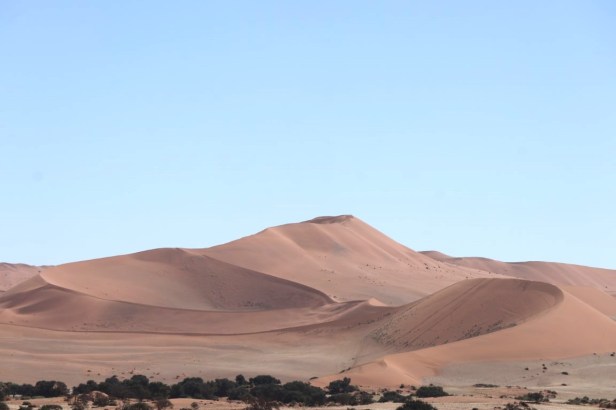
Sossusvlei
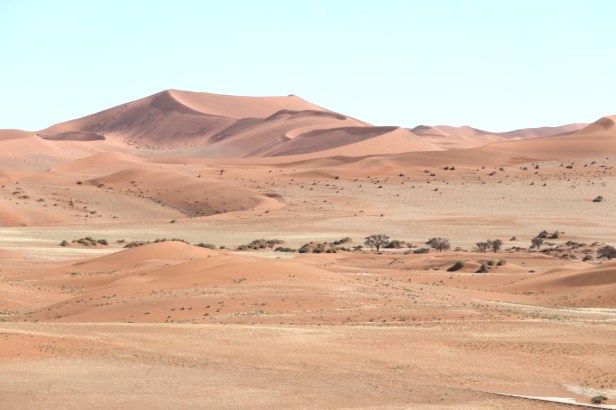
Goodbye to the sand dunes of Sossusvlei
On the way back to Sesriem, we decided to stop at Dune 45. This is the most popular dune to climb (90m high) and about 45km/28 miles from the Sesriem gate. When we got out of our ‘bakkie’, we felt for the first time that the wind had started to blow. As we looked at the dune through narrow eyes (almost closed due to the fine desert sand), we could understand why it is said that when the wind blows from multiple directions, it’s sculpting a star shaped dune with multiple “arms”.
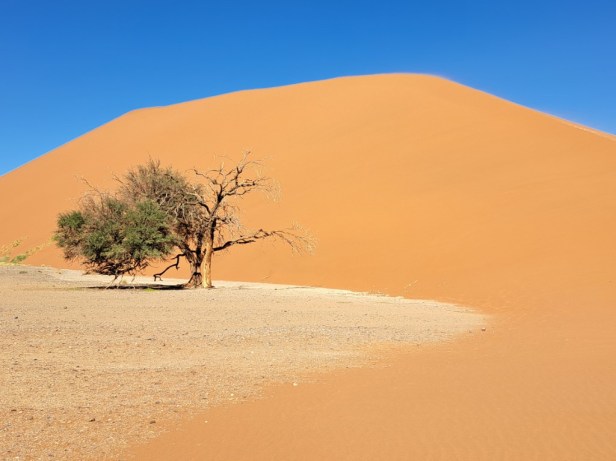
Dune 45

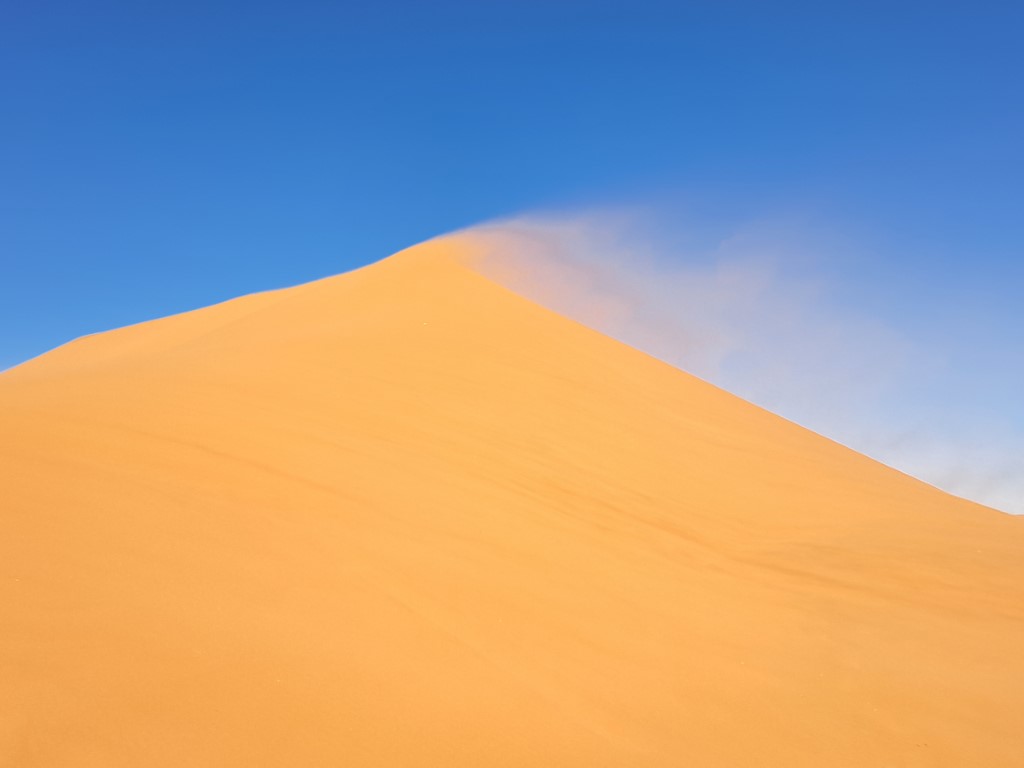
The wind blows over Dune 45
Back at Sesriem, we checked in at the Sesriem Camp’s reception to get our designated campsite. However, the wind was blowing so strongly that we decided to have lunch in their restaurant first and afterwards see if it was possible to set up our rooftop tent.

Look at those flags in the wind

Lunch at Sesriem Camp
After lunch, we returned to our campsite, where we sat in the ‘bakkie’ for almost an hour. The wind was blowing fiercely (even though it may not look like that in the photos).

Our campsite at Sesriem Camp
We decided to drink a few more beers at the bar – let’s just call it getting enough courage to set up our rooftop tent. After 5:00pm, we realised that the wind was not going to calm down and that we needed to set up the rooftop tent before dark.

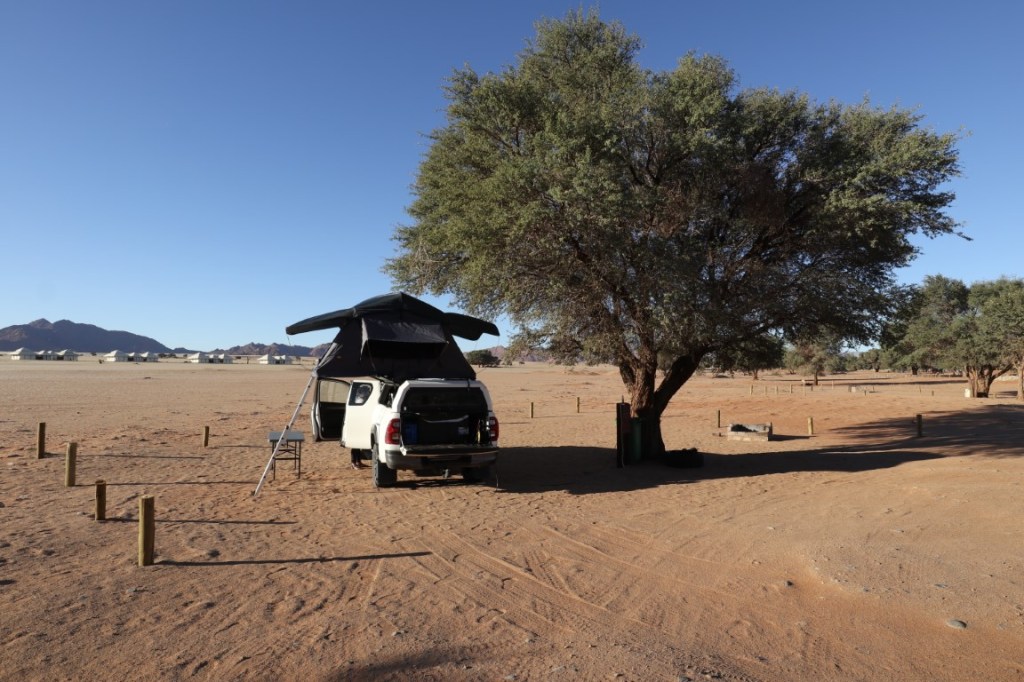
Our rooftop tent is up
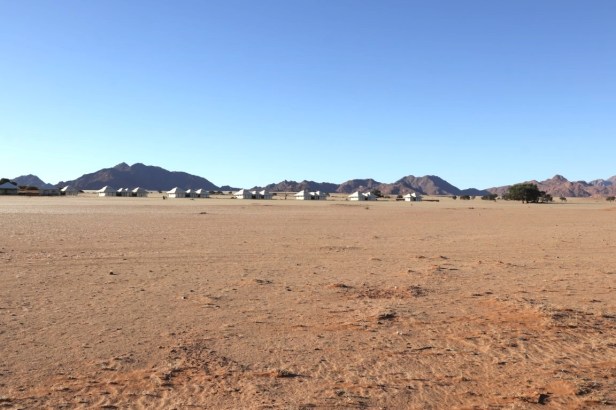
Those houses looked more inviting than our rooftop tent
The plan was that we would have a ‘braai’, but there was definitely no way we could make a fire in this wind. So, instead we went to have dinner at the restaurant. All the campers were there and everyone looked somewhat bewildered about the night ahead.
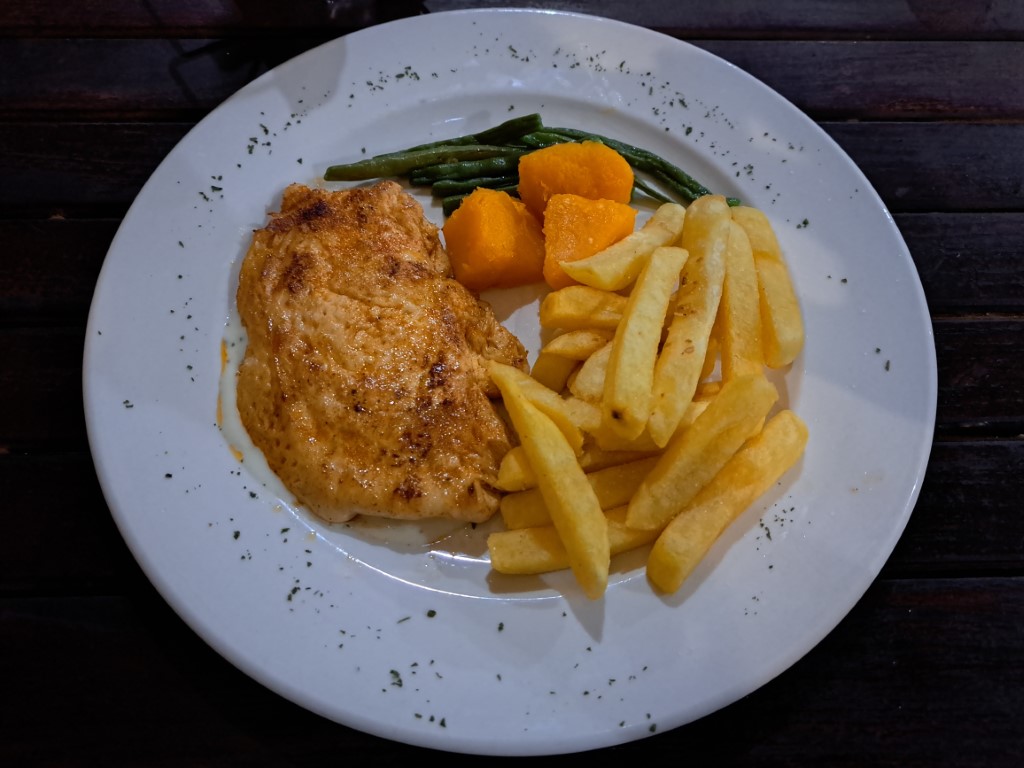

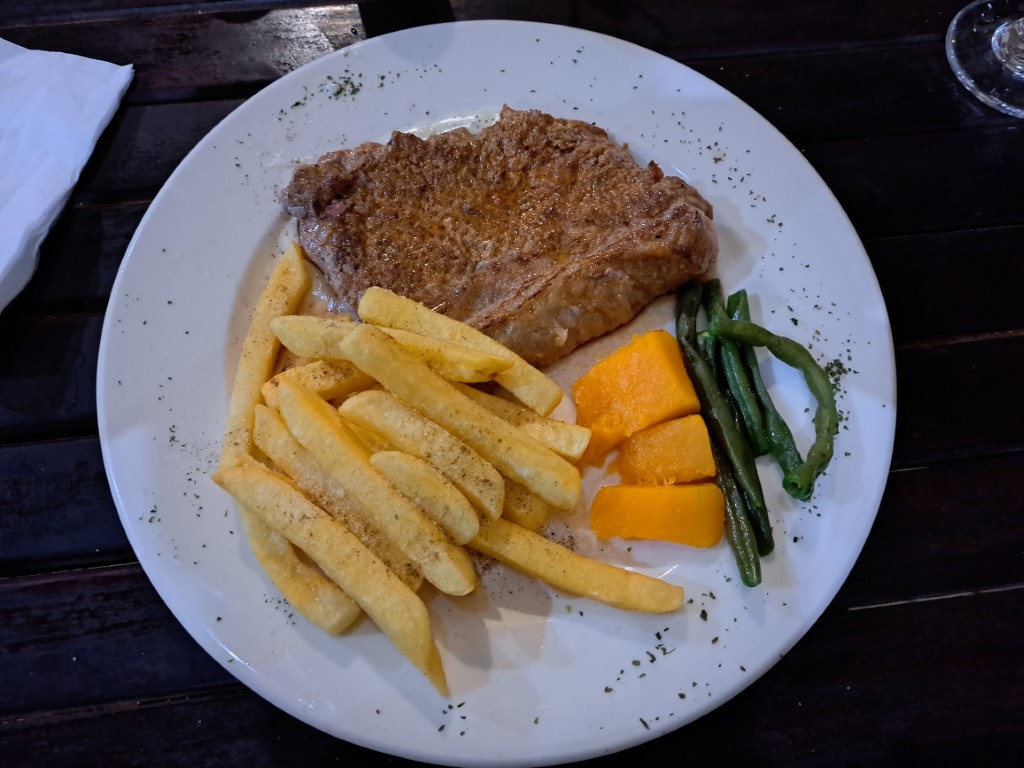
Dinner at the restaurant
Camp story:
From here on there are no photos. But the rest of the evening and night went more or less like this:
We returned from the restaurant around 9:00pm and climbed into our rooftop tent. Besides the fact that the tent’s sails made a deafening noise in the wind, it also swayed back and forth. One could almost have become seasick inside!
Around 10:00pm we decided it would be better to sleep inside the ‘bakkie’. But first we had to take down the rooftop tent so that it wouldn’t be destroyed by the wind or even blown away. This action definitely did not happen without (a lot of) swearing – it was an almost impossible task to take down the tent in the dark, as well as a gale force wind (which had, by now, turned into a full sandstorm).
It was already well past midnight when we finally managed to get into the ‘bakkie’. There was no space in the back, so we lowered our seats and tried to lie down – me in the passenger seat and Berto in the driver’s seat.
I think it’s unnecessary to say that we hardly slept at all. For the next 5 hours, this was the conversation between the two of us:
Berto: “Are you asleep?”
Me: “No”
15 minutes later
Berto: “What is the time?”
Me: “One o’clock”
15 minutes later
Berto: “What is the time?”
Me: “1:15”
And so it continued until sunrise …
With fine desert sand everywhere – in my hair, eyes, and nose – I wondered for the first time if camping is as much fun as they claim it to be.
Oh, and what about injuries? We actually came away with it very lightly (compared to other campers). Berto had a bloody finger, and I had a broken fingernail and a bruised toenail. We noticed that one of the other campers had a black eye and a bump on his forehead the next morning, while almost everyone had plasters on their fingers/arms/legs. Camping is not for the faint hearted!
Stay tuned for our next post if you want to know if we dared to camp again the next day. To read more, click here.
 Wet and Dusty Roads
Oh my. Sandstorms and camping don’t seem a very good combination. But what a good job the wind didn’t get up until after you had sen those wonderful dunes and the trees. Those blackened trees and the harsh shadows they throw make for an elegant image. I could see modelling shoots done there, against that amazing back drop. Your bakkie is doing very well by you!
LikeLiked by 1 person
We were quite happy that we could experience Sossusvlei without a strong wind – it would have been very unpleasant. Sesriem is known for sandstorms, so we weren’t really surprised to experience that – however, I don’t think we were ready to camp in a rooftop tent with a gale force wind! You’re completely right Carolyn; I have seen shoots that were done between the dunes of Sossusvlei and at Deadvlei – it’s the perfect backdrop! We are very impressed with our bakkie – the best vehicle we’ve bought yet! It meets all our outdoor activities😉.
LikeLike
So many beautiful photos here. I shall pick just one out that I think is exceptional, the one with you (Corna) next to the dead tree. When I visited this place it was soooo hot! Some of the group did climb the dunes, I stayed down by the Deadvlei. A place once seen never forgotten. I have only got a couple of photos though – film in those days…
I suspect you’ll never forget your camping fiasco either! But you two are made of sterner stuff and I am certain a little wind won’t have put you off camping!
LikeLiked by 1 person
Thanks Jude. I think, especially because you have also been to Sossusvlei, you know how incredibly beautiful it is to see this special place with your own eyes. I think it’s probably always warm there (even in winter). We have camped in strong winds before, but I don’t think we were completely prepared for a gale force wind inside a rooftop tent – it was quite a frightening experience! But you’re right, we don’t let ourselves that easily discouraged from camping 😊.
LikeLike
Oh yay, I’ve been excited for this post since you first mentioned Namibia. Sossusvlei is on my bucket list. I’m so glad it lived up to the hype for you guys, despite the number of tourists.
I don’t blame you for not climbing that dune. I’ve climbed the tallest sand dune in North America, and it remains one of the hardest hikes of my entire life. Much better to look up at it from below.
I also never knew the story behind the dead trees, so thanks for sharing that. It’s hard to imagine an environment so hot and dry that decomposition can’t occur for 1000 years. Wow!
Lastly, yikes on the camping. Sand + wind + tent is never a fun combo, and I can only imagine being in a tent on top of a vehicle makes the wind even worse. Hopefully you had better luck the next night.
LikeLiked by 1 person
Sossusvlei and Deadvlei were everything and more than we expected (we weren’t even disturbed by the many tourists – this was the one time I turned a blind eye 😉). As I got to know you through your posts, you’ll climb Sossusvlei’s dunes with a smile. I regret now that we didn’t at least climb Dune 45, but I didn’t think it would be a lot of fun to have desert sand in my eyes (if only I knew what was waiting for me later that evening)! Yes, it is wonderful to see that most of the dead trees still stand tall – that is what I call persistence. We are still quite new to camping in rooftop tents and the strong wind really tested us! But the next night we set it up again – on a calm, windless night!
LikeLiked by 1 person
Absolutely stunning photos! What a unique place to camp and explore. Your tent story sounds like an adventure in itself 🙂
LikeLiked by 1 person
We have always wanted to see Sossusvlei and Deadvlei and were not disappointed at all. You’re right, camping with a rooftop tent in gale force winds was not preferable, but what an adventure 😉.
LikeLiked by 1 person
Great scenery and I am glad you made it through the nicht!
LikeLiked by 1 person
The dunes at Sossusvlei are breathtaking to see, as are the dead trees at Deadvlei – definitely worth visiting this place when you ever come to Namibia! Ha, yes we were also very happy to see the end of this windy night 😁.
LikeLike
Well, the dunes and dead trees were spectacular, Corna. Shame there had to be a downside xx
LikeLiked by 1 person
Sossusvlei and Deadvlei are such unique places – I’m glad we decided to go there (even though we knew that they are known for their gale force winds). Next time we might choose more stable accommodation – the rooftop tent was maybe not the best option here!
LikeLiked by 1 person
You are two brave people! So many beautiful sand dunes. I would have had to walk up one too. You have to have bad moments to appreciate the good ones and other than that nasty wind it looks like a beautiful trip!
LikeLiked by 1 person
It was wonderful to see Sossusvlei and Deadvlei. If we had more time (and less wind), we would definitely have tackled one of those huge dunes … but it wasn’t meant to be. I think, looking back now, the beautiful moments were definitely more than the ordeal of the windy night. Retrospect is a wonderful thing, isn’t it 😁.
LikeLiked by 1 person
Your pictures of the iconic dead trees in Sossusvlei are gorgeous and reaffirm why Namibia is high on our list. We had to set up or take down strong winds in the mountains, but had vlowing snow to deal with not sand, which I think is worse. Maggie
LikeLiked by 1 person
The high dunes of Sossusvlei and the dead trees in Deadvlei are dramatic sights and I can understand why there were so many tourists (with a little planning and time, one can however miss the crowds). I’m not so sure if I want to pitch a tent (or take it down) in snowy weather – unfamiliar terrain for us!
LikeLiked by 1 person
😅
LikeLiked by 1 person
You’re right, Deadvlei in particular is a must-see! My husband climbed Dune 45 (it wasn’t windy that day) but I chose to stay at the bottom and take photos. But best of all was ballooning over the dunes just after sunrise – an amazing experience!
Your night camping sounds pretty daunting and ‘proves’ my point that hotels/lodges/cabins etc. are all better options 😉
LikeLiked by 1 person
I can believe that seeing these stunning dunes from a hot air balloon must be a wonderful experience. If we had more time, we would have loved to do that. Sarah, I can tell you this: My thoughts that windy and dusty night in Sesriem were that you are probably right with your choice of accommodation 😁! But then again – on a perfect (and windless) summer evening, I love camping!
LikeLiked by 1 person
As a non camper you’ve just reinforced my resolve not to do it! 😂. Sandstorms in that kind if wind are no fun huh. Nevertheless, Sossusvlei was our main target in Namibia, still a bit gutted that we didn’t get there, especially after reading your description…
LikeLiked by 1 person
Fortunately, I can count the bad camping experiences on one hand – so, hopefully we will still do this for a few more years (it’s definitely the cheapest way to see new places)! I can officially confirm: Sossusvlei is more beautiful than what you see on photos or in videos … so, don’t completely forget about a visit to Namibia!
LikeLiked by 1 person
We won’t….especially after posts like this!
LikeLiked by 1 person
This place is pretty much any traveller’s and photographer’s dream, dear Corna.
I have always dreamed about visiting Deadvlei as it is such a unique and visually stunning location within the Namib Desert, famous for its stark white clay pan, blackened, petrified trees, and towering red sand dunes. I love how the contrast of these elements creates a surreal and unforgettable landscape.
I am sorry to hear you had a sleepless night. Rooftop tents are elevated and exposed to the wind, creating a larger surface area for gusts to act upon, and this can cause noise and flapping.
I agree with you – camping is not for the faint of heart, especially as in certain situations or environments, it can be challenging and require resilience and a willingness to deal with potential discomforts. Thanks for sharing, and have a good day 🙂 Aiva xx
LikeLiked by 1 person
Thank you so much for your comments, Aiva. Sossusvlei and Deadvlei are definitely a destination that tourists cannot miss when they visit Namibia. The high red sand dunes and black dead trees create such unique photo opportunities. And yes, we were definitely not prepared for the onslaught of a strong wind when sleeping inside a rooftop tent … but like my husband said: “We lived to tell the story” 😉. So, all ends well!
LikeLiked by 1 person
🥰🥰🥰
LikeLiked by 1 person
Vriende het Sossusvlei onlangs besoek en danksy jou pragtige foto’s, het ek presies geweet waarvan hulle praat toe hulle van die grasvelde en rooi duine vertel het 🥰
LikeLiked by 1 person
Ek hoop hulle het dit net soveel soos ons geniet. Volgens die plaaslike inwoners is dit nie ‘n algemene gesig nie en selfs hulle was verras om hulle mooi rooi duine so bedek met gras te sien!
LikeLiked by 1 person
Your pictures of the sand dunes and dead trees are absolutely stunning! This really makes me want to visit Namibia. Good call on hanging out at the bar for a bit and going out for dinner to avoid being out in the wind. Sounds like a rough night! Oh gosh, I burst out laughing when you started to list the injuries from surviving the windstorm. I can’t believe someone got a black eye!
LikeLiked by 1 person
The contrast between the black dead trees and high red sand dunes provides great photo opportunities, but being there and experiencing it, was the best. We would probably have stayed in the bar all night if it had just been open 😁 … but eventually, we had to brave the wind in our rooftop tent! We wondered for a few days about that one camper with the black eye – perhaps it was not because of the stormy night at all, but a bar fight – who knows!!
LikeLiked by 1 person
Oh my goodness!! Well – firstly Deadvlei is absolutely amazing, the contrast of the dunes and the dead trees is incredibly striking and beautiful. But your night of camping – oh my goodness, I wouldn’t have managed it. You did amazingly to get the tent down again!!
LikeLiked by 1 person
You know Hannah, I think that’s perhaps what makes Sossusvlei so unique – that contrast between the black dead trees and the high red sand dunes – it’s absolutely stunning. Ha, I think one gains supernatural powers when you have to take down a tent in such stormy weather … think of me next time when you’re sleeping in one of those lovely hotel beds and there is storm outside 😁.
LikeLike
I love the photos and the story, thank you for sharing first hand expericene, I was planing to visit either Kenya or Namibia in January 2026. but I think since I will probably go by myself to go with one agency, they have good programs. Best regards.
LikeLiked by 2 people
It’s good to hear you enjoyed the post. Namibia is an incredibly beautiful country (and I’m sure Kenya is too, although I’ve never been there myself). I agree, when you travel solo, it’s always good to make use of a travel agency – that way you ensure you don’t miss out on all the sights. Enjoy your trip in 2026, whether it’s Namibia or Kenya!
LikeLiked by 1 person
Beautiful photos. It is a shame about the storm and camping night.
LikeLiked by 1 person
I’m sorry I missed this comment from you. Yes, the dunes at Sossusvlei are amazing and the sandstorm was wild … we were still trying to get sand out of our tent for weeks after the visit 😁!
LikeLiked by 1 person