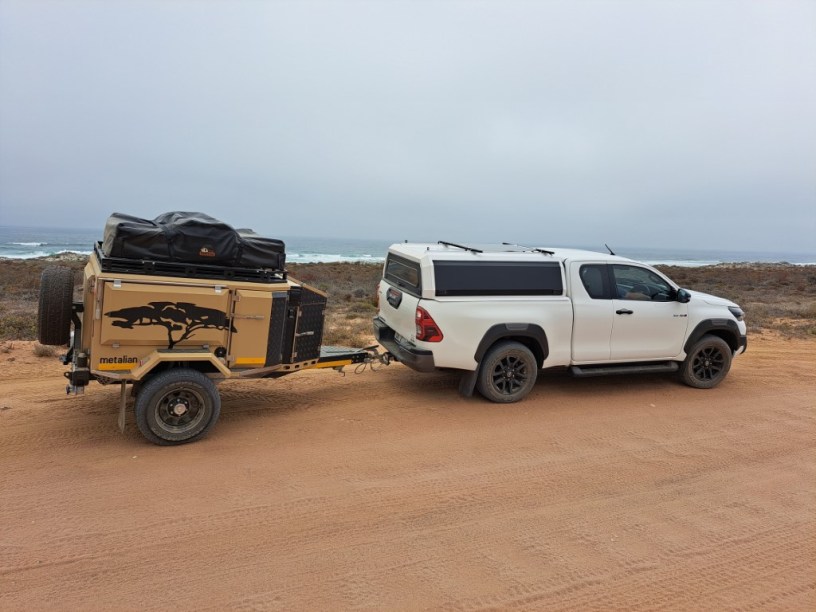
December 2025/January 2026
On our way – but got stuck in deep (‘swaar’) sand
After months of preparing for our wild camping adventure along the West Coast of South Africa, the time finally arrived just after Christmas to pack our camping trailer and head for the sea.
It’s impossible to write about our 12-day adventure in just one post, so this is the first post of … well, a few. There will be stories and photos of:
- Our wild camping set up,
- Breathtaking natural scenery (those sunsets were magical),
- Camp meals (yes, of course),
- ‘Rissibiekie’ Padstal (a very interesting farm stall in the middle of nowhere with friendly people and the cutest little animal I’ve ever seen),
- A glorious day of catching crayfish in the wild Atlantic Ocean,
- Picturesque hikes on the beach
- And much more
Background:
A few years ago, we’ve enjoyed wild camping near Groenriviermond (read here and here). This is a stretch of coastline where you can camp for free, however on our recent wild camping trip we decided to camp on the farm Waterval near Groenriviermond at a minimal fee. This meant that we were guaranteed a campsite. (For our English-speaking friends: ‘Waterval’ means ‘Waterfall’).
There are no facilities – as the term ‘wild camping’ suggests – and campers need to bring their own water, ablution facilities (shower & toilet), and firewood. However, we later found out that water (brackish water) is available on the farm, as well as firewood at Rissibiekie Padstal. Fresh drinking water is also available to buy at Rissibiekie Padstal, as well as at the small shop on Kotzesrus (cash only), which is a tiny village about 20km/12.4 miles from our campsite. (We will write more about this in a later post.)
But hey, enough of the small talk – we want to show you our campsite with a million-dollar view! But first, there’s a story – so, let’s get in the ‘bakkie’ and drive to Waterval!
Let’s go wild camping:
We left Langebaan bright and early because it’s about a 4–5-hour drive to Waterval and it takes time to properly set up a wild campsite. We also had to spent time at the last town (Lutzville) where we had to do a final trip to the shop and we also needed to fill our camping trailer’s 136-liter water tanks.
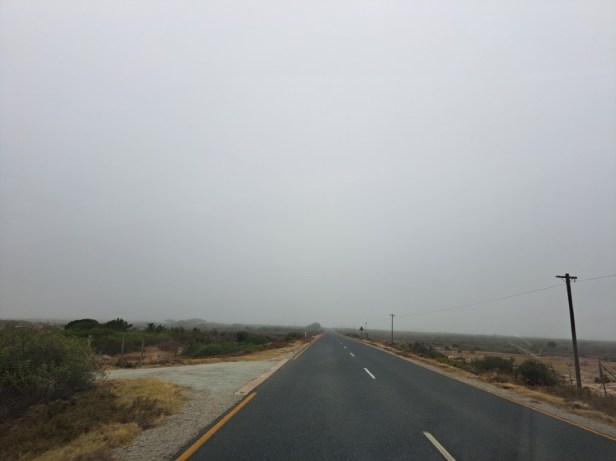
Leaving Langebaan in misty conditions
Fortunately, the sun quickly dispelled the early morning mist and we drove the rest of the journey in sunny weather.
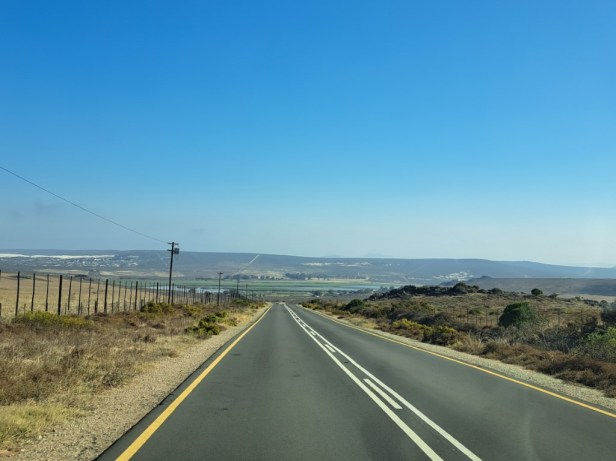
Sunny weather – that’s more like it
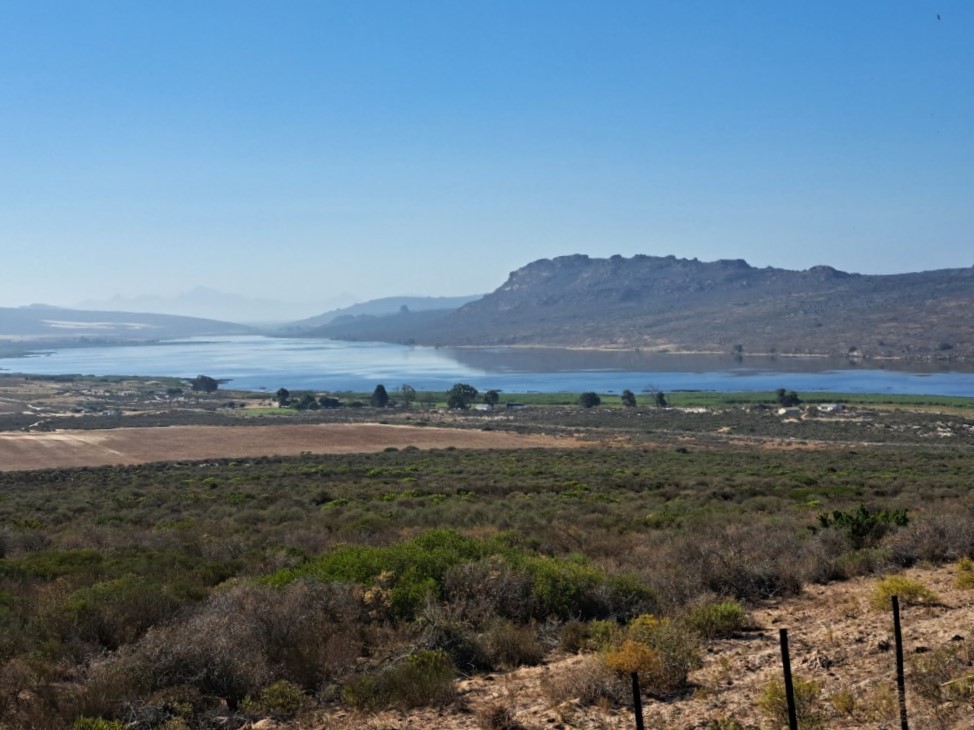
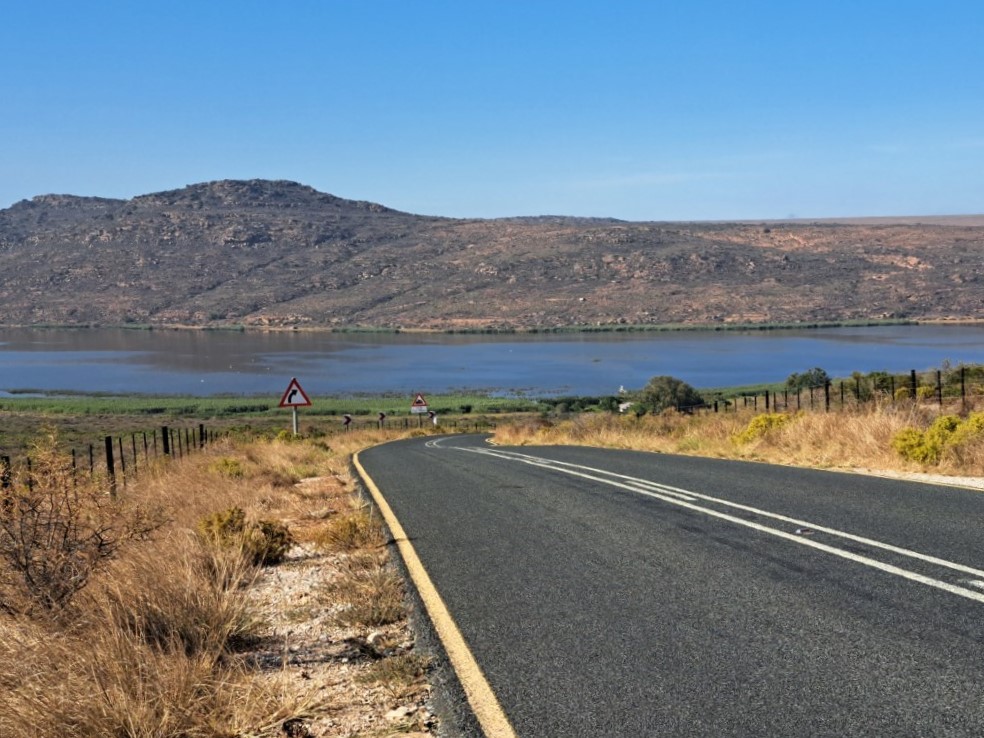
Verlorenvlei – one of the largest natural wetlands along the West Coast
A (not so) quick visit:
Although we were quite eager to get to our campsite, we couldn’t pass up the opportunity to stop in Lamberts Bay to visit fellow Alexander Bay residents (where we grew up). When Berto was still an electrical apprentice in his early 20s, he worked under ‘Oom’ Kallie Smit. (We were taught by our parents to address anyone who is 10 years older than us as ‘uncle’ and ‘aunt’. In Afrikaans uncle means ‘oom’ and aunt means ‘tannie’). Although we left Alexander Blay almost 30 years ago, the residents of this small diamond mine town still remain close to our hearts.
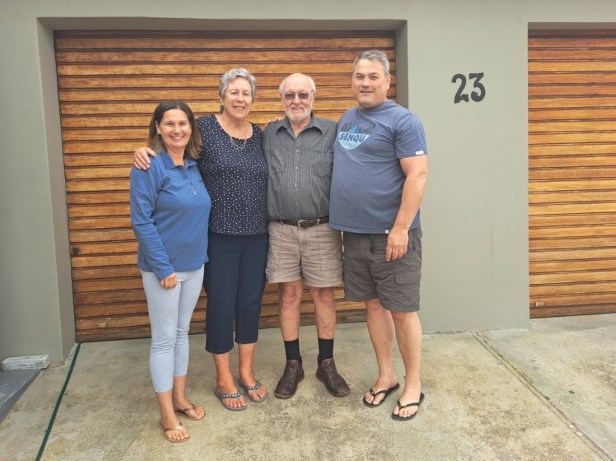
A ‘quick’ visit at the house of ‘Oom’ Kallie and ‘Tannie’ Alida in Lamberts Bay
We just wanted to quickly pop in, but there were so many stories to share and over coffee/tea and some tasty treats, we ended up spending more than an hour at their house (which was a blessing in disguise – yes, read on).
‘Tannie’ Alida made sure we didn’t leave empty-handed and packed some of her homemade Christmas fruitcake for us to take along on our wild camping trip.
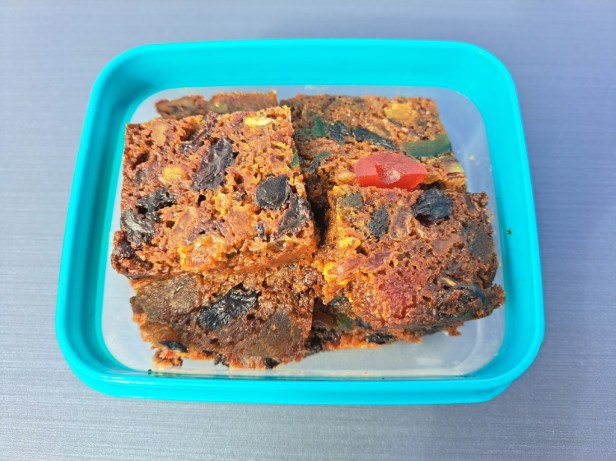
Delicious homemade Christmas fruit cake
As mentioned earlier in the post, we stopped in Lutzville to buy fresh bread and also stock up on enough water. The two tanks (68 liters each) of the camping trailer were filled to capacity, as well as two extra 25-liter water containers in the back of the ‘bakkie’. We also had drinking water in two 10-liter containers.
When we left Lutzville, Berto mentioned that the ‘bakkie’ and camping trailer were now very heavily loaded, and we drove extra slowly and carefully on the gravel road to get safely to our campsite, which was about 115km/71 miles further.
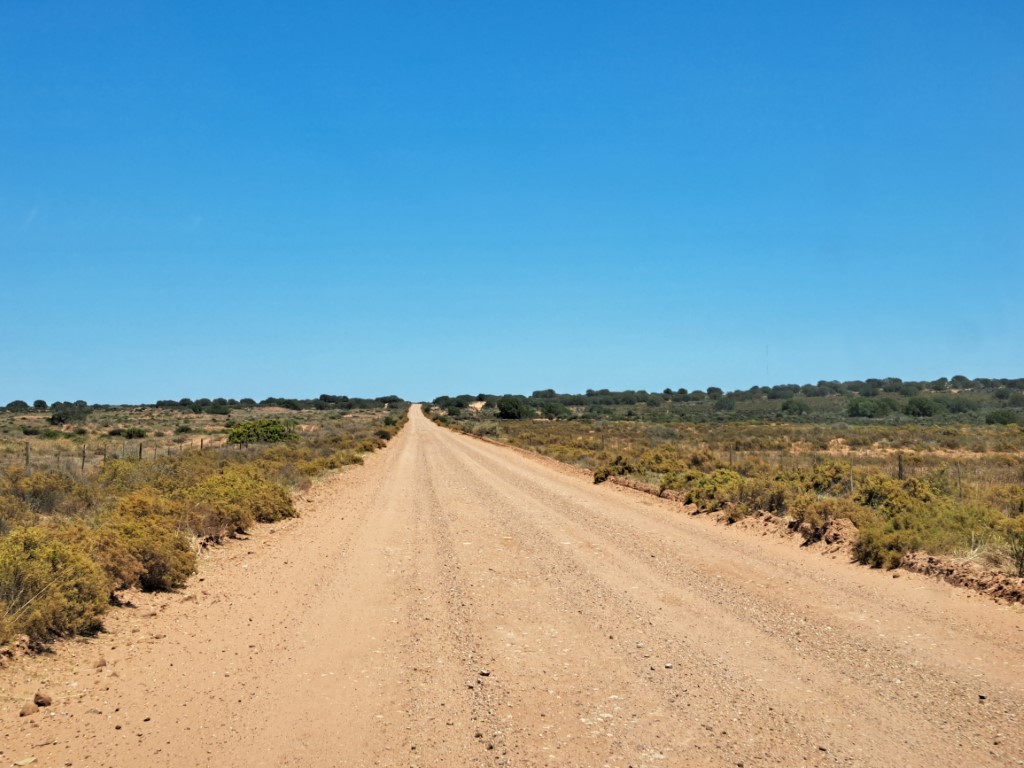
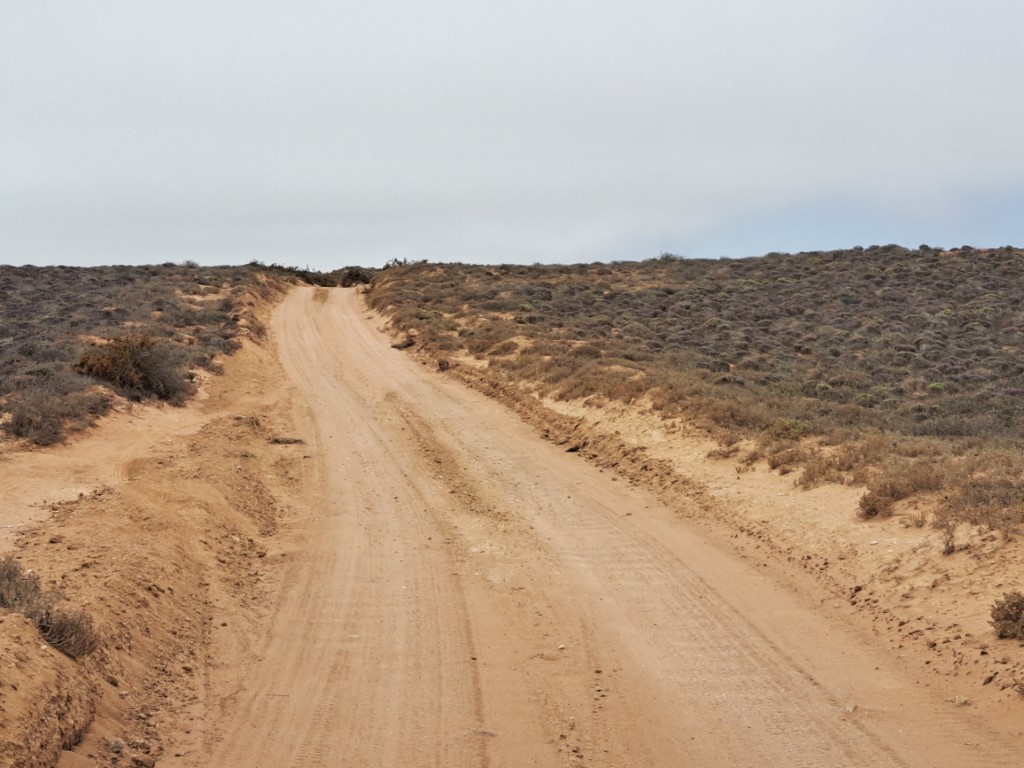
Gravel road on our way to Waterval
Waterval has quite a few campsites. Ruitersvlei (campsites 1-24) is the southernmost campsite and Skulpbank (campsites 49-60) the northernmost. We booked a campsite at Skulpbank and on the way there we passed by several occupied campsites. It turned out that quite a lot of campers came to wrap up the year on the West Coast.
At one point we stopped, got out of our ‘bakkie’ and just breathed in the fresh sea air – it wasn’t that far anymore, maybe just another 20 minutes to our campsite.
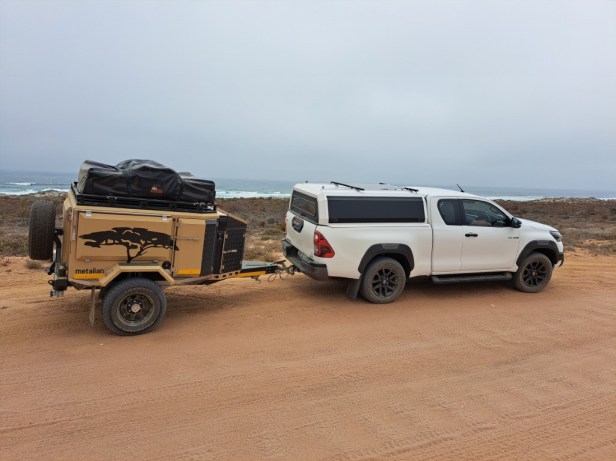
Our heavily loaded ‘bakkie’ and camping trailer
Crisis:
And then … just as we were going over a hill, we saw 3 vehicles parked next to the road. Berto slowed down and the next moment we were in deep sand and the ‘bakkie’ and camping trailer got stuck.
There is a sign next to the road warning of ‘swaar sand’ (which means deep/thick sand). We saw that too late and because the ‘bakkie’ and camping trailer were so heavily loaded we couldn’t really drive too fast.
No photos:
Unfortunately, there are no photos of this awkward situation we found ourselves in, so you’ll just have to use your imagination as I continue to tell the story.
The kindness of people:
As I mentioned earlier, there were quite a few vehicles parked next to the road. A group of young people were on the way back to their campsites after driving around for the day. Just before we arrived, they had helped another vehicle that got stuck in the deep sand. We could see they were tired, but without us asking, they immediately offered to help us.
Plan A, B, C & D:
Plan A: One of the young men brought his ‘bakkie’ closer and tried a few times to pull our ‘bakkie’ and camping trailer out of the deep sand. When that didn’t work, they detached the camping trailer from our ‘bakkie’ and then he was able to get our ‘bakkie’ out of the deep sand.
Plan B: With our ‘bakkie’ safely on solid ground, the young man reversed again and hitched our camping trailer to his ‘bakkie’. He hoped that his ‘bakkie’, without any luggage, would be able to tow the heavy trailer out of the deep sand, but the worst happened when he himself got stuck.
Plan C: Another man, who was with this group, then reversed his ‘bakkie’ to the back of our camping trailer and with a snatch strap, he got both the ‘bakkie’ and the camping trailer out of the deep sand.
Plan D: It was slightly good news that both our vehicles were now out of the deep sand, but there was a problem. Our ‘bakkie’ was now standing on one side of the deep sand and our camping trailer on the other side! The young man, the one who originally helped us, then reversed through the deep sand back to our camping trailer and hitched it to his ‘bakkie’ again. With a lot of power and speed he masterfully drove our camping trailer through the deep sand to our ‘bakkie’ waiting on the other side.
All the wives (me included) who stood next to the road, jumped in the air and clapped our hands. What do you give to other people who help so selflessly? They wanted nothing in return, and in the end, we just sincerely thanked them.
Thank you:
We didn’t even ask for their names, but if anyone reading this, knows the group of young people who helped us on 26 December 2025, please tell them we are immensely grateful for their assistance. It’s thanks to them that we were finally able to make it safely (and before dark) to our campsite.
Back to our visit to ‘Oom’ Kallie and ‘Tannie’ Alida:
If we hadn’t stopped earlier in Lamberts Bay, we wouldn’t have had this amazing group of people along the road to help us when we got stuck in the deep sand. In hindsight, we were very happy that our short visit finally turned into a long visit – it was truly a blessing in disguise!
Gratitude:
I would have loved to show you our campsite now, but this post is already far too long. Let me just end with the sunset on our first evening. Looking at this incredibly beautiful sunset, we were grateful to a group of people we don’t even know, who helped us without batting an eye.
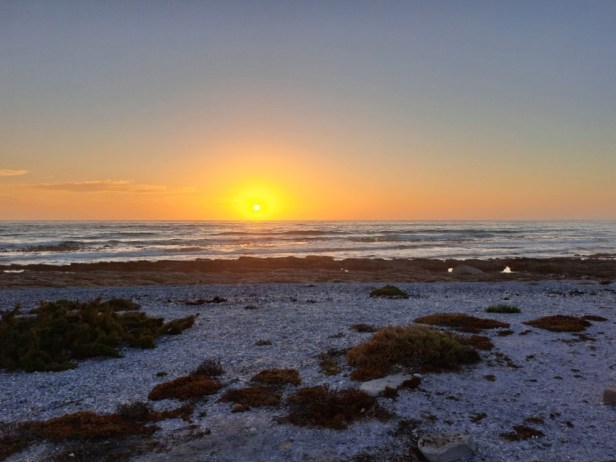
Our first sunset at Skulpbank, Waterval on the West Coast
Next week we’ll show you our wild camping setup (click here) – stay tuned, because there are a few surprises.
 Wet and Dusty Roads
O I enjoy your adventures. A holiday for my soul. Looking forward to see the wild campsite with the million dollar view. 💐🦋🌻
LikeLiked by 1 person
I’m glad you’re joining us for the start of our new wild camping series. And I’m sure you’re going to enjoy our million-dollar view as well 😁.
LikeLike
There is a lovely camaraderie amongst campers and they were definitely in the right place at the right time. I look forward to the next part of your adventure. Mel
LikeLiked by 1 person
It’s true what you say, Mel – there is definitely a sense of camaraderie among campers. All I can say is that the parents of those young men raised them well! I hope you enjoy the next few posts about our wild camping – there will be a bit of ‘hiking’ too (though, thinking about it, it’s actually more of a stroll on the beach 😁).
LikeLiked by 1 person
Never feat, I love a good beach stroll as much as the next person… 🙂
LikeLiked by 1 person
The kindness of strangers always restores our faith in human nature. What an adventure! I look forward to reading about the rest of your camping trip 🙂
LikeLiked by 1 person
It’s ironic that our wild camping adventures always start with a bang! You’re right, in times like today, one actually forgets that there are still people out there who care about others (even strangers they don’t even know) … it’s good to be reminded of that every now and then! I hope you enjoy the rest of our posts – as always, we’ll share wonderful views and food.
LikeLiked by 1 person
Corna, wat ñ opwindende dag! Definitief ñ storie om nog lank om kampvure oor te vertel. Moet sê, ek en my Bertus wil ook so gou as moontlik ñ “snatch strap” aanskaf.
LikeLiked by 1 person
Die ‘snatch strap’ is beslis ook op ons inkopie lys (en ‘recovery traction boards’). Ja, dit lyk nie of ons op ‘n wild camping trip kan gaan sonder dat daar eers ‘n bietjie opwinding vooraf moet gebeur nie … maar hoe sê hulle: Einde goed, alles goed 😉.
LikeLike
I thought you were going to hand out the Christmas cake in thanks, Corna xx
LikeLiked by 1 person
Haha, I would have rather given them a bottle of wine (or two) 😂. That cake container may look big, but it was definitely not enough to hand out to everybody …
LikeLiked by 1 person
I enjoyed the preview of your 12 day wild camping adventure. Sorry to hear that you got stuck in the sand though. That was very kind of those people to help you guys out, which included multiple attempts! What a stunning sunset on your first evening. Just seeing that I’m sure makes it all worthwhile.
LikeLiked by 1 person
It took the guys an hour to get our ‘bakkie’ and camping trailer out of the thick sand – and while we could see they were tired after their day of exploring, they still laughed and joked around. You’re right Linda, with that beautiful sunset we quickly forgot our little ‘crisis’ of earlier … but we will remember the kindness of that bunch of young people for a very long time!
LikeLiked by 1 person
Lucky for you to have such amazing people. I wondered what wild camping would be when you can reserve a site. In Canada, wild camping is out in the backcountry where there are no campsites, so you can set up your tent wherever you want. The more difficult part, and why most don’t do it, is hanging your food between two trees to keep it safe from bears. But that kind of wild camping is probably even more dangerous in Africa with lions!! Maggie
LikeLiked by 1 person
The West Coast of South Africa is a very popular area for wild camping, and during December months (holiday time in SA), it may happen that there isn’t a wild camping spot available. So, on this farm you only pay a minimal fee to ensure you do have a wild camping spot, as well as the use of a central point on the farm where wild campers can fetch brackish water for free. Fortunately, there are no lions (otherwise I definitely wouldn’t have been a wild camper)! Snakes are probably the most dangerous wildlife on the West Coast. I must admit, I would have been very cautious if there were bears!!
LikeLiked by 1 person
It looks so calm — feels like the perfect place to just switch off.
LikeLiked by 1 person
You’re right Angela, here you will find tranquility (and plenty of it 😉). For a few days, one completely forgets about all the problems in the world.
LikeLiked by 1 person
I am convinced that the Universe looks after us. I’m sure the people who helped you knew how much you appreciated them and knew you would have done the same for them.
LikeLiked by 1 person
Yes, I think you’re right, Carolyn. There is an unwritten rule that (especially) campers will always help each other in times of need. With everything going on in the world, one sometimes just forgets that there are still people who care about others.
LikeLike
A wonderful example of the kindness of strangers, and then a wonderful sunset to finish the tale. I hope your rescuers got to enjoy that sunset too!
LikeLiked by 1 person
An eventful day and just another reminder of the kindness of strangers, right? Yes, our rescuers’ campsite was just a few kilometers from where we got stuck, so I’m pretty sure they reached their campsite well in time to enjoy that lovely sunset.
LikeLiked by 1 person
I am glad to hear that all ended well, dear Corna, and someone was there to help. Being stuck in sand is challenging, especially since spinning tyres only make the car sink deeper. Thanks for sharing, and have a good day 🙂 Aiva xx
LikeLiked by 1 person
The sand is always much softer later in the day (especially when the sun has been shining on it for a long time), so it was definitely not the ideal time to drive along there with a heavily loaded vehicle and camping trailer … but thank goodness for our rescuers who were in the right place at the right time! Thanks Aiva, enjoy your day 🌷.
LikeLiked by 1 person
🥰🥰🥰
LikeLiked by 1 person
It’s always wonderful to experience the kindness of strangers; what a wonderful story. Beautiful sunset photo, Corna, I’m looking forward to reading more about your wild camping trip.
LikeLiked by 1 person
I know there are still many kind-hearted people in the world (even though the media sometimes makes us doubt this) – it was wonderful to experience this firsthand. The sunset was a beautiful ending to our first day … just a taste of what was waiting for us!
LikeLiked by 1 person
You were very lucky that help was at hand. I guess you don’t have much in the way of breakdown services in such a remote area. I remember on my camping trip though southern Africa that our truck got stuck in sand in Namibia and we had to use planks (which they carried of course) to get traction under the wheels and all the blokes had to push hard!
That fruit cake looks yum.
LikeLiked by 1 person
Absolutely – on the gravel roads along the West Coast, there are no breakdown services … that’s probably why fellow campers are so helpful. Recovering traction boards (the modern version of planks) is now at the very top of our shopping list for the next wild camping trip – they were a huge help, especially in getting our ‘bakkie’ out of the thick sand. Hmm, the fruitcake was delicious – I could probably have shared it with our rescuers, but it wouldn’t have been enough for everyone (and I think in any case they were just looking forward to sitting on their chairs around the campfire with a beer in hand after their hectic day)!
LikeLike
Oh my goodness, what a way to restore faith in humanity. And I’m sure you’ve written before about strangers helping you! I’m so pleased you were able to sort everything out and be on your way safely 🙂 And that fruit cake looks delicious.
LikeLiked by 1 person
You have a very good memory, Hannah! Yes, a little over a year ago I also wrote about a young man and his sister who helped us when our ‘bakkie’ ended up in a ditch. There are more kind-hearted people in this world than we think, aren’t there? The fruit cake was delicious – I had almost finished half of it as we finally set off to the campsite after our ordeal 😁.
LikeLike
Oh gosh, sand is such a nightmare when you have to drive in it. I’m glad you guys had some help to get un-stuck so you could enjoy your camping adventure! What a beautiful sunset. With views like that, I can only imagine how amazing your campsite must have been.
LikeLiked by 1 person
We’ve driven through thick sand quite a few times before (and got through safely), but with a heavily loaded ‘bakkie’ and camping trailer, it was a whole different story! Yes, fortunately, those young men still had quite a bit of energy left to help us – I don’t think it was just us, but also them who later that evening sat around the campfire and were able to tell quite a few stories. The campsite is actually nothing more than just an open piece of ground, but the views almost make it better than a 5* hotel 😉.
LikeLiked by 1 person
What an adventure already! 😄 Love how the trip started with challenges, kindness from strangers, and that incredible sunset as the reward. Wild camping on the West Coast looks absolutely magical and can’t wait to see the campsite setup in the next post!
LikeLiked by 1 person
We definitely started our wild camping trip with a ‘bang’😉. You’re right, the West Coast of SA is magical and in the next few posts you’ll see why – untouched and a beauty that’s hard to describe.
LikeLiked by 1 person
Haha, the best trips always do 😉 That sounds incredible, untouched places are the ones that stay with you. Really looking forward to seeing more of that West Coast magic!
LikeLiked by 1 person
What a start of your trip! Isn’t it amazing when wonderful people come your way just when you need them? It is a sign someone up above loves you🥰
xx
LikeLiked by 1 person
You’re right, we were very lucky that there were so many helping hands nearby – especially since it’s such a remote and vast area. Our wild camping adventure really kicked off with a ‘bang’!
LikeLiked by 1 person