May 2025
Let me just admit right now at the beginning of this series – I am like a kid in a candy store and totally overwhelmed! I honestly don’t know where to start to tell you how amazing our trip to Namibia was. Berto advised me to first give an introduction of our trip. And then he added:
“For the first post, use only one photo per place we visited”.
“Haha, impossible!” I groaned. I tried to negotiate. “What about two, or maybe three, photos?”
But he insisted and for days I was working through hundreds of photos. The photos in this post are not necessarily the most beautiful of them all, but I feel they reflect the feelings we experienced at each place the best – feelings like anticipation, excitement, nostalgy, serenity, and sometimes just being absolutely content.
Here then, is a brief summary of our 8-day road trip of 3,053km/1,897 miles through the incredibly beautiful southern part of Namibia.
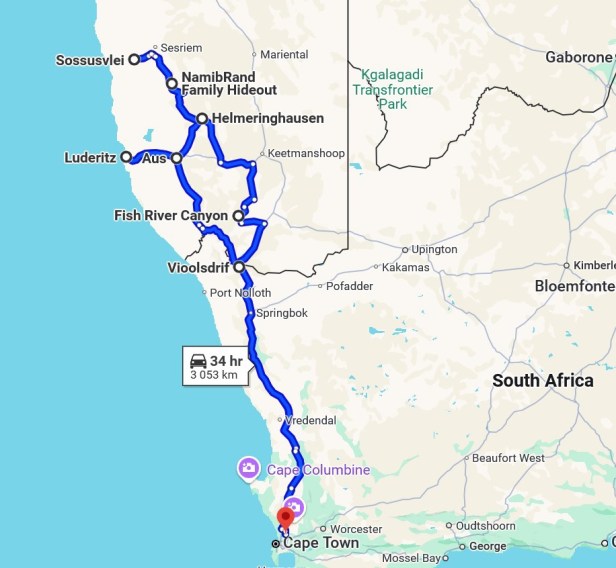
Our route map from Cape Town to Namibia
- Kwelanga Lodge, Vioolsdrif (South Africa):
On the first day, we drove 660km/410 miles from our farmhouse outside Cape Town to Kwelanga Lodge which is just 6km/3.7 miles from Vioolsdrif, the border post between South Africa and Namibia. The lodge is situated on the banks of the Orange River, the longest river in South Africa.
The water level of the Orange River was almost at flood height after recent heavy rain. It was an incredible sight to see, especially at sunrise.
- To read about this day, click here.
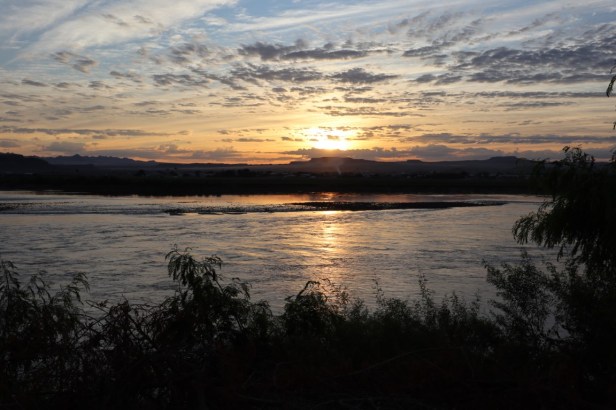
Sunrise over the Orange River from Kwelanga Lodge
- Lüderitz:
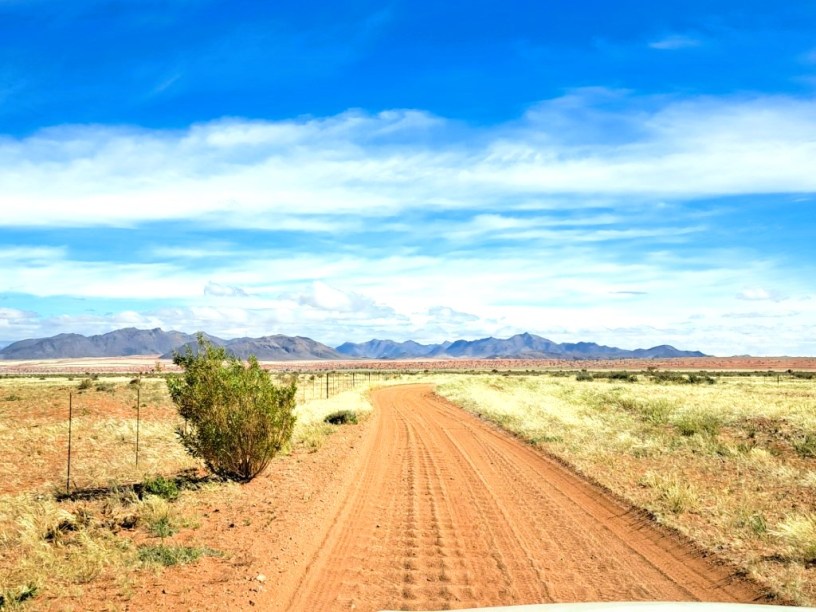
On the second day of our road trip, we travelled to Lüderitz. We followed a beautiful dirt road along a full Orange River – oh, how I wish I could show you photos of this beautiful stretch of road now. But soon, I promise!
Lüderitz is a small coastal town on the Namibian coast and is known for its colonial architecture. It was here that the famous Portuguese explorer, Bartolomeu Dias, arrived with his ship in 1487. We enjoyed a delicious seafood dinner at the Portuguese Fisherman and our accommodation, The Cormorant House, had a spectacular view over the bay – the sunset was one of the most beautiful I have seen in a long time.
- To see these beautiful buildings and other places of interest in Lüderitz, click here.
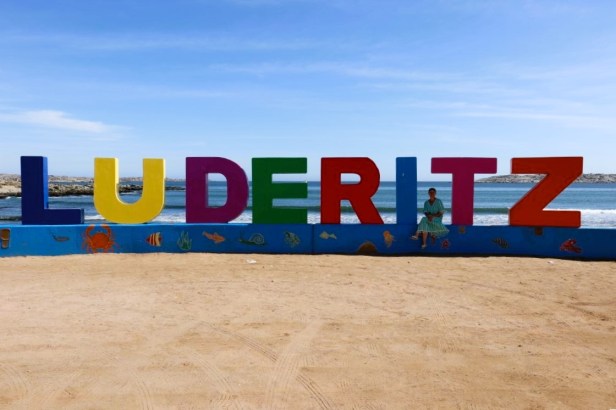
The Namibian coastal town of Lüderitz
- Kolmanskop/Kolmannskuppe:
The ghost town, Kolmanskop (also known as Kolmannskuppe) is just outside Lüderitz. This was a rich diamond mining town in 1910, but abandoned after World War I.
Kolmanskop is slowly being swallowed by the Namib Desert. We spent a considerable amount of time here – houses that were once beautiful buildings are now filled with fine desert sand. It was both beautiful and sad to see – a once flourishing place now lies abandoned, at the mercy of the fierce desert wind with devastating results.
- If you want to stroll through Kolmanskop in the Namib Desert, click here.

One of the houses at the ghost town of Kolmanskop
- Abandoned Garub train station:
We were actually on our way to search for the famous Wild Horses (also known as the Feral Horses of Namibia), when we came across the abandoned Garub train station. This station is located between Lüderitz and Aus and was once an important watering hole on the Lüderitz to Keetmanshoop line. Now it is deserted and just a faint memory of bygone days.
- To read about our visit to this picturesque train station, click here.
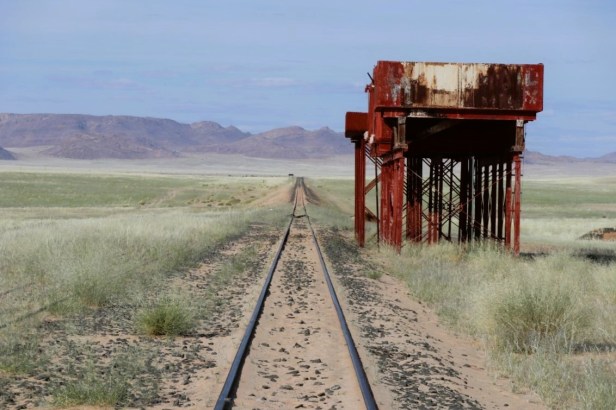
Garub train station – one of the landmarks of bygone days
- Wild/Feral Horses of Namibia:
Namibia’s only wild horses live in the rugged, sandy landscape between Lüderitz and Aus. They have been in this area for more than 100 years.
The wild horses in Namibia are believed to be descendants of horses that escaped from local stables, as well as from South African and German military horses that outlived their owners during World War I. Left to fend for themselves, these horses became a unique feature of the Namib desert.
Sometimes you see them and sometimes you don’t. We couldn’t believe our luck to see a whole herd – even so close that we could touch them!
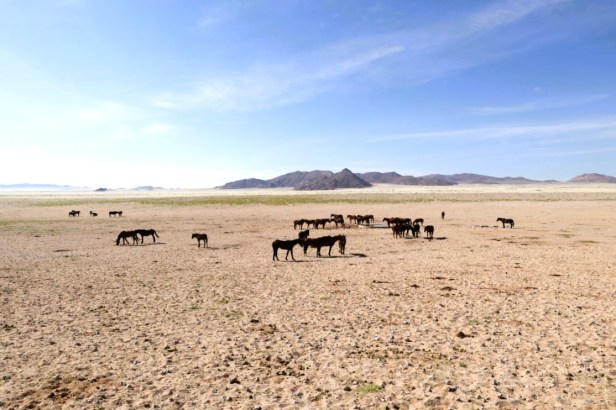
The Wild Horses of Namibia
- Klein Aus Vista:
We used our new rooftop tent for the first time at Klein Aus Vista at the Desert Horse Camp. I can’t think of a better place to sleep than on top of our bakkie’s roof – the bright starry sky felt so much closer.
In the late afternoon sun, the field and mountains were adorned in different shades of gold. We could just sit quietly and admire the scenery – a great peacefulness came over us this evening.
- If you want to see the golden sunset at our campsite, click here.
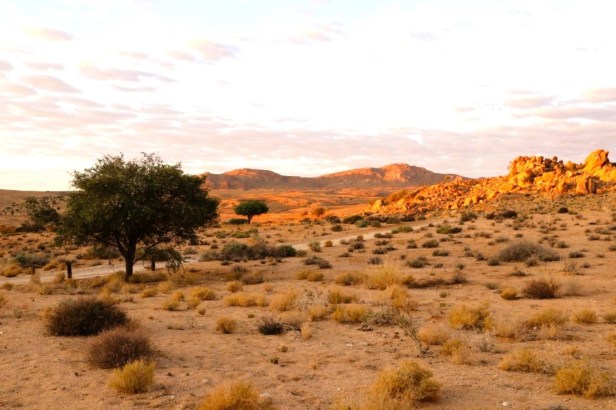
Golden colours at Klein Aus – our first night of camping
- NamibRand Family Hideout:
On the way to the well-known dunes of Sossusvlei, we slept at NamibRand Family Hideout. It was not our first choice of accommodation, as we wanted to stay closer to Sossusvlei. However, we could not find a place and ultimately decided to stay at an old, renovated farmhouse at NamibRand.
And ironically, this stay was the highlight of our trip. We experienced rain this evening in the Namib Desert and a large herd of gemsbok (oryx) and springbok came to drink water right in front of our house. But the cherry on top was our drive through the red sand dunes with a view that I will not forget as long as I live.
- If you want to see the beautiful road we drove to NamibRand Nature Reserve, click here.
- To see why this was our favourite day, click here.
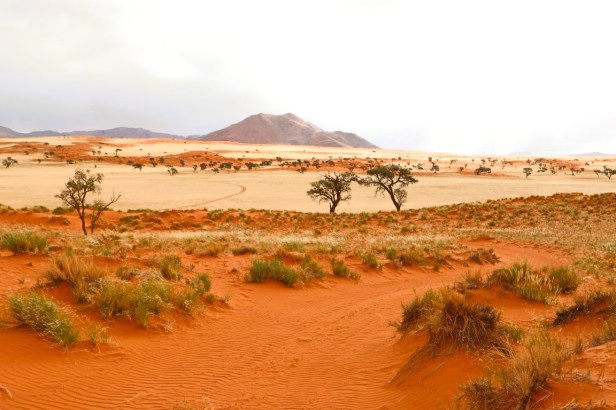
What a view at NamibRand
- Sossusvlei:
If you want to see high red sand dunes in Namibia, Sossusvlei is the place to visit. These dunes are among the highest of the world, with the highest being the one nicknamed Big Daddy, about 325 metres high. (The highest dune in the Namib Desert however, Dune 7 at Walvis Bay, is about 388 metres high).
I will tell you all about the sandstorm we experienced that night in a future post.
- If you want to see the amazing dunes of Sussusvlei and read about our stormy night in a rooftop tent, click here.
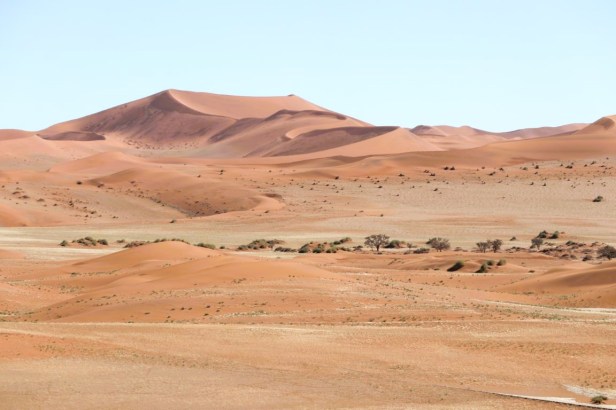
Red sand dunes at Sossusvlei
- Deadvlei (Dooievlei):
Deadvlei is a white clay pan located near the more famous salt pan of Sossusvlei, in a valley between the dunes. (The pan is also referred to as “Dooievlei” which is the Afrikaans name).
The trees here died as there was no longer enough water to survive. The remaining skeletons of the trees, which are believed to have died 600 – 700 years ago, are now black and scorched by the intense heat.
- If you want to see more of the dead trees at Deadvlei, click here.
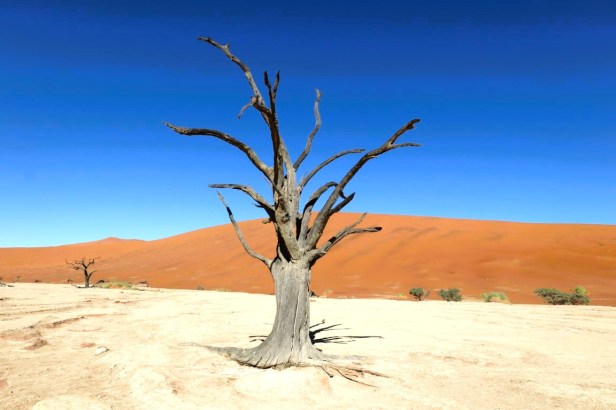
A dead tree on the salt pan at Deadvlei
- Duwisib Castle:
Duwisib Castle is about 20km/12.4 miles from the tiny village Betta. It was built by the German ‘Baron’ Hans Heinrich von Wolf for his bride in the early 1900s and gives a glimpse of German colonial times.
Hans Heinrich planned on breeding horses in the semi-desert environment. Sadly, he was killed during World War I. His wife left for America, never to return, leaving the castle and all of its contents and dreams behind.
- To see what it looks like inside Duwisib Castle, click here.
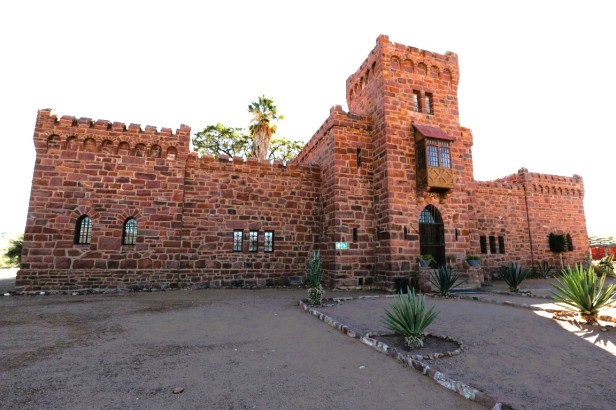
Duwisib Castle
- Helmeringhausen:
How is it possible that we could be so impressed with a place where there is only one shop, a fuel station, and a hotel?
Helmeringhausen is a tiny village (actually, it’s situated on private land) with very friendly people. We camped next to the hotel, and I think it’s possible that it was just the two of us that night in Helmeringhausen. It’s also here at the hotel where we had “the best apple cake in Namibia” (or so the hotel claims – and we’re not going to argue)!
- To see the tiny place called Helmeringhausen – and what the “best apple cake in Namibia” looks like – click here.
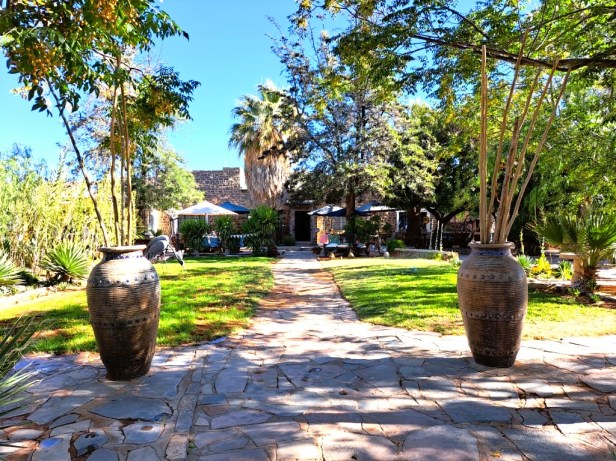
Beautiful garden at Helmeringhausen Hotel
- Canyon Roadhouse (and Fish River Canyon):
On our last night in Namibia, we stayed at Canyon Roadhouse. This unique and fun lodge with a vintage car theme exceeded all our expectations.
There are rooms to stay in, but we decided to camp one last time in Namibia. It’s also just 14km/8.6 miles from the Fish River Canyon – the second largest canyon in the world. (We share photos of this incredible canyon in our post, Namibia 11). There is a wonderful sign at Canyon Roadhouse that says: “Fill up on smiles” and that’s exactly what we got here.
- To enjoy the beautiful views we had at the Fish River Canyon and why Canyon Roadhouse is such a quirky place, click here.
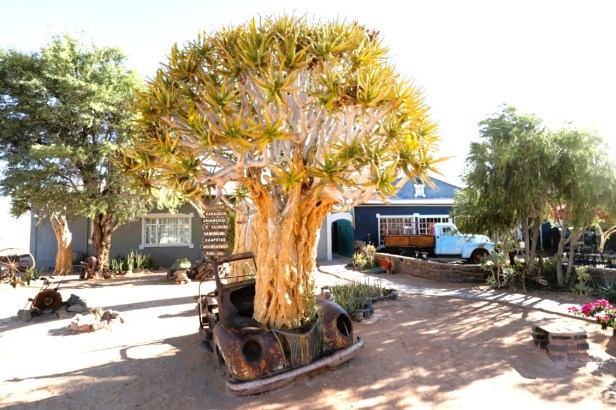
Quiver tree grows out of a vintage car at Canyon Roadhouse
Namibia is a country of contrasts with grass plains, desert, ocean, and mountains. Oh, and it’s true – they do have the friendliest people we have ever met on our travels. The moment we crossed the Orange River and left Namibia behind, we speculated about when we would return to explore the rest of this beautiful country.
Click on the links above to travel with us through this incredible country.

We saw a lot of this – such beauty
 Wet and Dusty Roads
Namibia is high-end our list, and your excitement for it has raised it a bit higher. Love the pictures, tell Berto it’s OK to use more 😊 Maggie
LikeLiked by 1 person
Oh Maggie, it’s a beautiful country – and we have only just scratched the surface! Ha, thank you, I passed your important message on to Berto – just wait for the next posts (I will soon have to pay WP for extra photo space😉).
LikeLiked by 1 person
Oh I meant to add, we were just in Erg Chebbi in Morocco. And those dunes are tourlted as being high and they’re 1/3 of the height of these! Maggie
LikeLiked by 1 person
The dunes at Sossusvlei are super high! I sat at the foot of Big Daddy and in the photo I’m barely visible against this huge dune!
LikeLiked by 1 person
Wonderful trip! Looking forward to your posts.
LikeLiked by 1 person
It was an incredible trip! Namibia is such a beautiful country (and we only saw a small part of the south) … I can only imagine how beautiful it must be further up north! I hope you will enjoy the next couple of posts!
LikeLike
Oe, dankie vir hierdie “lusmaker”! Ek sien uit na die res. (Die suide van Suid-Wes is niks in vergelyking met die ruie noorde nie – julle moet eenvoudig by Etosha uitkom!)
LikeLiked by 1 person
Ag, Tannie Frannie moenie dit eens vir my sê nie! As daar nie ‘n werk was waarvoor ons moes omdraai nie, het ons tot bo in die noorde gery (en in hierdie mooi land gebly vir so lank as wat dit moontlik was – 90 dae dink ek – maklik)! Dis die eenvoud wat so mooi is – niks aangeplak of kunsmatig verfraai nie.
LikeLiked by 1 person
Wonderful Corna. I’ve heard lots of positive things about Namibia and hope to visit one day. Apple pie, how delicious!
LikeLiked by 1 person
Marion, we were blown away by the beauty of Namibia (as you can obviously tell). We explored only a small part of this beautiful country – there are so many other stunning places up north (hopefully we’ll get an opportunity to visit that part as well). The apple pie was delicious – come to think about it, I should have taken a second portion as a takeaway 😉.
LikeLiked by 1 person
Weereens hang ek aan jou lippe! Ek wil ontsettend graag deur Namibië gaan toer, Corna. Was laas in 1984 daar, ons het in die Boesman kamp buite Tsumkwe gebly. My dogters se pappa was daar as weermag dokter gestasioneer en ons het met n 9 maande oue baba in ñ karavaan ingetrek. Moet sê, dit was ñ ongelooflike ondervinding. Ek kan dink jy is baie opgewonde om jul fotos met ons te deel.
LikeLiked by 1 person
O aarde Una, om in ‘n karavaan te bly het reeds sy eie uitdagings … met ‘n 9 maande oue babatjie, nog te meer! Maar wanneer jy iets moet doen (en daar is nie ander alternatiewe nie), dan verbaas mens soms jouself met wat jy kan regkry! Namibië is ‘n ongelooflike mooi land – die uitgestrektheid en ongereptheid is ontsettend mooi. O ja, ek kan nie wag om al die mooi te deel nie … dit gaan ‘n baie lekker reeks posts wees!
LikeLiked by 1 person
I loved Namibia too and have such great memories of our own trip there! You covered some of the same ground but also lots of places we didn’t see. Based on this ‘teaser’ I can’t wait to see and here more!
LikeLiked by 1 person
It’s great to hear that you also have good memories of your visit to this beautiful country. I’m sure you’ll recognise quite a few places in our next posts. We encountered foreigners everywhere we went, so it seems we were on an extremely popular route in the southern part of Namibia. I think Sossusvlei was the place where we saw the most foreigners (many people from eastern European countries) … and all of them loved their time in Namibia.
LikeLiked by 1 person
What a sensational experience! I imagine you will be thinking back on it and reliving the excitement for years to come. I would have enjoyed it very much, the scenery, the horses, the ghost towns, the sunrises and sunsets. I so look forward to more pictures!
LikeLiked by 1 person
I might even go so far as to say it was a once-in-a-lifetime experience! Although I hope we get the opportunity to visit Namibia again – the north apparently is just as beautiful! You’re right, I’m sure you would have enjoyed this trip a lot – animals, old buildings, train tracks, beautiful nature … it’s all there!
LikeLike
Can’t wait to see more…add my name to Maggie’s message 😂. You’re doing the bit that we dropped from our trip last year, you’ll remember, so I absolutely fascinated to read and see the rest of your story, Corna. It already sounds completely magical. Fascinated by that deserted town….yet more proof that mankind only kids itself that we’re in charge of the planet huh
LikeLiked by 1 person
I’m glad to hear that you and Maggie think the same 😂. I remember you wanted to visit Namibia, but didn’t know it was this specific part of Namibia that you had in mind. I must admit, accommodation in Namibia is quite expensive, but because we did a combination of camping and two cheaper options, we were lucky in that regard. However, it was expensive to fill our bakkie (truck) with diesel regularly because we had to drive such long distances. It was an incredible trip, though, and I’m sure you will enjoy the next few posts. Oh yes, the abandoned desert town of Kolmanskop was very interesting to visit – the discovery of diamonds made people completely lose their heads if you ask me!
LikeLiked by 1 person
Great preview of your road trip to Namibia. Sounds amazing (maybe not the sandstorm though). And the landscape looks incredible. Looking forward to hearing more about it and seeing many more pictures!
LikeLiked by 1 person
The Namibian landscape is so unique – it’s hard to believe that plains and red sand dunes can be amazing, but in Namibia it is truly breathtakingly beautiful. And you’re right, the sandstorm was no joke – for a few days afterward, I was still trying to get sand out of my ears, nose and hair 😂.
LikeLiked by 1 person
More pictures please! 😉 It looks absolutely stunning, Corna. I’m anxious to see and read more about all of the places you visited.
LikeLiked by 1 person
Oh, don’t worry Tricia – I’m going to make sure I show more than enough photos in the upcoming posts 😁. We have seen beautiful places and I’m going to start with the first post within the next day or two – I’m so excited to share these with you guys!
LikeLiked by 1 person
Can’t wait to see them!
LikeLiked by 1 person
What an introduction! Can’t wait for the actual series to begin. Much of where I went except I didn’t see the abandoned town – have seen photos of it though and it looks amazing. Love the photo of Garub train station and the Quiver tree in the car. So many wonderful landscapes you have captured, brings back so many memories.
LikeLiked by 1 person
Oh, you will then recognise many places in our next few posts. I have always wanted to visit Kolmanskop and I’m glad I finally got the chance – it was quite amazing. Garub train station was one of those random visits – one that we really enjoyed taking photos of. Namibia is an incredibly beautiful country – the landscapes kept changing and it was hard not to stop frequently!
LikeLiked by 1 person
I think my camping trip was around 10 days through Namibia. It’s a BIG country. And yes, very varied.
LikeLiked by 1 person
WOW WOW WOW! Can’t wait to read your next posts. This one has really whetted my appetite! 🙂 Mel
LikeLiked by 1 person
Oh Mel, Namibia is such a beautiful country! The expanse of desert and plains has left a lasting impression. And no, we didn’t pack a backpack and went for a long hike – there just wasn’t enough time for that. But the Fish River Canyon Hiking Trail has our name on it! One day …
LikeLiked by 1 person
It sounds like you have spotted all the best bits for a return visit. Nice.
LikeLiked by 1 person
I am so excited to see pictures of your new adventures, what a beautiful area! You seem so happy, I’m happy for you.
LikeLiked by 1 person
Namibia is such an incredibly beautiful country, and we have wanted to take a trip through the south for so long, but just never had the time. I’m glad you can tell from this post how happy I was about it, because to be honest: I was over the moon with happiness 😁.
LikeLike
Oh yay, I’ve been very excited to read about this since I first learned you were going! I feel your pain on the one photo a day thing… currently working on a post of my own from our recent trip based on the same premise. It is not easy.
I’ve long dreamed of seeing Sossusvlei and your photo does not disappoint… but I think the view from NamibRand might take the cake on this collection of photos. Wow!
LikeLiked by 1 person
Diana, I think all our posts about Namibia are going to be a challenge when it comes to selecting photos – I think we have almost 2,000 photos – hectic! The dunes of Sossusvlei are much bigger than I thought – it’s somewhat of a tourist hot spot, but luckily, we arrived there after most people started to leave. NamibRand was incredibly beautiful – with not a soul in sight … just us and the red sand dunes.
LikeLiked by 1 person
It looks AMAZING, I can’t wait to read more in detail. I’m really stuck on the first bit though where you drove 400+ miles in one day like it’s just a throw away sentence. I’m going to Scotland tomorrow and it’s 337 miles – that’s way too far for me so I’m getting the train!!! You guys are amazing 🙂
LikeLiked by 1 person
I hope Scotland was/is a wonderful getaway (and hopefully for leisure and not work related). I think, because South Africa is a relatively big country, we are used to driving long distances … although, I wouldn’t have minded a train journey now and then!
LikeLiked by 1 person
What a wonderful roadtrip. Look forward to reading more. Cheers
LikeLiked by 1 person
One of the best road trips we have ever had! There are a whole bunch of posts coming up (and lots of photos), so I hope you enjoy it.
LikeLike
Very beautiful 👌
LikeLiked by 1 person
Thank you! Namibia is an incredibly beautiful country.
LikeLike
Corna, I love reading your posts because you are a lot like me. I get really excited when planning a trip and always enjoy every moment.
I have not been reading blog posts for a while but am catching up now and I am particularly excited about reading about your Namibian trip.
LikeLiked by 1 person
I’m glad to hear we feel the same about trips – there is always great excitement in our house when we plan a trip (beforehand to plan and afterwards to share the stories and photos). I hope you enjoy the next few posts of Namibia; it was incredible – even the sandstorm we experienced at Sesriem (in retrospect of course 😉).
LikeLike
This really is like a candy store! I was a bit apprehensive about sharing with Sladja that you have visited Namibia and wrote a series of blog posts on the trip. It’s one of her most desired destinations, so she continues to bring it up every now and then. When you consider that some of our favourite things are ghost towns and abandoned places in general, wild horses and skeletal trees, you must come to the inevitable conclusion that we are fully committed to reading your entire series over the next few weeks. Looks like an amazing trip! Well done for being so disciplined and choosing only one photo for each destination.
LikeLiked by 1 person
Oh well Leighton, I have bad news for you (and good news for Sladja) … when I read in your comments about your favourite places to see on your travels, then I knew that the south of Namibia meets all the requirements! When you page through the rest of our Namibian posts, you will understand that choosing just one photo per place in our introduction post was a very difficult task … but I made up for that in each individual post 😉.
LikeLiked by 1 person