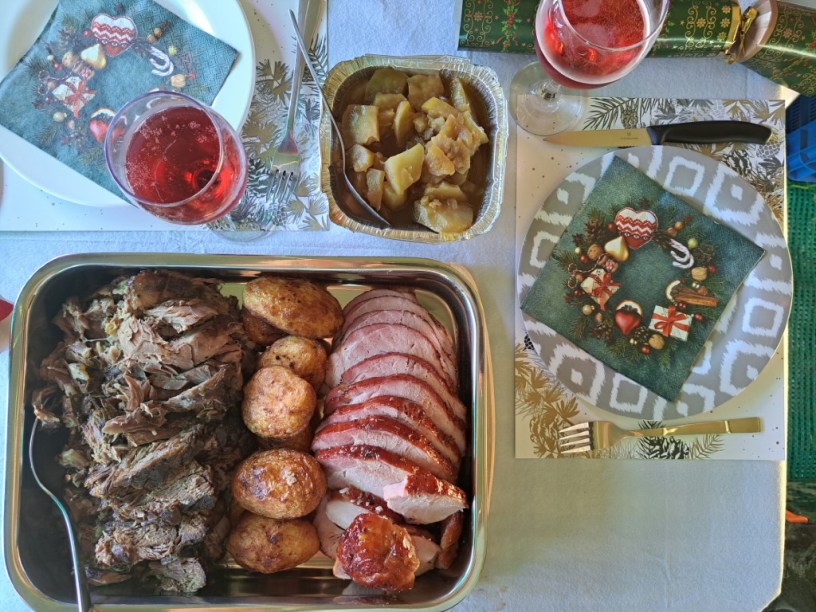
Deboned Leg of Lamb (made in a ‘vuurvarkie’)
In our family, Christmas lunch traditionally consists of leg of lamb, gammon, roasted potatoes, yellow rice and caramelised sweet potatoes. And even though we were camping this past Christmas, we wanted to enjoy the same meal again.
We realised that preparing our traditional Christmas lunch without a stove might be a challenge. But we were also hopeful that our ‘vuurvarkie’ (fire piggy) might be able to stand in for the stove. And to our surprise, it not only met our expectations, but exceeded them!
What is a ‘vuurvarkie’ (fire piggy)?
As explained in a previous post (read here), a ‘vuurvarkie’ is a traditional South African bread oven. Surrounded by hot coals and fire briquettes it guarantees even heating. And we were hoping that it would do the same for our leg of lamb.
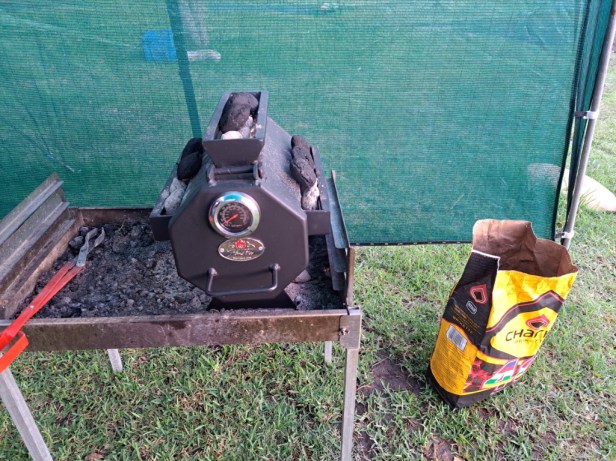
Traditional ‘vuurvarkie’ (fire piggy)
Put it on the table:
Cooking the leg of lamb is usually my mother’s forte. On our camping holiday she prepared it, while Berto ensured that the ‘vuurvarkie’s’ temperature remained at 150°C/300°F at all times. We decided on a deboned leg of lamb, because that way it would cook faster.
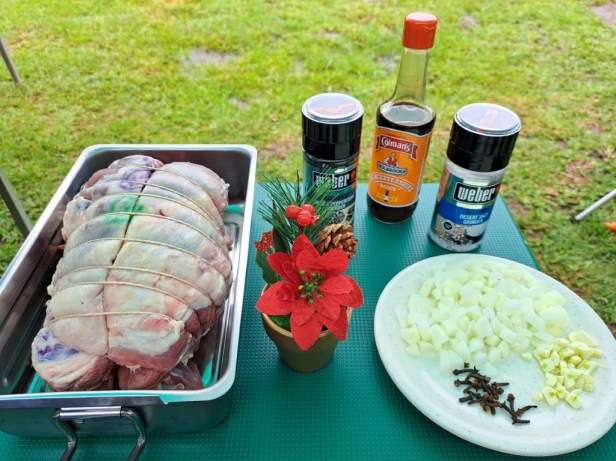
Ingredients for deboned leg of lamb
Deboned leg of lamb (1.5kg)
½ onion, chopped in big pieces
6 big garlic cloves, sliced
cloves
Worcestershire sauce
salt & pepper
fresh rosemary
My mum made small incisions into the lamb, using a sharp knife, at an angle, about 5cm into the meat. She filled each little hole with a piece of chopped onion, garlic, clove and rosemary.
The leg of lamb is now rubbed with salt and pepper and then with Worcestershire sauce. The remaining chopped onion was sprinkled on top of the lamb.
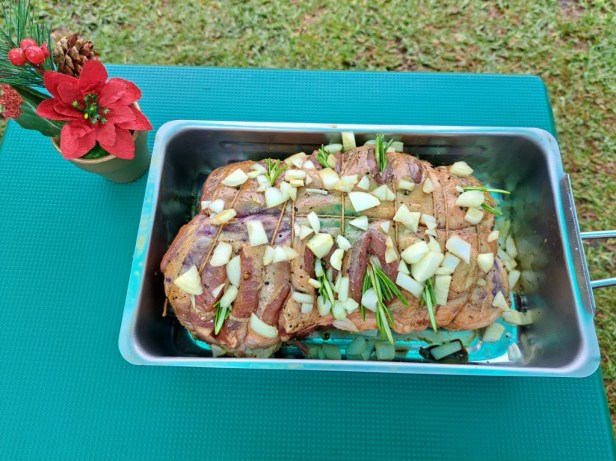
Leg of lamb stuffed with onion, garlic, cloves and rosemary
Meanwhile, Berto prepared the fire with charcoal.
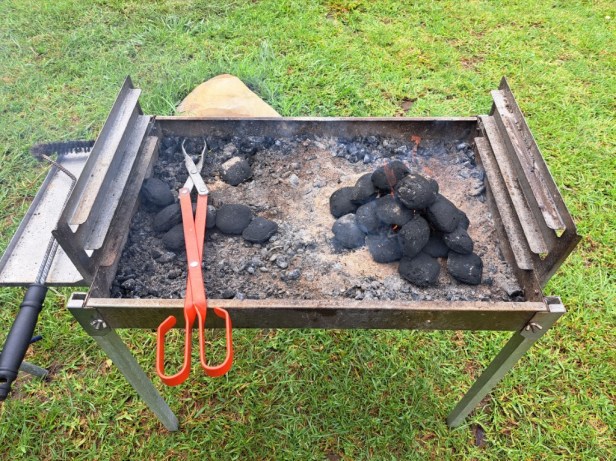
Charcoal fire for the leg of lamb
The leg of lamb was placed in a stainless-steel dish, covered with foil and then placed in the ‘vuurvarkie’.
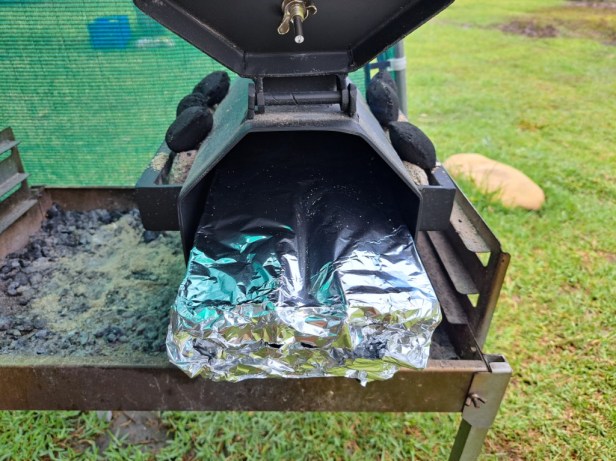
Leg of lamb going into the ‘vuurvarkie’
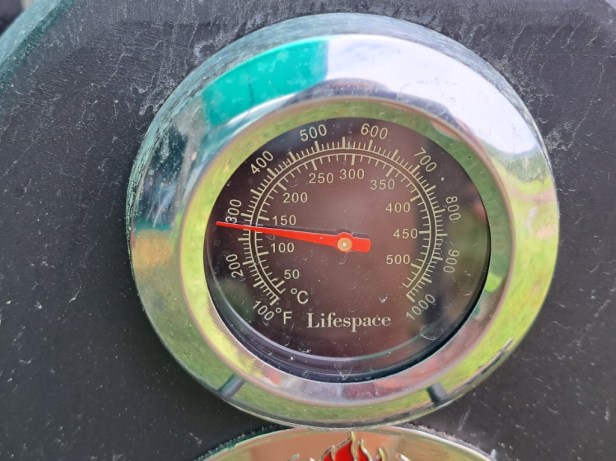
The temperature on 150°C/300°F
When the temperature dropped below 150°C/300°F, Berto placed more briquettes below, on the sides and on top of the ‘vuurvarkie’ to push the temperature back up again.
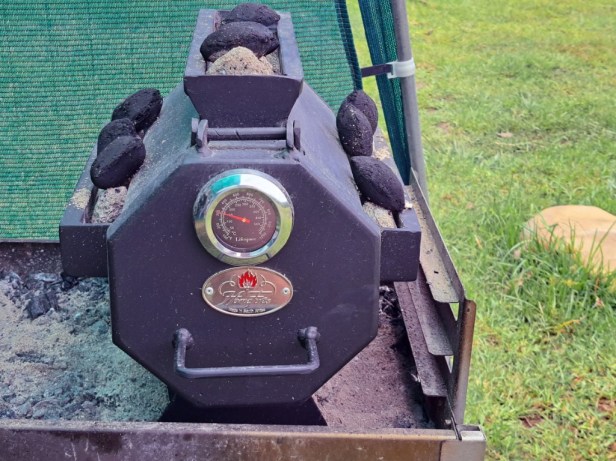
Keeping the temperature of the ‘vuurvarkie’ at 150°C/300°F
After about 1½ hours, Berto took the leg of lamb out of the ‘vuurvarkie’ to see how it was progressing. It looked promising and the leg of lamb was then placed back into the ‘vuurvarkie’ for another 1½ hours.
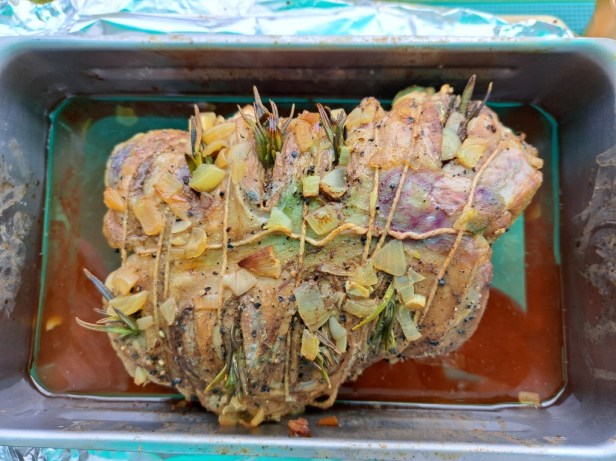
Leg of lamb after 1½ hours
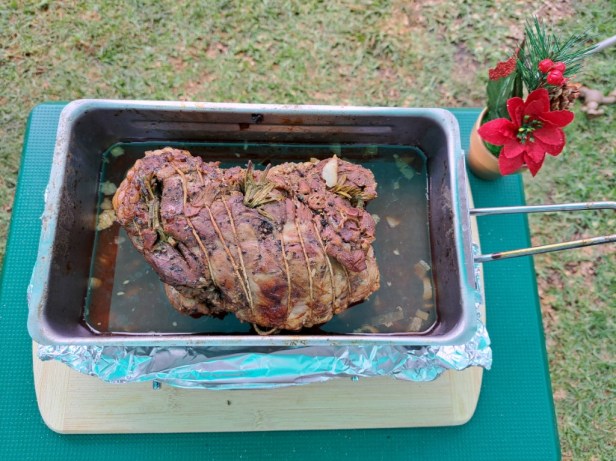
Leg of lamb after 3 hours in the ‘vuurvarkie’
After 3 hours in the ‘vuurvarkie’, the leg of lamb was placed aside, covered with foil. The next day (Christmas Day) it was placed back in the hot ‘vuurvarkie’ (without the foil) for about half an hour to brown.
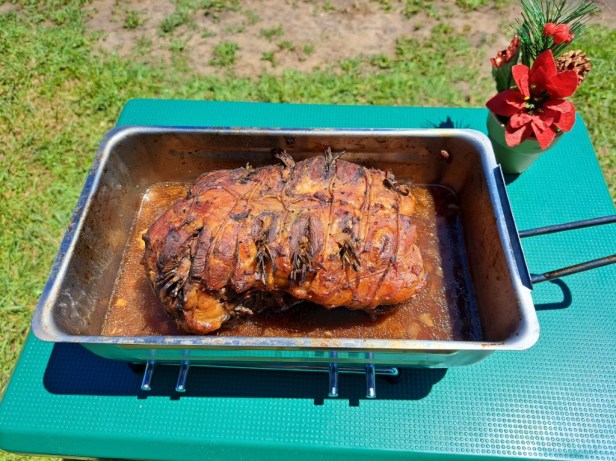
Our Christmas leg of lamb (done in a ‘vuurvarkie’)
We all agreed that this leg of lamb was probably the best we had ever eaten. I think it’s possible that we will cook the leg of lamb for Christmas 2025 again in the ‘vuurvarkie’ – mind you, even if there is a stove available.
Gammon:
Gammon is another meat we cook on Christmas Day. Usually we buy an uncooked gammon and cook it on the stove top for a few hours with onions, celery and carrots and then roast it in the oven.
But since we didn’t have a stove at our disposal, we took a shortcut and bought a cooked gammon and simply grilled it on the hot coals.
This is how we did it:
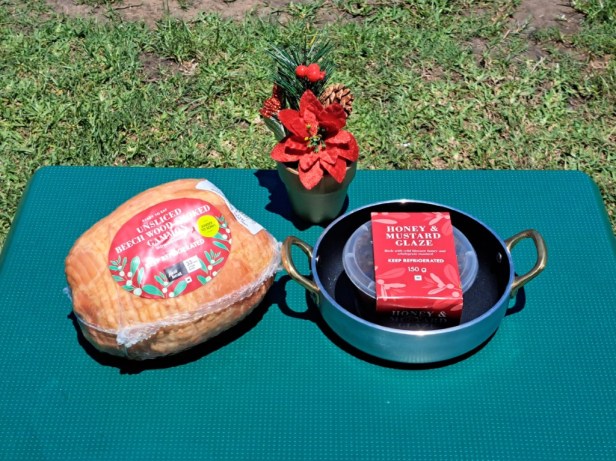
Ingredients for gammon
Cooked gammon
Honey & Mustard Glaze
While the leg of lamb was browning, Berto made another fire with charcoal next to the ‘vuurvarkie’.
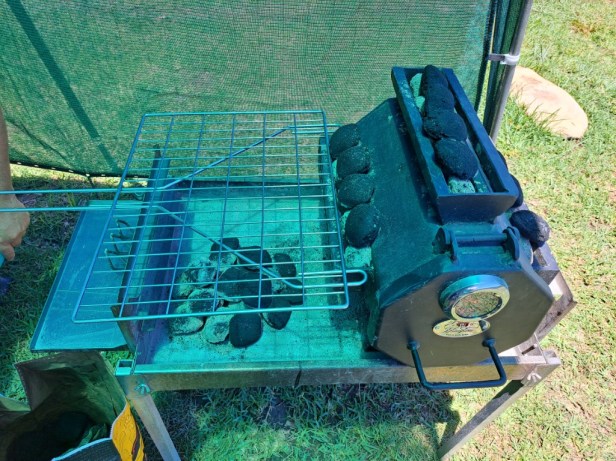
Separate fire with charcoal for the gammon
While the gammon was on the fire, Berto heated the sauce in a small pan and occasionally glazed the gammon.
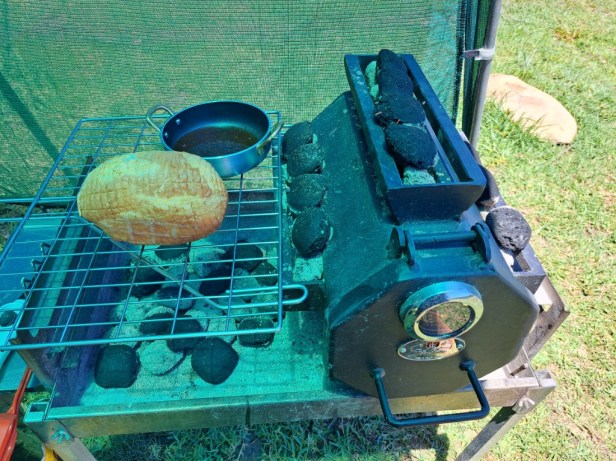
Gammon and sauce heating
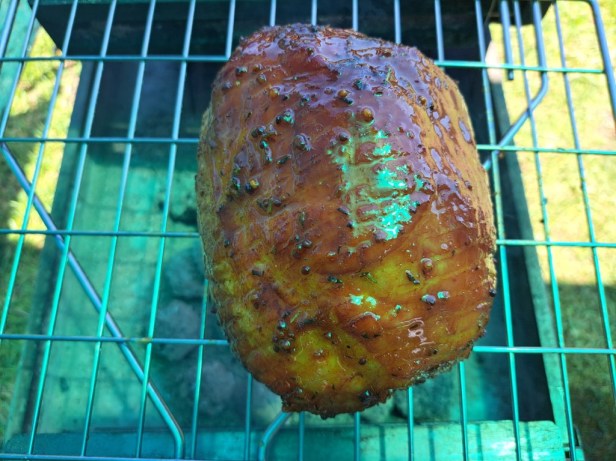
Glazed gammon
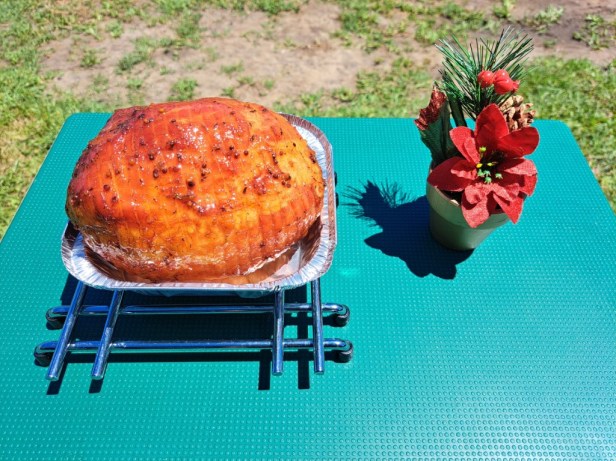
Christmas gammon
Both the leg of lamb and gammon were perfectly cooked – and that without a stove. I think that’s proof that you can make really good food while camping.
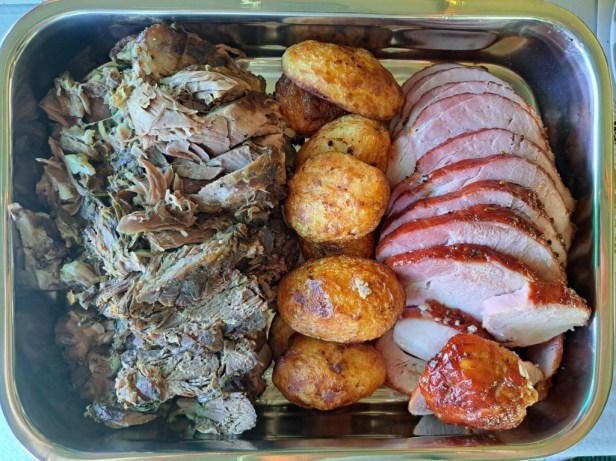
Leg of lamb and gammon (with roasted potatoes)
We had more than enough meat to share with our fellow campers. They were quite surprised that we could cook this type of food on a fire, but all agreed that it was really delicious.
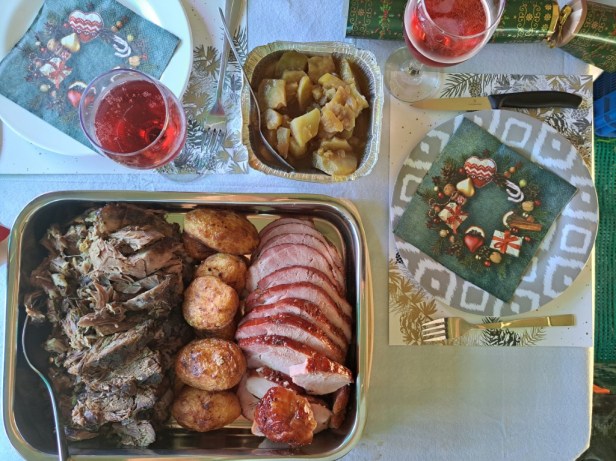
Meat and roasted potatoes on our Christmas table
Next week we’ll show you how to make the best ever caramelised sweet potatoes while camping (or, as we call it in Afrikaans, ‘soetpatats’). To read about this, click here.
 Wet and Dusty Roads
Corna, my mond water en dis nog so vroeg in die oggend! Jou kos-fotos is goed gedoen. Julle het ñ feesmaal voorberei, en dit op ñ kamp-vakansie. Ek is verstom.🤗
LikeLike
Dit was beslis ‘n feesmaal – baie geskik vir ‘n Kerstafel! Ek sê jou, ek was self verstom dat ons hierdie maaltyd kon voorberei terwyl ons gekamp het. Wys jou net: Alles is moontlik 😁!
LikeLiked by 1 person
I will have some gammon please! I’m like your fellow campers, it’s unbelievable you cooked all that delicious food while camping over the fire. Does every camp site have the Fire Piggy?
LikeLike
Gammon on a sandwich the next day – that’s the best! No, we bought the fire piggy just before the start of our camping holiday (hoping we could use it for our Christmas meal). It’s definitely one of our best camping purchases yet! I wish you could see the disbelief on our fellow campers’ faces when we told them that we cooked all that food at our camp site – it was actually quite hilarious 😅!
LikeLike
WOW! That looks like it would melt in your mouth. I bet the gorgeous smells wafting from your tent were killing the other campers! 🙂
LikeLike
I think it was our best Christmas meal yet! Oh well, maybe not, but to think we cooked that on the fire made us appreciate the food a lot more. Our fellow campers were at our camp site early in the morning to see what smells so good – the ‘vuurvarkie’ was the center of every conversation for the next few days after our Christmas meal 😅.
LikeLiked by 1 person
You should have been on a commission – you probably could have sold hundreds of the little cookers.
LikeLike
Now why didn’t I think of that 😂.
LikeLiked by 1 person
🙂
LikeLike
Your Christmas lunch with Leg of lamb and gammon (with roasted potatoes) looks so scrumptious.
LikeLike
Rupali, it was truly a feast! I’m so glad we were able to prepare all these delicious food – now we know what is possible when camping!
LikeLike
The fire piggy is certainly an interesting looking contraption, and it looks incredibly useful too. Your Christmas dinner looks delicious, and having your mum there must have made it an extra special occasion.
LikeLike
We can’t imagine that we ever had to prepare camp food without having a fire piggy 😁. You’re right Tricia, it was fun sharing everything with my mum on our camping holiday (some of the things she had never experienced before). I feel truly blessed that she was able to visit us – and very happy that we could enjoy her delicious leg of lamb 😉.
LikeLiked by 1 person
Now that’s what I call determination when keeping the temperature constant for three hours! I think the best lamb I have ever eaten was spit roasted over a fire pit dug in someone’s garden. South Africans do take their braais very seriously 😂
LikeLike
I should perhaps have added that Berto did it quite willingly while I kept his wine glass full 😄. You’re right, the South Africans are very serious about their campfires and braais. These days there’s even a reality TV show to track down South Africa’s best Braai King!
LikeLiked by 1 person
Absolutely delicious Corna. As you well know by now, lamb is my favourite meat. We also cooked a leg of lamb over the Christmas holidays but not on Christmas Day. I follow the same method of preparation but had not thought or heard of adding Worcestershire sauce so I’ll give it a try at Easter when we next roast a leg in our oven.
LikeLike
Oh yes, I remember that you like lamb – and I’m sure you would have enjoyed our Christmas version. My mother usually rubs the Worcestershire sauce over for more flavour, but also to give it a lovey colour when it has to roast in the oven (or in the fire piggy) for the last half hour. It’s definitely one of my favourite meats too!
LikeLiked by 1 person
Christmas Day, the place to be was obviously with you. I wasn’t always vegetarian and lamb used to be a favourite. The best I ever had was cooked on a friend’s barbecue but your version looks even better. The gammon must have been delicious too. You have got camping cuisine down to a fine art!
LikeLike
I think lamb on the fire is a winner (and now we know that gammon also works well on the campfire). I wouldn’t say that food is important to us when we camp, but we like to eat well when we camp … oh well, maybe it’s the same thing 😉.
LikeLike
Hoe dankbaar is ek nou dat ek sopas ontbyt geëet het 😉 Is dit Berto wat die perfekte, simmetriese skywe sny? Jou gekapte groente lyk ook altyd so netjies – ek dink julle is baie fluks.
LikeLike
Haha, Tannie Frannie let fyn op 😊. Ja, dis inderdaad Berto wat so perfek sny. Ek weet nie of Tannie ons ystervarkies “Dish of the Week” gesien het nie … maar daar het Berto selfs sy maatband uit sy “tool box” gaan haal om die ystervarkies in mooi ewe groot blokkies te sny. Ek dink hy’t ‘n ding oor presiesheid 😅.
LikeLiked by 1 person
💖
LikeLike
One day we can dream of tucking into a roast lamb dinner together somewhere!
LikeLike
That would be really great Marion!
LikeLiked by 1 person
DELICIOUS. And so impressive to manage this without an oven!!
LikeLike
I have to admit that I was a little doubtful that we would be able to make our normal Christmas meal while camping. I don’t know who was more surprised … we or our fellow campers 😁.
LikeLiked by 1 person
Glad to hear you were able to carry on your Christmas traditions while camping. Looks like quite the feast!!
LikeLike
It was a feast indeed – even better than previous years’ meals prepared in the more “normal” way (which included a stove) 😉.
LikeLiked by 1 person
Delicious
LikeLike
A real festive meal … and yes, delicious indeed.
LikeLike