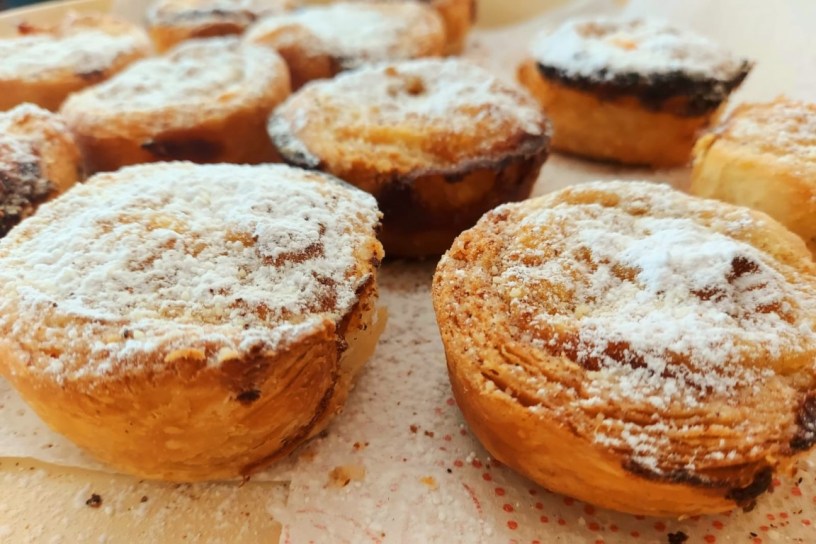
Pastéis de nata
In 2009, The Guardian listed pastéis de nata as one of the 50 ‘best things to eat’ in the world – and I couldn’t agree more! When we walked the Portuguese Camino in Portugal during 2018, I enjoyed these Portuguese custard tarts every day (ok, I confess: there were days I enjoyed it twice).
So, although today’s dish is not a traditional South African recipe at all, but typical of Portugal, it’s just so good that I can’t help but share it here.
The history of pastéis de nata:
The term pastéis de nata is Portuguese for ‘cream pastries’ and were created before the 18th century by Catholic monks at the Hieronymites Monastery in Lisbon. At the time, convents and monasteries used large quantities of egg-whites for starching clothes, such as friars and nuns’ religious habits. It was quite common for monasteries and convents to use the leftover egg yolks to make cakes and pastries. (Source: Wikipedia).
The chef:
My brother, like Berto, is very capable in the kitchen. Johan knows how much I love pastéis de nata and made it especially for me. I watched with great amazement as he made the puff pastry from scratch and almost forgot to take pictures.
Here is Johan’s take on pastéis de nata:
Put it on the table:
Start making the puff pastry first, as it needs to rest in the fridge for a few hours. The filling (custard) can be made after the prepared puff pastry has been in the fridge for a few hours.
(Note: I told my brother it was definitely easier to buy puff pastry, but he didn’t want to know about it. But if you’re in a hurry to enjoy your pastéis de nata, I’m sure you’ll find decent puff pastry at your local store – just don’t tell my brother I mentioned it.)
Ingredients for the dough:
250g all-purpose flour (plus more for the work surface)
150ml cold water
200g salted butter (at least 82% fat, solid and straight from the fridge)
Method – dough:
- Mix the flour and water until a pliable dough form. Put back in fridge for 15 minutes.
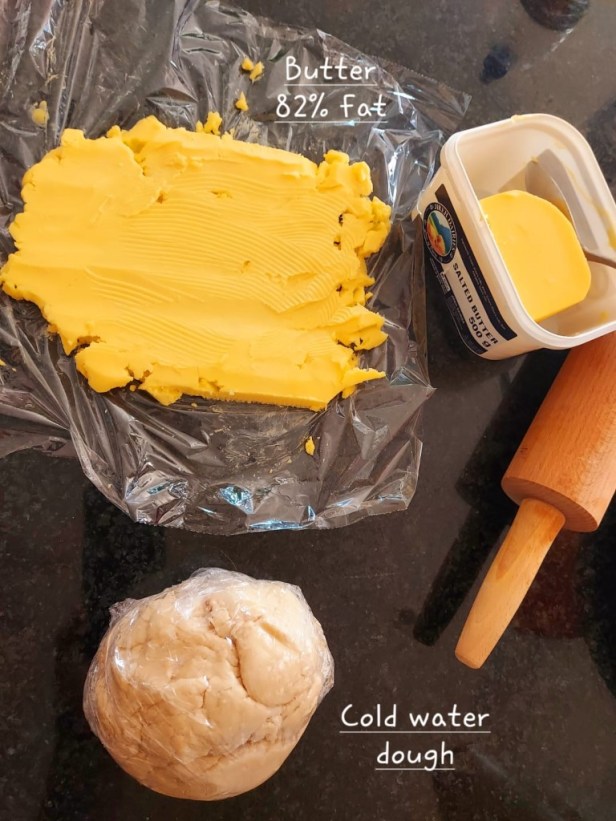
Preparation of the dough
- Roll dough out in 20cm x 40cm rectangle. Flatten butter with a rolling pin to a 15cm square and place on the top half of dough.
- Fold dough like an envelope over butter in 3 layers, leaving 2cm gap all sides.
- Turn 90°, roll out again in 20cm x 40cm rectangle and fold the same way again.
- Cover with some flour after every turn. Let rest in fridge for 30 minutes to an hour.
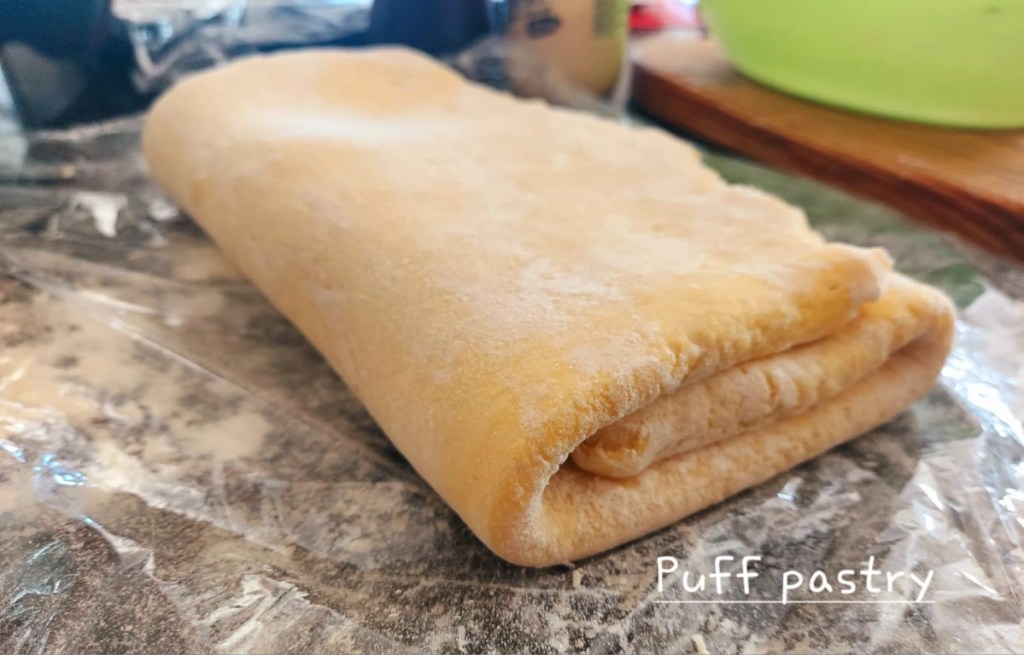
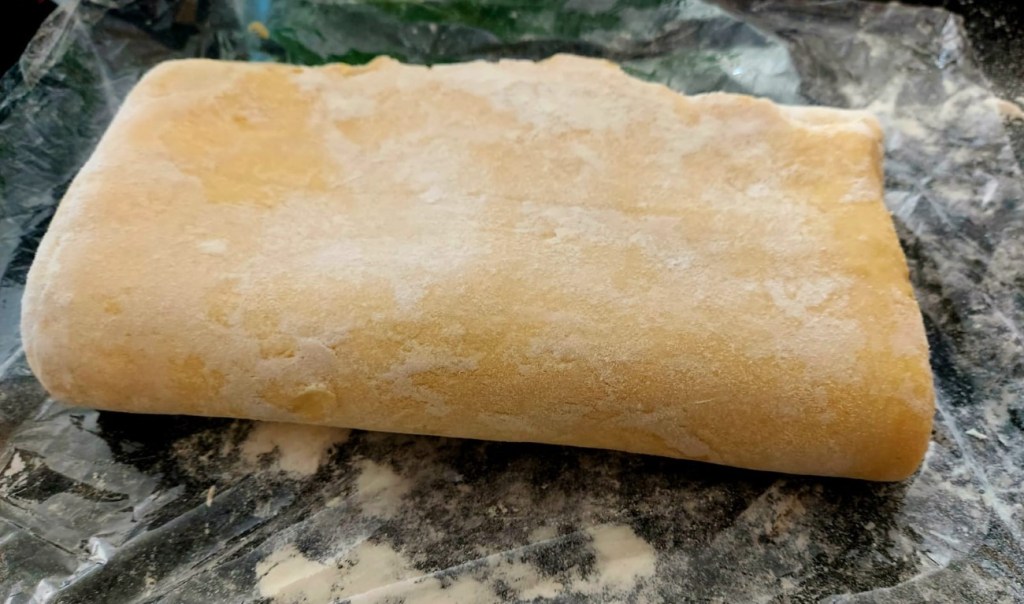
Homemade puff pastry
- Repeat the process 2 more times.
- With the longest side horizontal in front of you, roll the dough from the bottom away from you into a tight log, brushing the excess flour underneath as you go.
- Trim the ends and cut the log in half.
- Wrap each piece in plastic wrap and chill for 30 minutes to a few hours. (You can freeze the 2nd log for another time).
Ingredients for the custard:
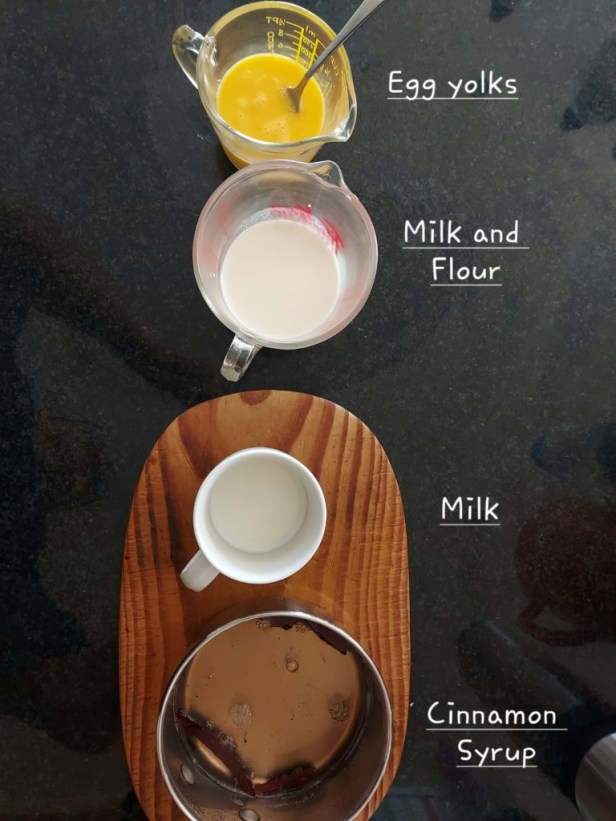
Preparation for the custard
3 tablespoons all-purpose flour
80ml milk (+ 250ml milk)
300g granulated sugar
1 cinnamon stick
150ml water
½ teaspoon vanilla extract
6 egg yolks
Method – custard:
- Bring the sugar, cinnamon stick and water to a boil in a small saucepan and cook until reduced. Do not stir.
- Heat 250ml cup of milk in microwave for 1 minute. Whisk the hot milk into the flour and 80ml milk mixture.
- Remove the cinnamon stick and then pour the sugar syrup in a thin stream into the hot milk-and-flour mixture, whisking briskly.
- Add the vanilla and stir for a minute. Whisk in the yolks, strain the mixture into a bowl, cover and set aside.
(Note: The custard will be thin)
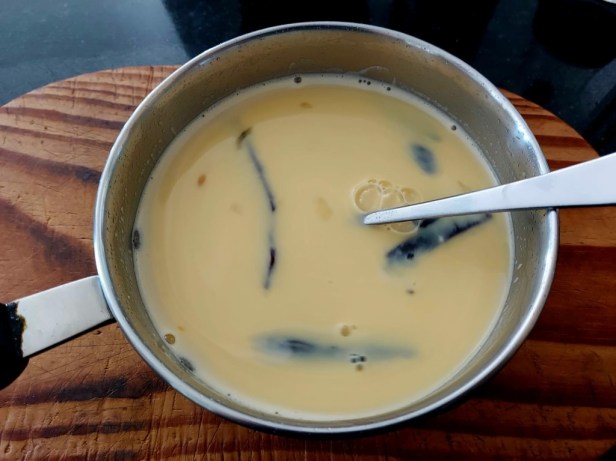
The custard
Time to bake:
- Preheat the oven to 220°C/428°F (fan).
- Cover pan holes with butter/oil spray and sprinkle flour in each hole, swirling the pan to cover the full hole with flour, removing the excess flour.
- Remove a pastry log from the fridge and roll it to about 25mm in diameter and 30cm long.
- Cut it into 20mm pieces, should make around 12 pieces.
- Place 1-piece pastry dough, cut side down, in each well of a nonstick 12-cup muffin pan.
- If using classic tins, cut the dough into generous 1-inch (25mm) pieces.
- Dip your thumbs in a bowl of water, then straight down into the middle of the dough spiral in the pan. Flatten it against the bottom of the cup to a thickness of about 1.5mm.
- Then smooth the dough up the sides and create a raised lip about 3mm above the pan.
(Note: The pastry bottoms should be thinner than the tops).
- Fill each cup ¾ full with the cool custard.
- Bake the pastries until the edges of the dough are frilled and brown – about 15 to 17 minutes.
- Check after 12 minutes, it should have puffed up with a few darker specs on top of the custard.
Remove from the oven and allow to cool. Sprinkle with cinnamon, then icing sugar.
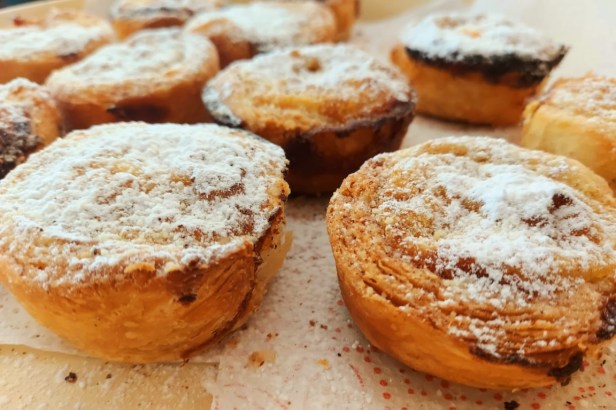
Home baked pastéis de nata
Yes, you guessed it … my brother is a perfectionist when it comes to baking. How did it taste? Well, when I closed my eyes, I might as well have been standing in one of Lisbon’s hilly streets at a bakery – it was heavenly!
Many thanks to my brother for his contribution to our ‘Dish of the Week’ – it was a masterpiece!
 Wet and Dusty Roads
Hoe watertand ek nou! Jou boetie weet beslis wat hy doen – gekoopte skilferdeeg kom nie naby die selfgemaakte weergawe nie.
LikeLiked by 1 person
Tannie Frannie skryf nou presies wat my broer vir my gesê het toe ek die voorstel van gekoopte skilfderdeeg genoem het! En dan het hy nog iets van “dis terapie om deeg uit te rol” ook bygevoeg … al wat ek weet is dat dit baie lekker was!
LikeLiked by 1 person
Hy’s ‘n ware sjef!
LikeLiked by 1 person
Sy vrou dink ook so!
LikeLiked by 1 person
Oh this looks sooo delicious! 🙂
LikeLiked by 1 person
It’s really-really good! And even better if I don’t have to make it myself 🙂.
LikeLiked by 1 person
Hahah true!
LikeLiked by 1 person
Gaan net moet probeer maak … lyk heerlik!
LikeLiked by 1 person
Dis nogal tydrowend – die deeg rollery – maar volgens my broer is dit goeie terapie. Noudat ek gesien het hoe hy dit maak, is die maak van ‘puff pastry’ nie meer so intimiderend nie … ek mag dalk net self probeer. En dis sooo lekker!
LikeLiked by 1 person
Sal mens die gekooptes ook kan gebruik?
LikeLiked by 1 person
Ek is seker ‘n mens kan dit doen. Die vraag is of die eindresultaat dieselfde sal wees …
LikeLiked by 1 person
Dit gaan ek nou nie weet nie – weet nie hoe dit moet proe nie
LikeLiked by 2 people
I never really understand the mentality of chefs, who spend all that time and effort on something that sits on the plate for 30 seconds 🤣🩷 but, goodness, they do taste good.
LikeLiked by 2 people
That’s exactly what I said Jo! I’m assuming it’s fun for some people to make an effort in preparing food, while for others (the majority maybe) it’s fun to eat … I definitely fall into the second category! And these were really GOOD (and made me think back with fondness to our time in Portugal).
LikeLike
🤗🩵
LikeLiked by 1 person
That looks and sounds like a lot of work but the end result looks delicious!
LikeLiked by 1 person
Yes, it’s quite a long process (although, for me it didn’t feel like that long because I could relax with a glass of wine while my brother made it)! But oh my, it was delicious!
LikeLike
The ones from Lidl taste pretty good too! 😂
LikeLiked by 1 person
And so are the ones we buy in Cafe Lisboa here in Langebaan 😂! But hey, the ‘chef’ enjoyed preparing it and the rest of the family enjoyed eating it up as quickly as possible!
LikeLiked by 1 person
Wow! How nice to have a Portuguese café close by. But yes, compliments to the chef. I have never had the patience to make my own puff pastry.
LikeLiked by 1 person
Oh, I love that café … it’s too close for my own health!
LikeLiked by 1 person
A good job that you have moved to the Eastern Cape then 😁
LikeLiked by 1 person
Haha, yes it’s good to always notice the silver lining, right?
LikeLiked by 1 person
I adore these Portuguese custard tarts. You can also find them in shops in England but they tend to be quite pricey so I’m tempted to follow your recipe in the new year and try to bake some myself.
LikeLiked by 1 person
They’re delicious, aren’t they? And you’re right, it’s pretty expensive to buy (I now know why when I see how long it takes to make it). I also think I’m going to try to make it – my brother made it look easy … and if I just remember how delicious it tasted, it might be worth a try.
LikeLiked by 1 person
Oh my, Corna. I’m all in for these!
LikeLiked by 1 person
It was absolutely heavenly Frank! The problem is that one can’t just eat one …
LikeLiked by 1 person
Now that sounds like a good problem
LikeLiked by 1 person
Yum yum! They look tasty, I loved the original ones in Lisbon 🙂
LikeLiked by 1 person
Oh, the pasteis de nata we ate in Lisbon was the best! This was a big treat from my brother and I had way too many!
LikeLike
My friend Ester is Portuguese and she introduced me to these. How nice that your brother could create them so beautifully. Alas, I was never any good at pastry. Not at making it, anyway. I remember my mum doing all that folding and rolling. The last time I made any attempt with flour my cat Kina leapt over the barrier I had erected to keep him from the kitchen and next thing there were little white paw prints all over my blue carpet. That was my excuse to stop trying!
LikeLiked by 1 person
I remember you talking about Ester before – she made you eat the very best of Portugal! I’m not good at pastry either – my mom always says you should have “light hands” when working with pastries. Oh my, Kina left you with fond memories – I can only imagine what your blue carpet must have looked like after this episode! My brother did a great job – within two days we finished his masterpiece without even a blink of the eye!
LikeLike
Looks amazing! Like you, I enjoyed pastéis de nata daily when we visited Portugal; it’s absolutely delicious. Thank you to Johan for sharing this recipe!
LikeLiked by 1 person
When I took some of these for our neighbours, they immediately assumed that I had bought it at Cafe Lisboa (the local Portuguese deli) … that’s how delicious it was! I think Johan can leave his day job and become a chef instead!
LikeLike
They look yummy – I’ll be right over 🙂 Maggie
LikeLiked by 1 person
We’ll have to bake again Maggie … I think the first batch barely had enough time to cool down before we finished it!
LikeLike
Jong! My mond water nou so, ek sal sowaar heeltemal vergeet dat ek bant!
LikeLiked by 1 person
Ek dink as ‘n mens ‘effens’ wil kroek wanneer jy bant, dan moet jy dit doen met een van hierdie pasteie. Laat weet my wanneer jy ‘n bant resep uitgewerk het vir pasteis de nata!
LikeLiked by 1 person
My hoenderkaaskoek is effens pasteierig. Dit moenie gevries word nie. Ek het hierdie vakansie baie gekroek. Gewoonlik verloor ek gewig oor ‘n Des vakansie, maar ek twyfel oor hierdie jaar.
LikeLiked by 1 person
Oh yay! These were my favorite in Portugal. I also ate them more than once a day at times 😂. I am so glad to get this recipe 👏👏 thank you!
LikeLiked by 1 person
I’m glad you share my love for pasteis de nata Morag. The recipe may sound more complicated than it really is – now that I’ve seen how to make it myself, I’m definitely going to try it – one day when I have enough time and patience 🙂
LikeLiked by 1 person
Me too, for sure
LikeLiked by 1 person
Yum! My brother in law is Portuguese and often brings these custard tarts to family gatherings. They are a fan favourite. Thanks for sharing the recipe.
LikeLiked by 1 person
I think your brother-in-law must be a very popular family member! It’s quite a hassle to make it, but so worth it!
LikeLiked by 1 person
That’s the kind of skill I value and appreciate in people – making puff pastry from scratch. I tried pastéis de nata in Macau and they were absolutely glorious. What a wonderful treat from your brother.
LikeLiked by 1 person
I watched my brother as he made it and I’m afraid, it’s not a skill I have! And after Johan made it for me, I will now not only always just think of Portugal when I eat pastéis de nata, but also of my brother – a lovely memory!
LikeLiked by 1 person
You are one lucky lady!
LikeLiked by 1 person
My brother knows me very well! It was a wonderful treat – luckily there was enough for the other people too …
LikeLike
Loved it.
This is what I see in your post
Such a wonderful and delicious treat! The pastéis de nata look absolutely delightful and I can almost taste them through the screen. Thank you for sharing this amazing recipe and story!
Ely
LikeLiked by 1 person
There are few things as delicious as fresh pastéis de nata. I’m glad you enjoyed it too.
LikeLike