June 2025
Fantastic Cederberg rock scenery
In our previous post, we told you about our camping weekend – and our new camping trailer – at Kromrivier in the Cederberg Mountains (read here).
During a previous visit in 2022 at Kromrivier, we hiked to the Maltese Cross (read here) and visited the Stadsaal Grotte/Caves (read here). However, we ran out of time to also pay a visit to the beautiful Truitjieskraal.
Truitjieskraal is only 6km/3.7 miles from Kromrivier and the dirt road is in a drivable condition, especially when you have a high-clearance vehicle.
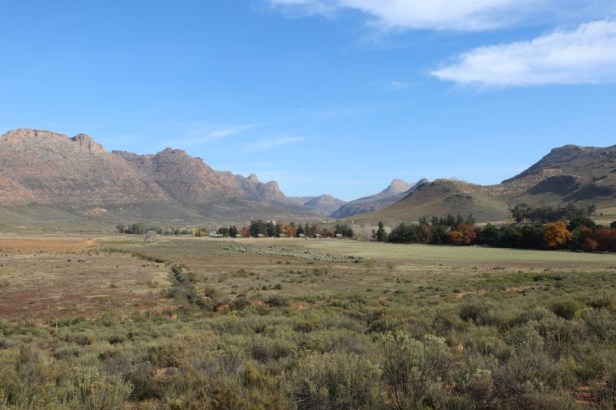
On our way to Truitjieskraal, with a view back to Kromrivier
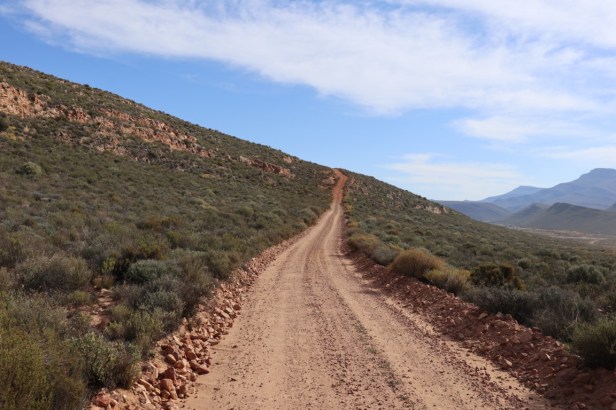
The road to Truitjieskraal
Permit troubles along the way:
However, our visit did not start off well. To enter Truitjieskraal, we had to buy a permit. At Kromrivier we were informed that permits could be obtained at the Truitjieskraal gate, but upon our arrival, the park warden said he could no longer issue any permits because his book was full (it was still early in the morning). He suggested that we drive to the office of CapeNature at Matjiesrivier – a further 8.6km/5.3 miles – to buy permits there – and then return.
We had no other choice but to do this and drove to CapeNature’s office. We offered to take a new permit book to the park warden so that other visitors wouldn’t have to drive the extra distance like we did to buy permits, but the staff said they would send one of their own vehicles later with a new book.
About 45 minutes after we’ve left Kromrivier, we were finally back at the entrance of Truitjieskraal – with our permits in hand – and ready to explore this beautiful place.
Truitjieskraal – the name:
Truitjieskraal is on an old route that was used by cattle farmers until the middle of the twentieth century to move their sheep and goats from winter to summer grazing areas. ‘Truitjie’ is an abbreviation of the girl’s name Gertruida. Historians believe it may have been an overnight stop along the route named after a shepherd’s wife or loved one.
What makes Truitjieskraal so special?
If you like rock climbing, then Truitjieskraal is the perfect place with a range of grades from easy to difficult on vertical to overhanging rocks. And although we saw a few brave rock climbers during our visit, we were more interested in the wonderful rock formations and Bushmen (San) rock paintings from an ancient time when elephants still roamed freely through the Cederberg.
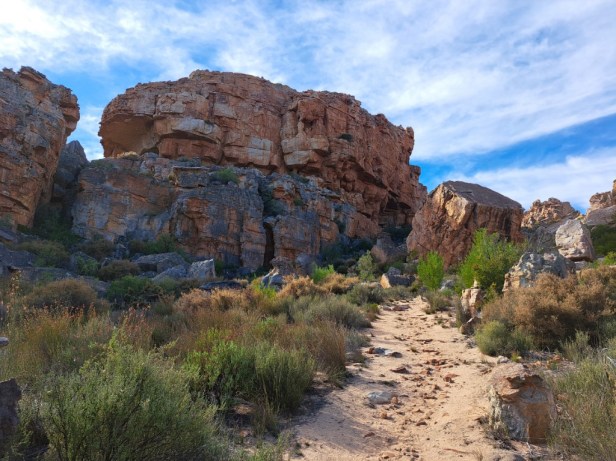
Walking path at Truitjieskraal
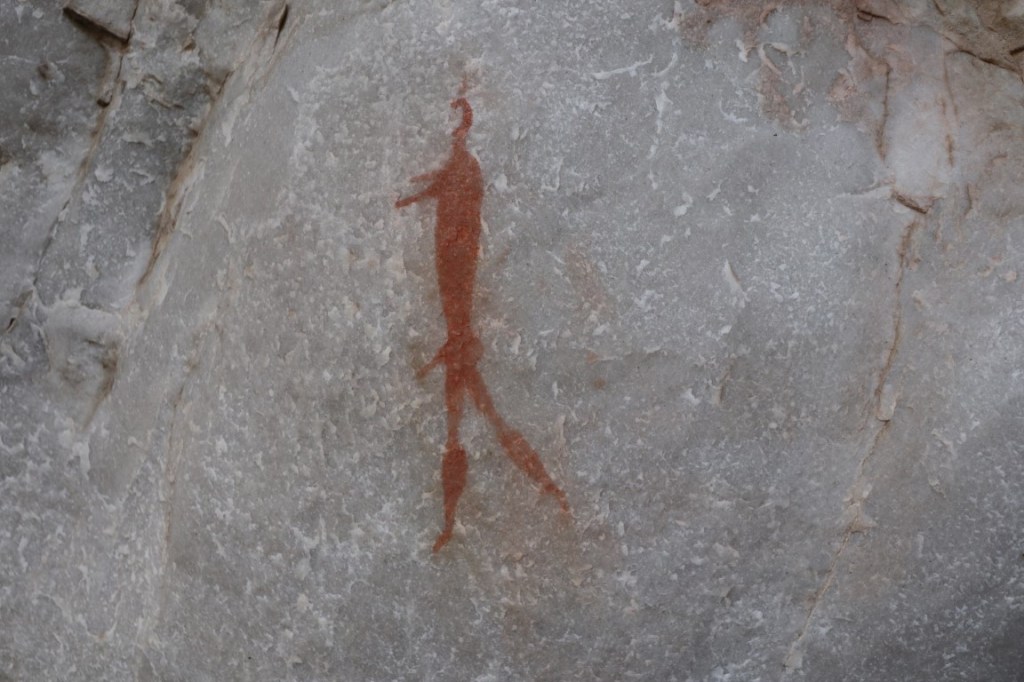
It was quite amazing to think that we were walking in the footsteps of ancient hunter gatherers. There are interpretive signs along the trail and we first walked up to a selection of San and Khoekhoe (pronounced ‘Kwekwe’) rock paintings.

Finding our way to the rock paintings
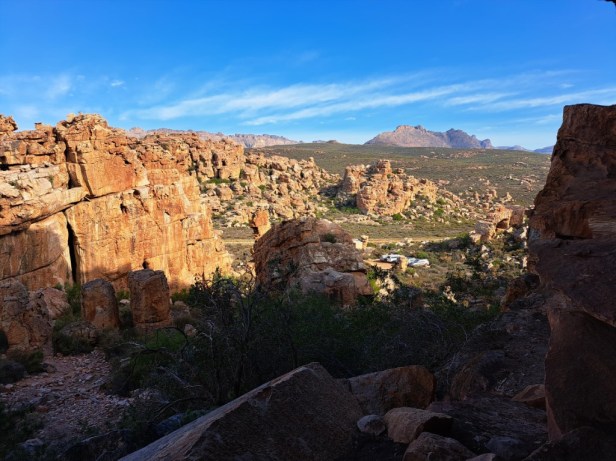
View back to the parking area from the cave with rock paintings

Stunning rock formations
It is believed that the San people were the direct descendants of the first true human inhabitants in Southern Africa, more than 150,000 years ago. Some of these rock art sites are believed to be between 250 to as old as 8,000 years.
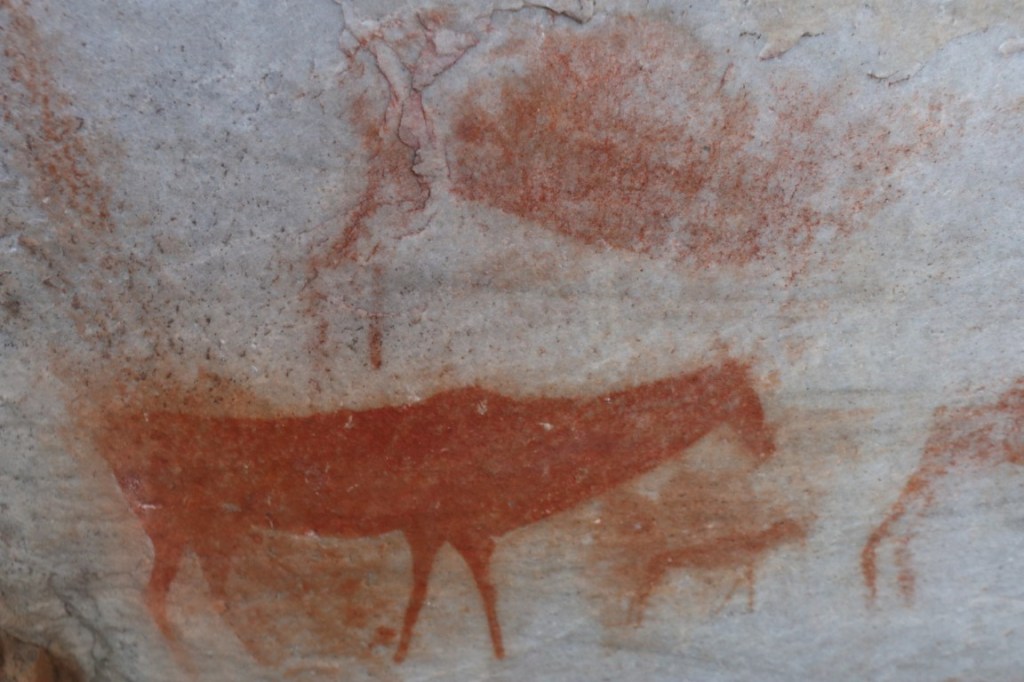

Rock paintings
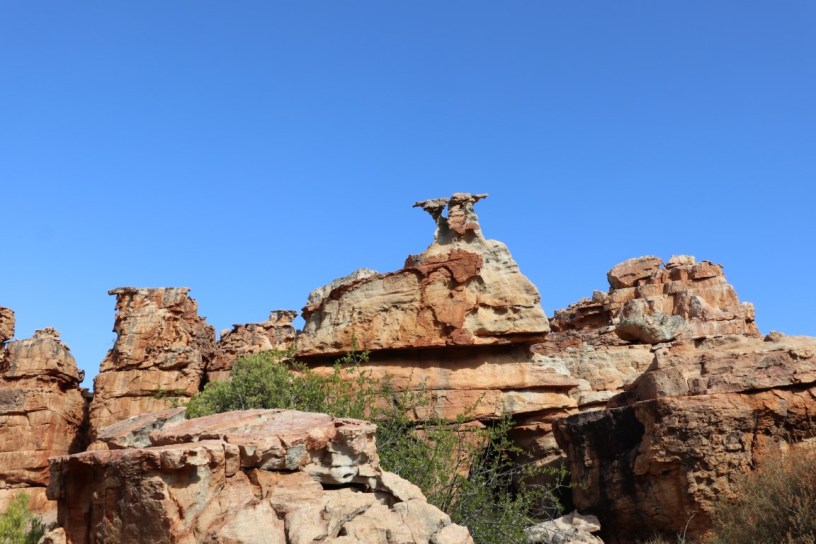
The hiking trail takes you through breathtaking rock formations that are characteristic of the Cederberg Mountains. The area at Truitjieskraal is primarily composed of sandstone sculpted by years of erosion and geological processes, resulting in distinctive shapes and structures.
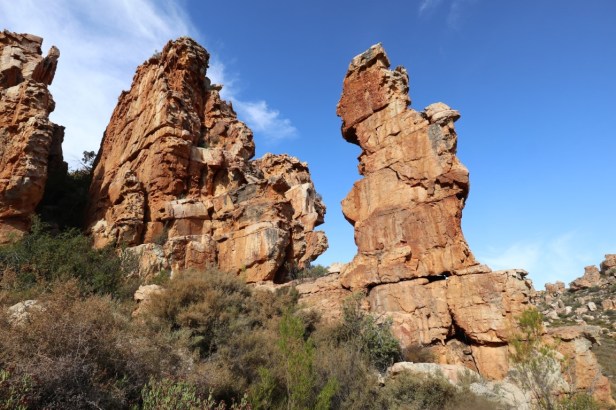
Rock formations
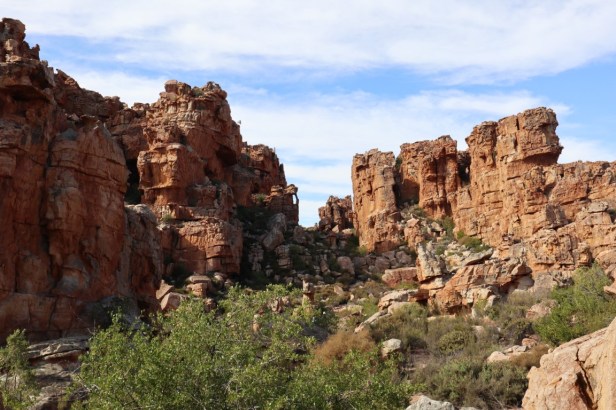
Truitjieskraal
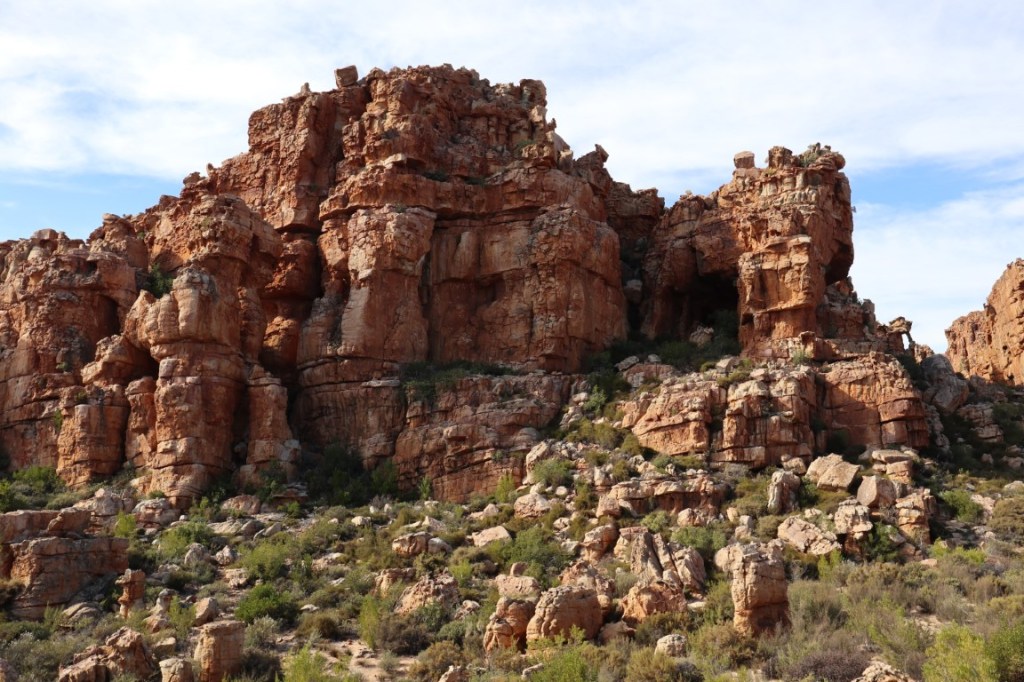

Rock formations
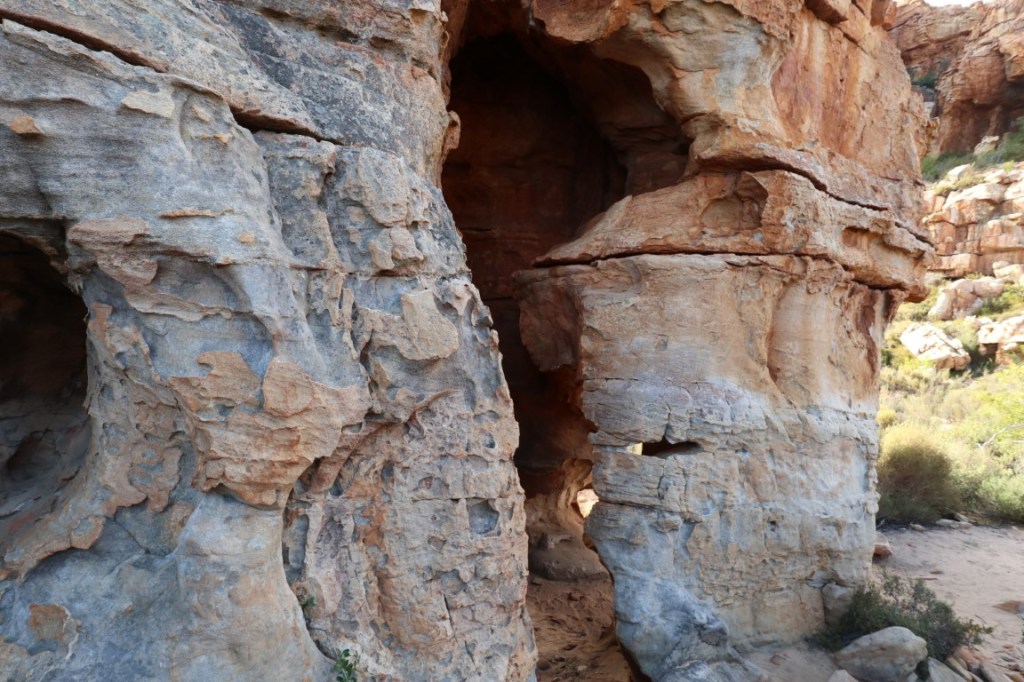
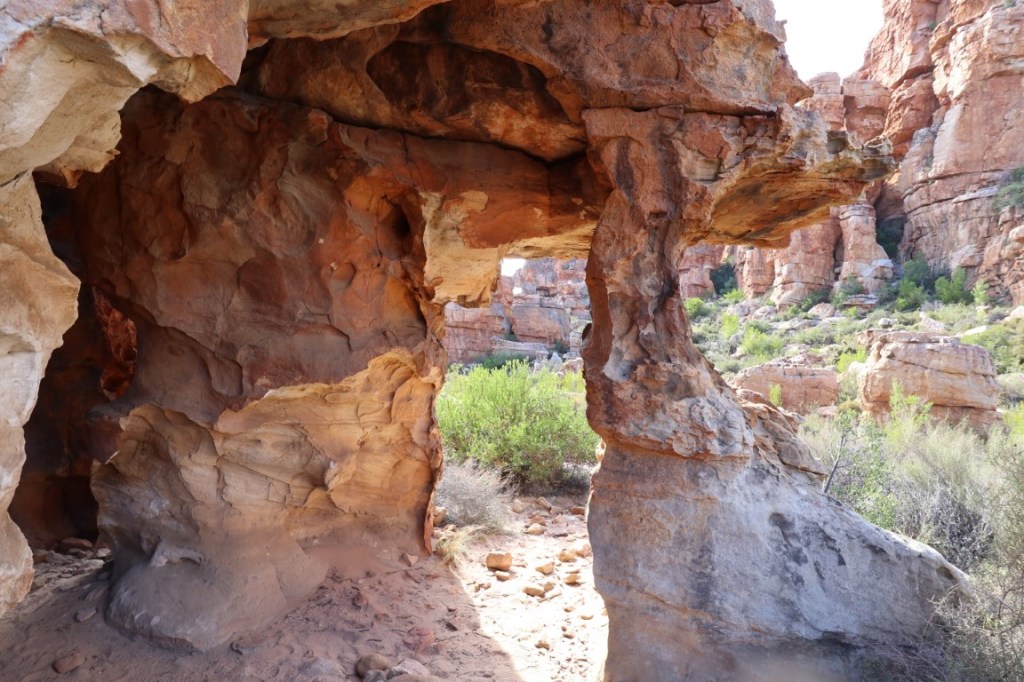
Closer look at the rock formations
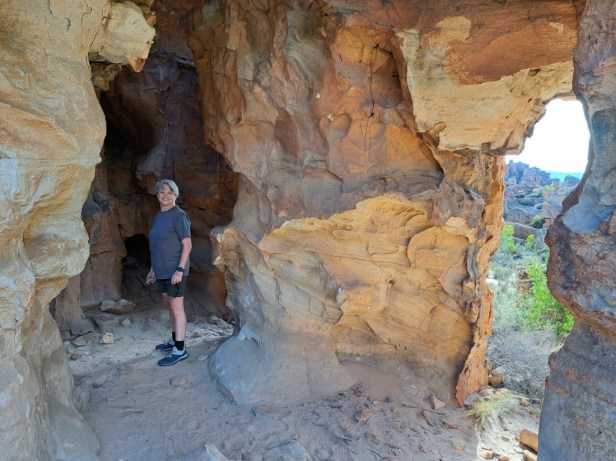
Our friend, Fiela inside the rock formations
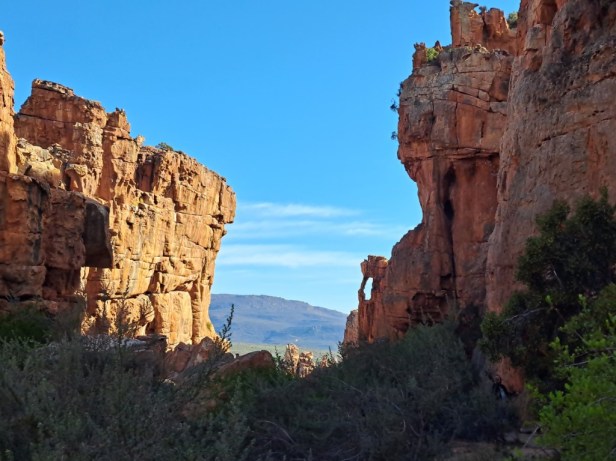
Rock formations against the blue sky
The sandstone exhibits a range of hues from deep reds and oranges to lighter shades of beige and grey. These colours were influenced by iron oxide.
In the folds and fractures of the rock, you might spot the silhouette of a handle of a motorbike, maybe a sleeping giant or a ball of wool. But I will leave it entirely up to you to decide what these rocks may represent.
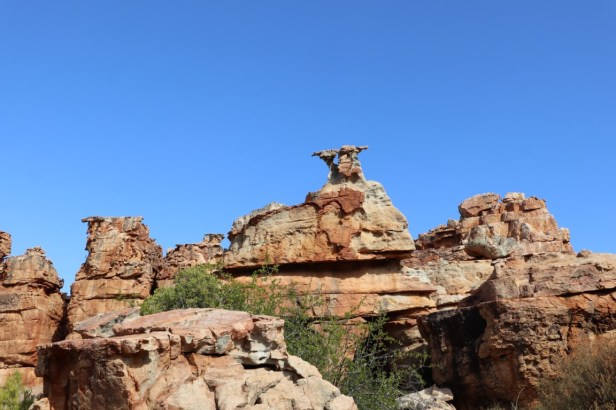
Motorbike handles
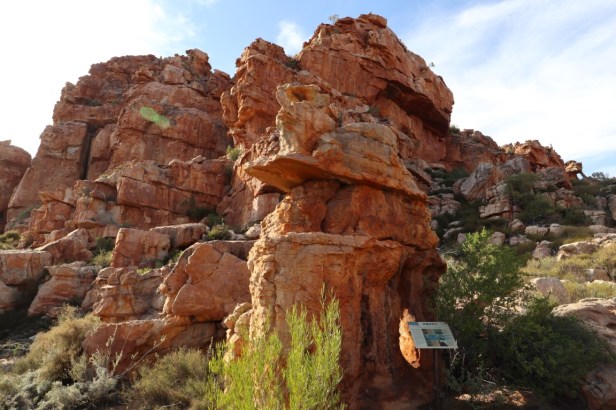
Layers of rock
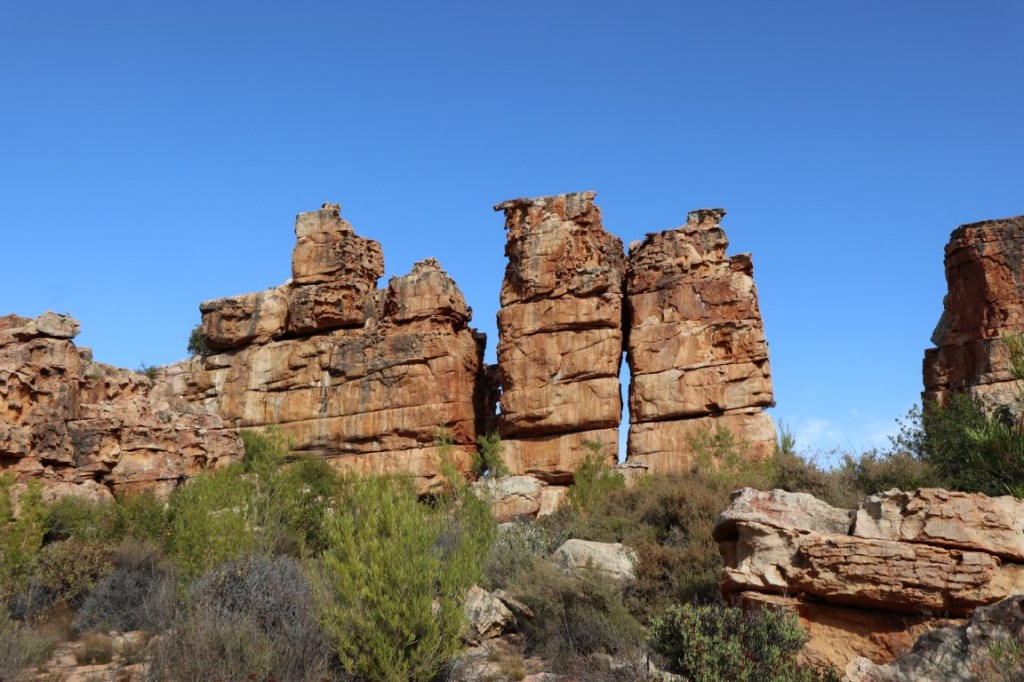
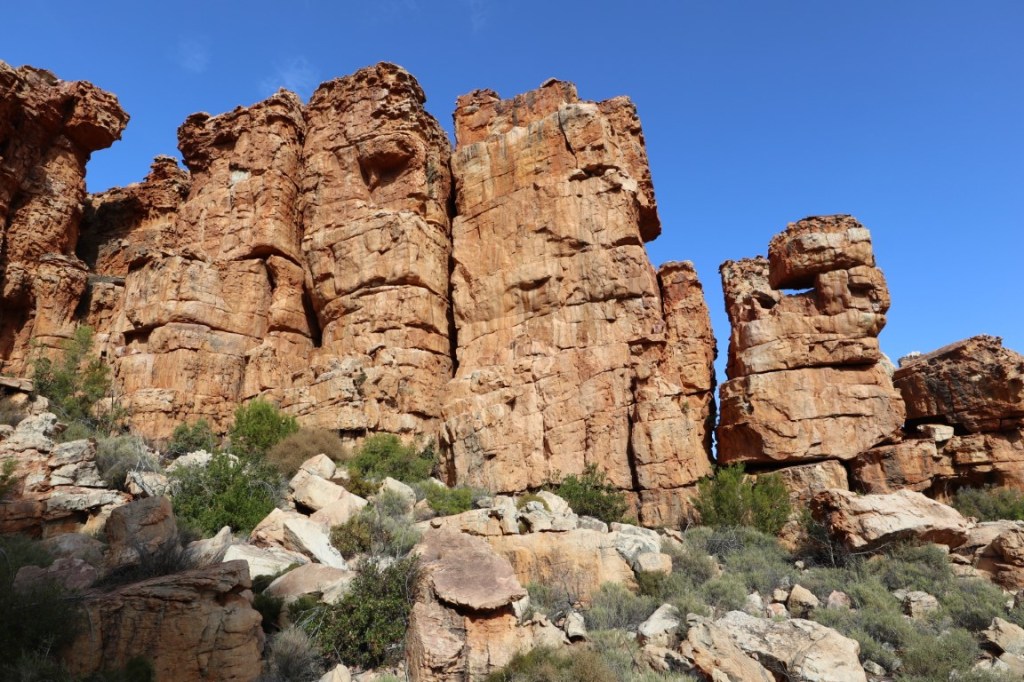
Rocks that are ideal for rock climbers
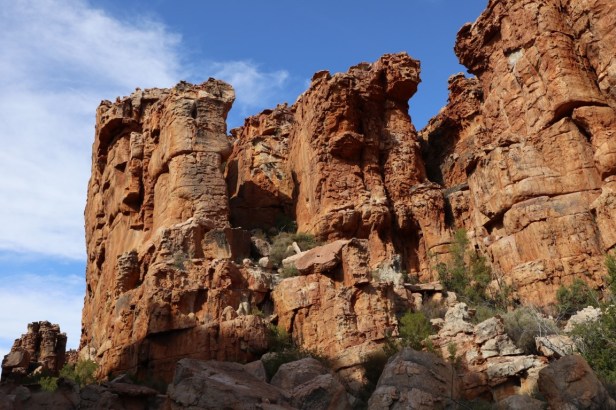
There’s a face somewhere
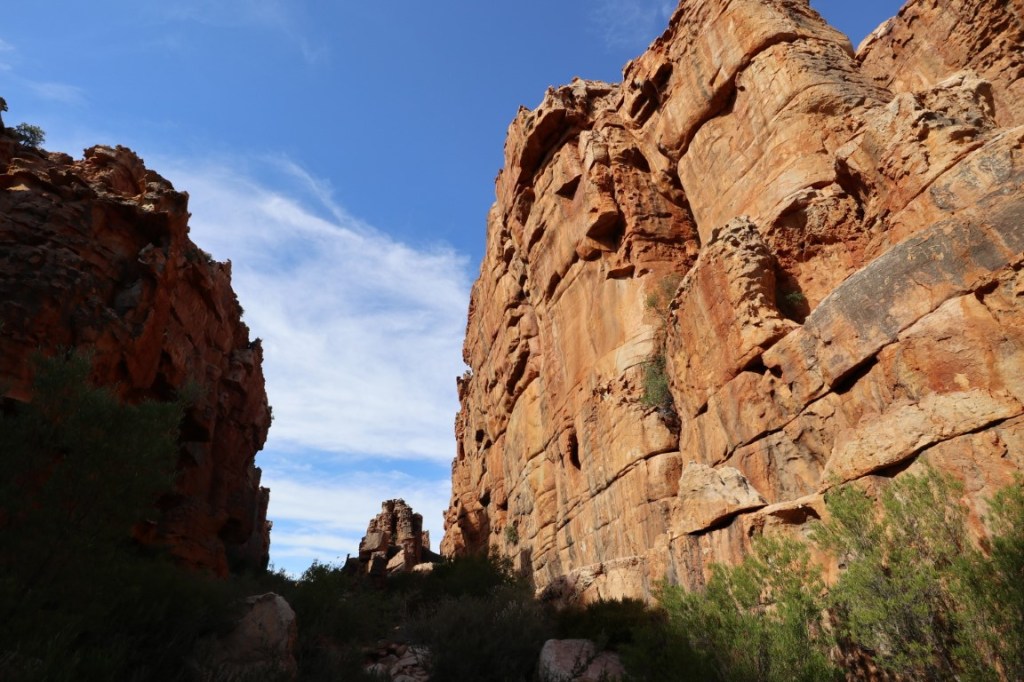

Towering rocks
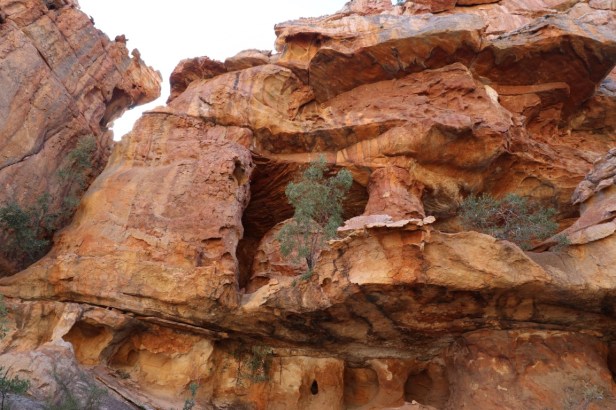
Trees growing out of the rocks

Narrow space between two towering rocks
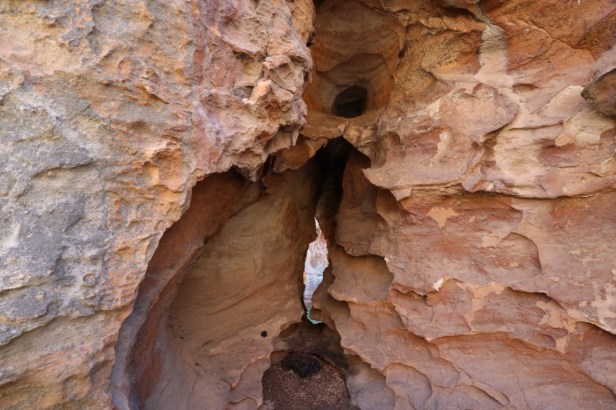
Face of a sleeping giant
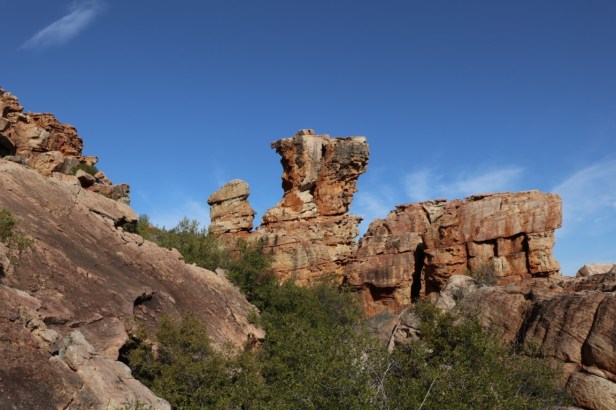
Two faces looking to the right (with prominent noses)
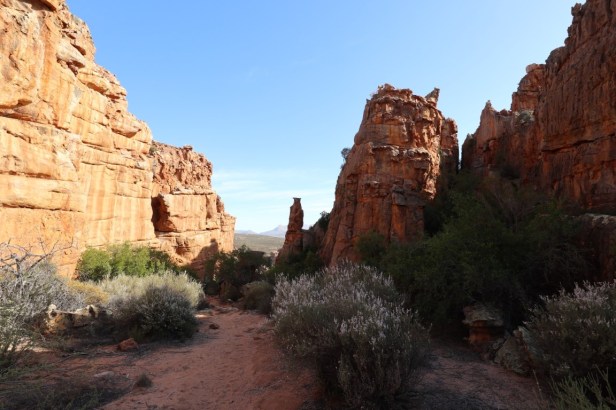
Walking trail between the rocks
When one observes the rocks up close, it sometimes looks like they are assembled with building blocks – almost like Lego. And don’t forget to look down at the path as well, because all sorts of plants and delicate flowers are growing here.
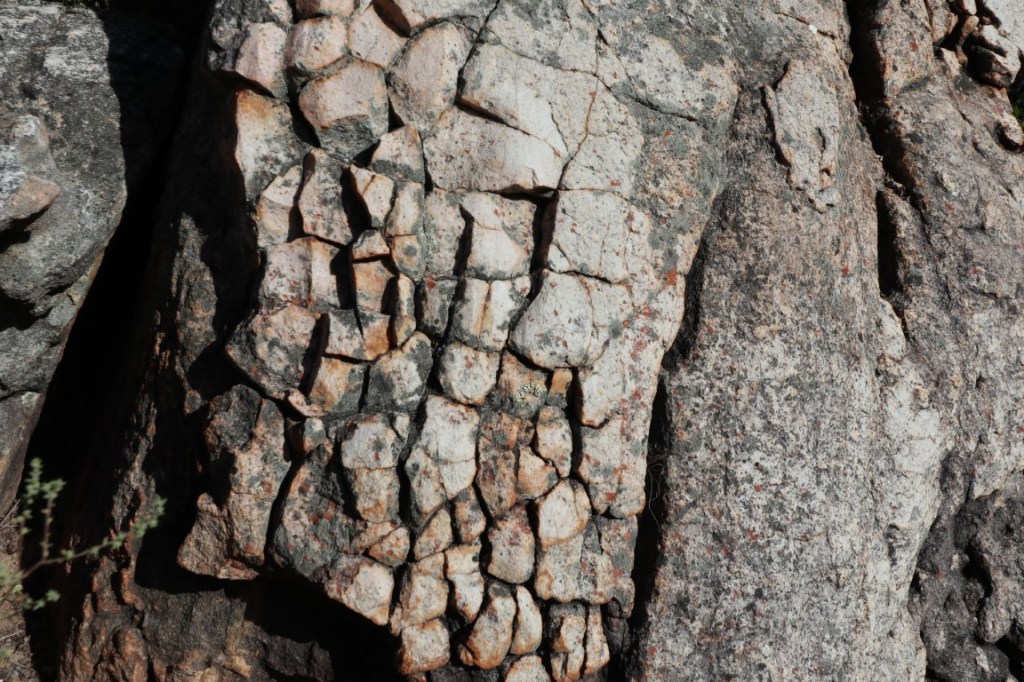
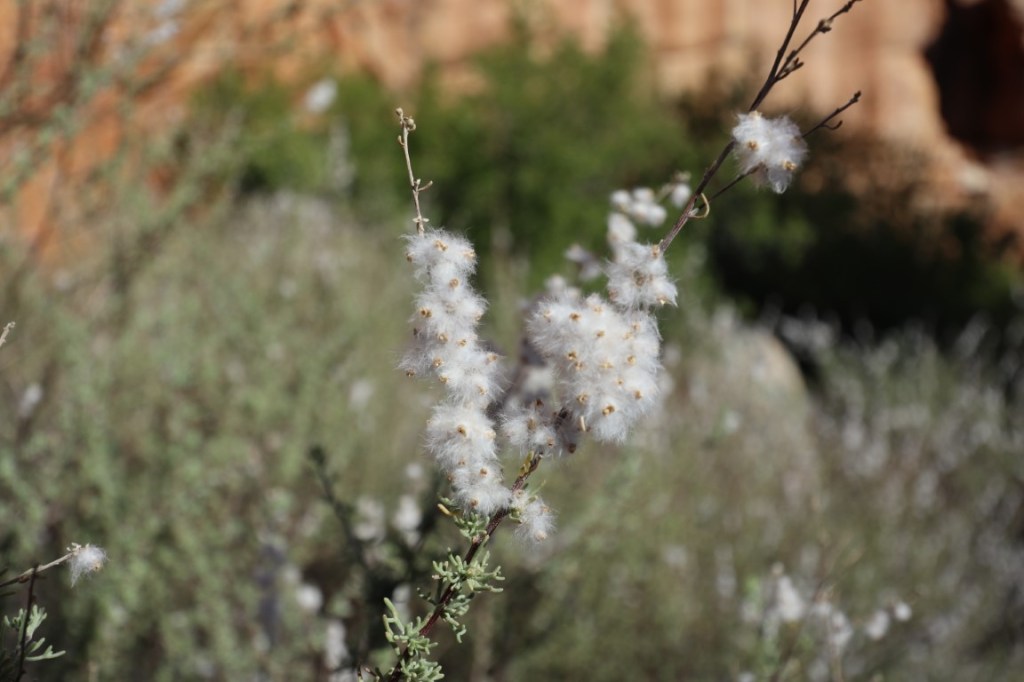
Close up of rock and featherly flowers
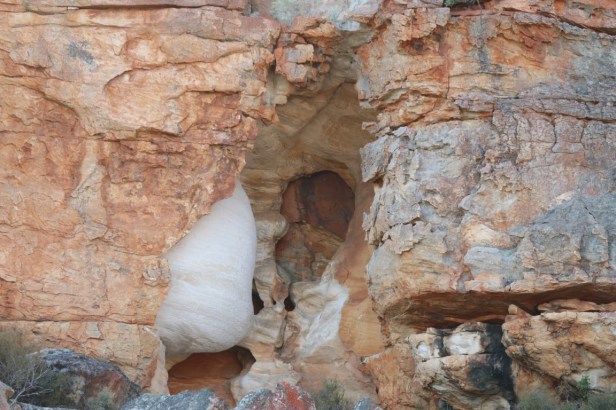
Looks like a ball of wool inside the rock (or maybe an ice cream)
After we walked through the rock formations, we saw a large group of ‘dassies’ (rock hyrax) basking on the rocks in the sun.
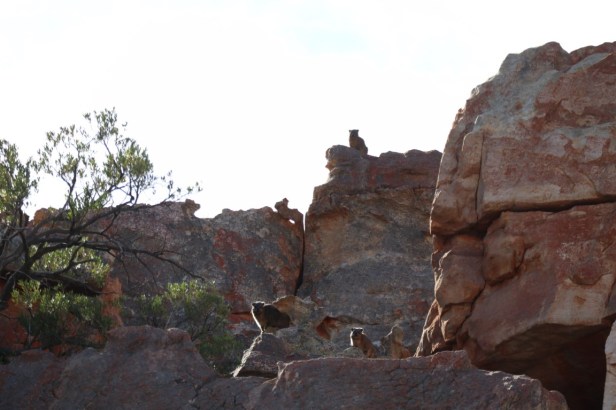
‘Dassies’ enjoying the sun
It was a beautiful morning stroll among these exceptional rock formations. On the way back to our camp at Kromrivier, we stopped to look at the wildflowers along the road. The Cederberg Mountains host numerous endemic plant species (especially fynbos). As I’ve mentioned many times before, it is always a highlight to see the beautiful Protea (our country’s national flower) in nature.
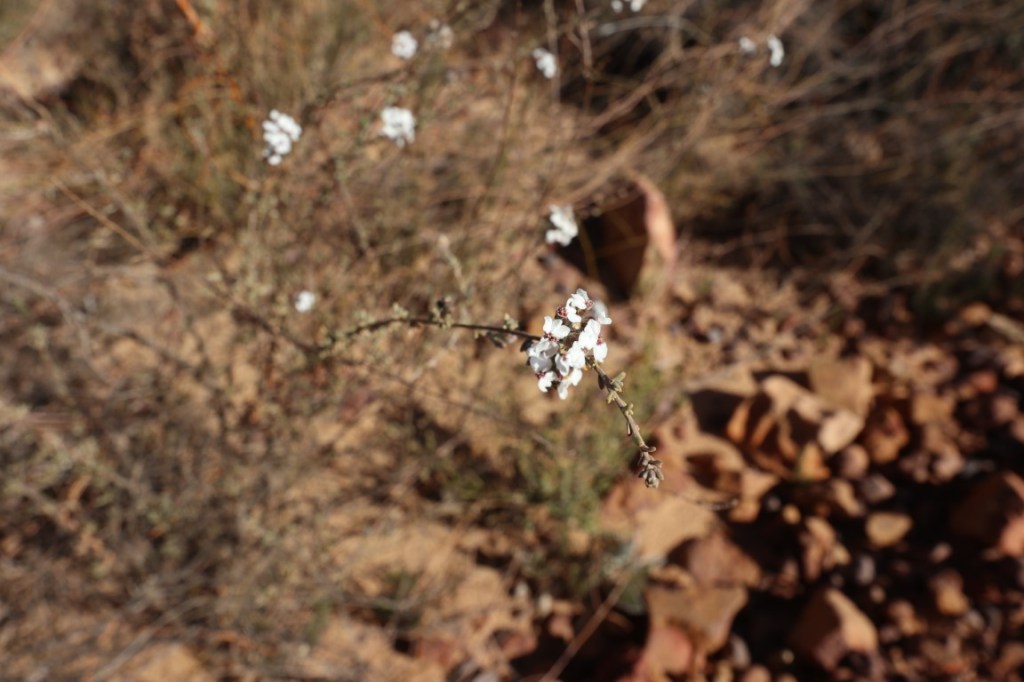
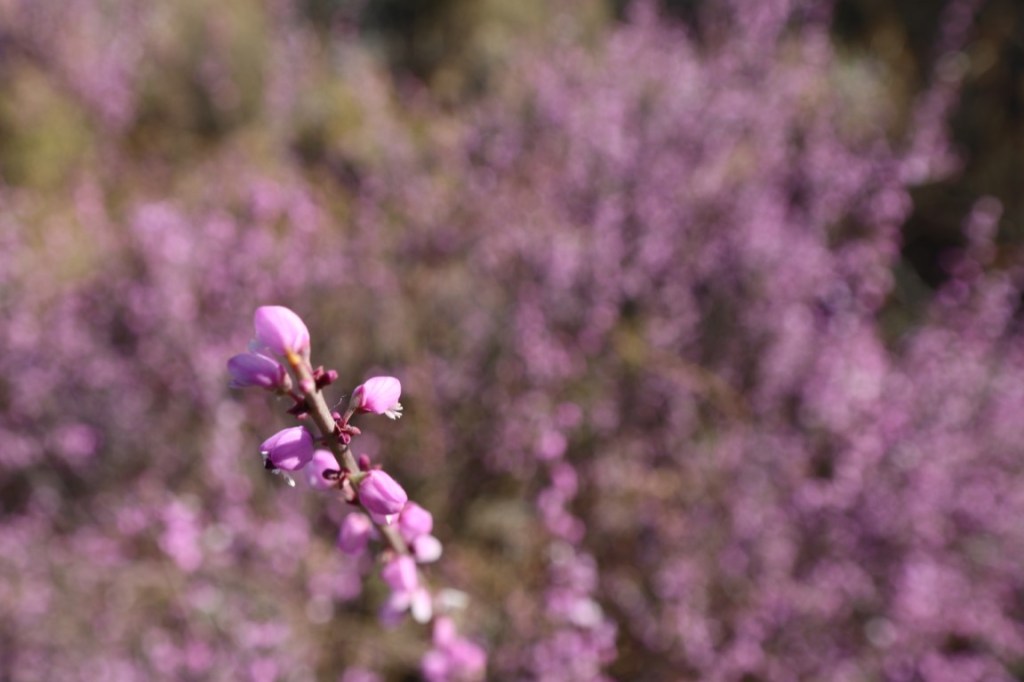
Tiny flowers in the field
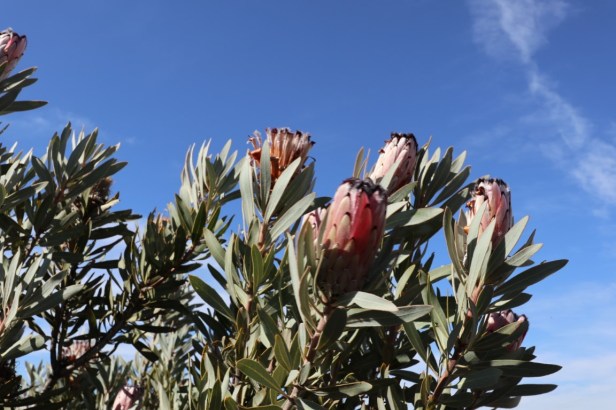
Protea bush


Such a unique flower
We enjoyed our visit to Truitjieskraal. The Cederberg Mountains are incredibly beautiful and I’m glad we could show it to you (again).
 Wet and Dusty Roads
Beautiful place and amazing history!
LikeLiked by 1 person
You’re right Angela, there is so much history at Truitjieskraal and it was great to be able to walk around at this amazing place. And it’s true – it’s really beautiful. The rocks that change colour as the sun’s rays move over them, were lovely to see.
LikeLiked by 1 person
What fabulous rock features, it does look like a great climbing venue. And finding rock art makes it even better! Crazy about the permit problem though. They don’t sound very organized. Maggie
LikeLiked by 1 person
Yes, that’s rock climbing paradise! But it was also wonderful to just walk around among all these wonderful rocks. What I didn’t mention in the post was that it was a long weekend with more visitors than usual – so I was very surprised that CapeNature was not prepared with enough books/permits. We saw a few cars that had to turn around at the gate (and I also don’t know if a new book was ever delivered). Any way … 🙈
LikeLiked by 1 person
The rock formations are all so interesting and unique! They remind me of the ones we saw in Utah. Great post and photos, Corns!
LikeLiked by 1 person
I’m glad you mention that the rock formations look a lot like those in Utah (because I have also seen the resemblance), but coming from you who visited Utah, it’s just more credible 😉. Thank you Tricia, I’m glad you enjoyed our post.
LikeLiked by 1 person
Indeed, a rock-climber’s paradise! Those formations are wonderful and the rock paintings very interesting. We don’t have protea here, of course, but it is a gorgeous flower. Thank you for posting your great pictures.
LikeLiked by 1 person
As someone who has a fear of heights, I have great respect for rock climbers. It was enough for me to just look at the incredible rock formations. Yes, the protea is one of a kind and for me the most beautiful flower in nature. Thank you for walking with us through Truitjieskraal, Carolyn.
LikeLike
Ah, thanks for this post. When I did the camping tour of southern Africa we were supposed to go to the Cederberg Mountains and the rock paintings which I would have loved. Instead that was replaced by the Orange River canoe trip which I didn’t like. We did see other rock paintings in Namibia and the northern Transvaal, but thank you for showing me what I missed.
LikeLiked by 1 person
I’m glad you enjoyed the post, Jude. If I had to choose between a canoe trip on the Orange River or a hike through the Cederberg Mountains, it would be the latter. There is just a grandeur at these mountains that captivates me every time … although, if you are a water baby (like Berto) and enjoy adventure, then the canoe trip might also have its own charm.
LikeLiked by 1 person
Those rock formations are stunning! And I’m always fascinated by rock art, especially when it’s as old as these.
LikeLiked by 1 person
The combination of the stunning rock formations and ancient rock paintings makes Truitjieskraal a popular place for tourists. It’s quite a big area, and we were lucky that there were not many people on the hiking trail.
LikeLiked by 1 person
A permit book being full sounds like (a) bad planning, and (b) something that should have an easier workaround than sending you on a wild goose chase. But at least you got a permit, so yay! I’m glad you included the pronunciation of Khoekhoe, because I definitely was saying it wrong in my head.
What a great place! I can’t believe the rock art has survived for 8000 years. That’s amazing!
LikeLiked by 1 person
I think you’re absolutely right with your observation of ‘bad planning’ regarding the full permit book. There were quite a few cars lining up at the gate that could not get in when we arrived (for the second time). At least the beautiful rock formations and rock paintings made us forget about that quickly. Don’t feel alone, I also mispronounced Khoekhoe (it’s a language of the Khoikhoi people – related to the Bushman/San people) … and believe me, it’s almost impossible to speak if you don’t know it!
LikeLiked by 1 person
I love all the rock formations. Where we live it’s pretty flat or hilly. When we drove out west I must have taken 50 pictures of rocks because it was new to me. That had to be frustrating driving to get the permit. Did you get a different camera? Your pictures look like they were taken on a professional camera!
LikeLiked by 1 person
I understand what you mean, Diane! When we get to the Cederberg Mountains, I want to take a photo of every rock (much to Berto’s great annoyance) 😁. But at Truitjieskraal, he was the one taking photos of almost every rock formation – so, I rest my case. It was a bit of a hassle with the permit, but luckily we don’t let such things get us down! No, we still use the same camera – it’s probably just the unique rocks that make such beautiful photos (thank you) … and Berto will appreciate your compliment, because he was behind the camera!
LikeLiked by 1 person
What a stunning place. Thanks for sharing.
One wonders why the got issueing permits couldn’t just give you a signed and stamped piece of paper in place of an official form. And he should have ordered a new book before he ran out. Most annoying! 😔
LikeLiked by 1 person
There is just something special about the rock formations in the Cederberg Mountains – and Truitjieskraal is no exception. The issuing of the permits was a hassle, but fortunately, it did not dampen our enthusiasm. But I wish CapeNature would use a different system (I like your suggestion … maybe I should send this to them 😉).
LikeLiked by 1 person
I love those rock paintings and am amazed they are still so clear after all this time! A wonderful sight. Thanks, Mel
LikeLiked by 1 person
There are so many rock paintings in the Cederberg Mountains which we have seen on previous visits, that we almost consider it a fairly common sight. But I must say that these rock paintings at Truitjieskraal are in very good condition – it was surprising to see how clear they were, having been done centuries ago!
LikeLiked by 1 person
You are lucky to have such wonderful history on your doorstep, so to speak. 🙂
LikeLiked by 1 person
Liking the unusual rock formations. Had to give a wry smile to the permit thing, the world is just full of things which make you shake your head in disbelief. Basic things run badly! Still, you managed to enjoy a great stay despite the nonsense start.
LikeLiked by 1 person
The rock formations in the Cederberg Mountains are special, but those at Truitjieskraal were quite surprising. Yes, for me, the issuing of permits is actually such a simple thing, and I’m not entirely sure if our complaints will make a difference … but as you’ve mentioned, we still had a wonderful time.
LikeLiked by 1 person
Even though you were off to a slower start because of the permit issues, it sounds like it was still a memorable day. The rock formations are beautiful. And the rock paintings are fascinating. It’s incredible to hear how old they are and that they are still in such great shape.
LikeLiked by 1 person
It was a great day out in nature (yes, despite the permit issues). I was amazed to read how old some of the rock paintings are – and how well they have been preserved. It was definitely another amazing day in the Cederberg Mountains.
LikeLiked by 1 person
Jou fotos is absoluut pragtig, Corna. So helder! Lees julle voor die tyd ñ area se geskiedenis op? Jy verstom my soos gewoonlik met al jou insig en inligting.🤗
LikeLiked by 1 person
Dankie vir die mooi kompliment Una! Ons lees gewoonlik ‘n bietjie op oor die plekke wat ons gaan besoek – maar nie te veel nie, want ons wil ook verras word 😉. Maar dis lekker om ‘n plek te besoek en dan reeds die geskiedenis so effe te ken (sodoende weet ons as daar iets spesifiek is waarvoor ons moet uitkyk).
LikeLiked by 1 person
The rock formations are absolutely incredible, wow!! It looks like a gorgeous place to hike, and 8000 years old is incredible!!
LikeLiked by 1 person
The rock formations in the Cederberg Mountains are spectacular (with Truitjieskraal being a very good example)! Yes, can you believe – 800 years old? And that the rock paintings are still so clear, that was absolutely mind-blowing.
LikeLike
Thanks for sharing such a nice post!
Greetings from Greece.
LikeLiked by 1 person
And thank you for dropping in – the rock formations in the Cederberg Mountains are pretty special!
LikeLiked by 1 person
Incredible photos! It’s amazing what can be spotted in these kinds of formations, it is a bit like looking at clouds. Also, I love the ancient artwork.
LikeLiked by 1 person
Thanks a lot, I’m glad you enjoyed the rock formations and rock art of Truitjieskraal. Oh yes, I completely agree … rock formations and clouds are definitely in the same category. As a young girl, I could lay on my back on the grass for hours and watched the clouds drifting by – I could write a whole storybook about that 😊!
LikeLiked by 1 person
Beautiful rock formations.
LikeLiked by 1 person
The Cederberg Mountains is known for incredible rock formations – it’s a wonderful place to visit when you want to be among stunning mountains!
LikeLiked by 1 person
With those fabulous rock paintings and amazing rock formations this looks like a wonderful place to hike. Cheers
LikeLiked by 1 person
You are right, Mark, the Cederberg Mountains are a hiker’s paradise! We have done quite a few hikes here and each one has been exceptional.
LikeLike