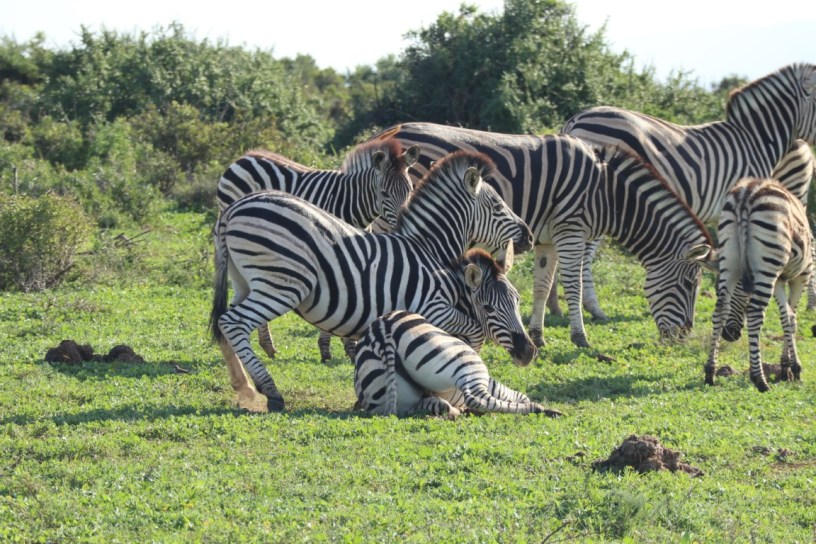
June 2024
After our overview post of the Addo Elephant National Park (read here) and our elephant album of last week (read here), it’s now time to show you all the other wild animals we saw in this park during our visit.
Big wild animals:
Although the park is home to more than 700 elephants, there are also a variety of antelope species, Cape buffalo, lions, leopards and spotted hyenas. The endangered south-western black rhinoceros is also found here.
Small wild animals:
The smaller wild animals eluded us – such as foxes, jackals, honey badgers, vervet monkeys and porcupines. The warthogs made up for this though – we saw them quite a few times each day on our drives through the park.
We did hear jackals at night and on one of our drives through the park we heard the roar of lions near the road, but we could not spot them between the bushes and trees.
First day sightings:
It’s a fact that warthogs might not win a beauty pageant, but they entertained us with their flat faces that were often covered in mud as they dug in the ground for roots or when they run away with their upright tails.
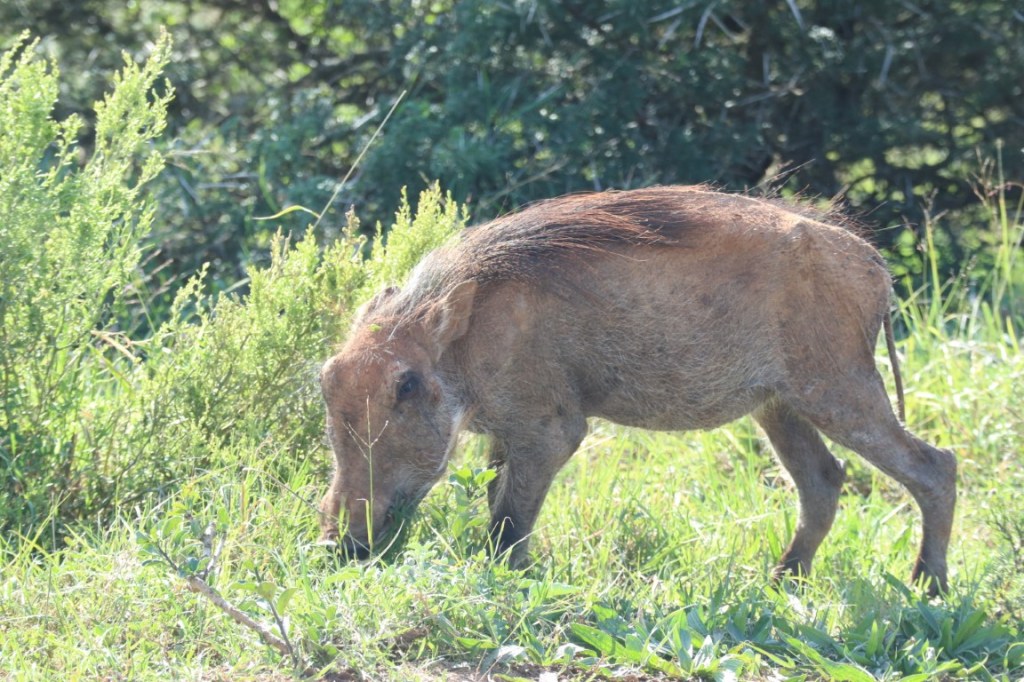
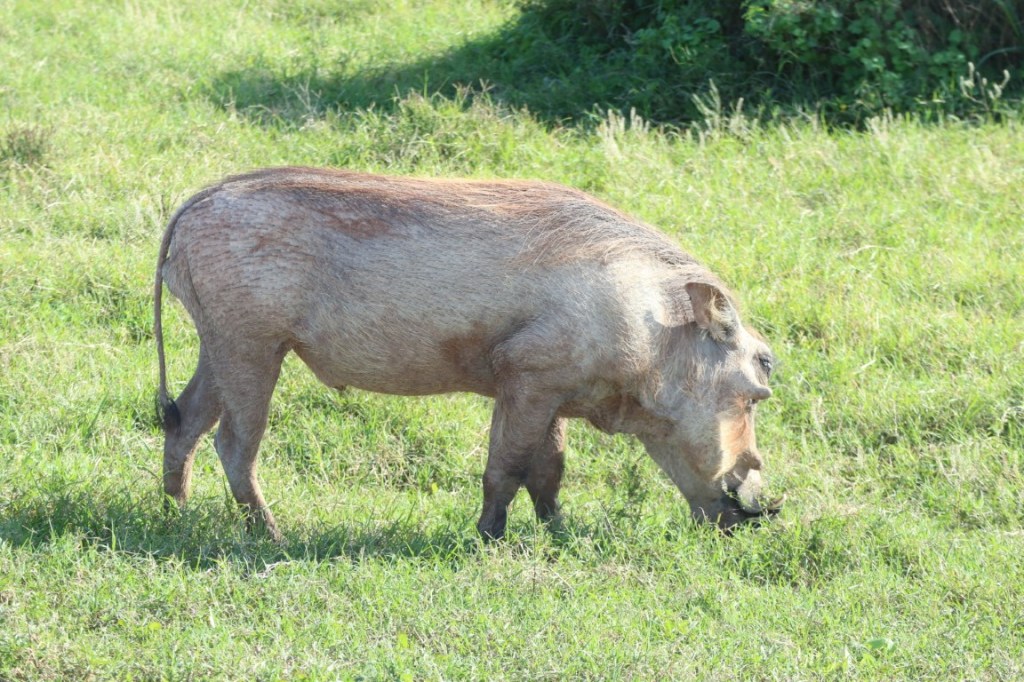
The entertaining warthog
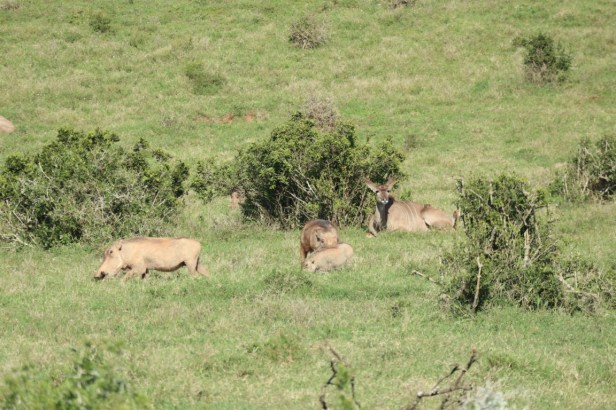
Warthogs (and a kudu cow on the right)
Speaking of kudus, we often saw them grazing together with warthogs. Kudus are one of the largest antelopes. The male kudu has long spiral horns which they use mainly for defense against predators and also in fighting during breeding season.
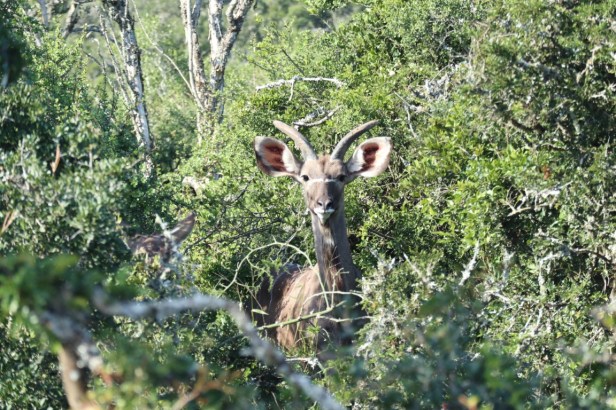
Young kudu bull
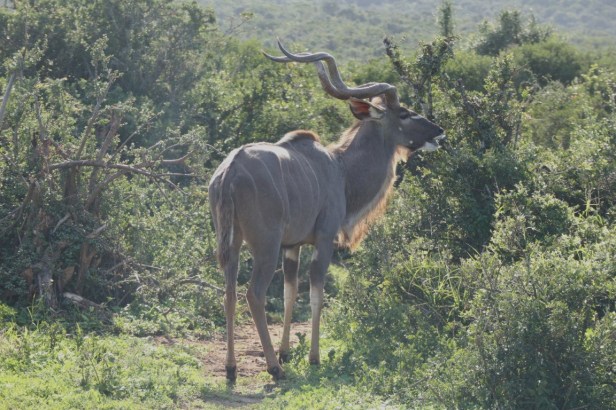
The characteristic spiral horns of a kudu
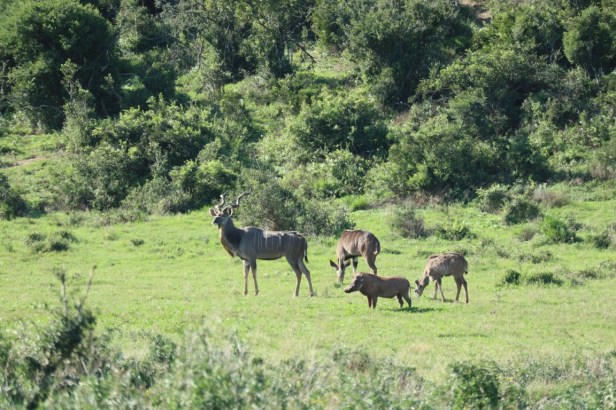
Kudu family accompanied by a warthog
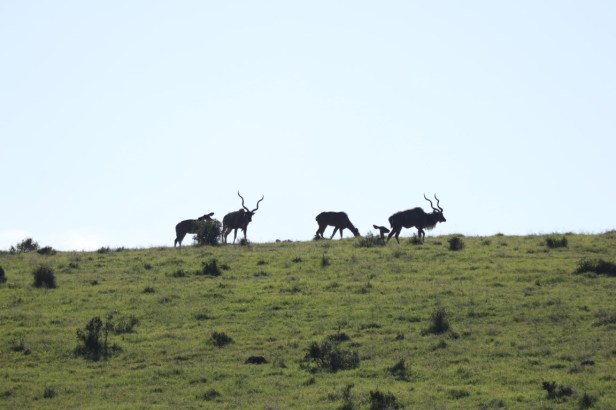
Kudus on a hill
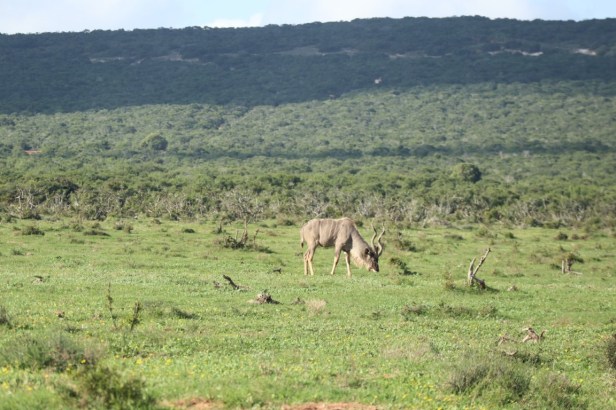
A lone male kudu
The Burchell’s Zebra is another common sight in the Addo Elephant National Park. It is easy to confuse the Burchell’s and Mountain Zebra. However, the difference between the two species lies in their stripes – the stripes on the legs (pale stripes in Burchell’s Zebra vs. bright stripes on the Mountain Zebra) and the belly of the Mountain Zebra is completely white without stripes.
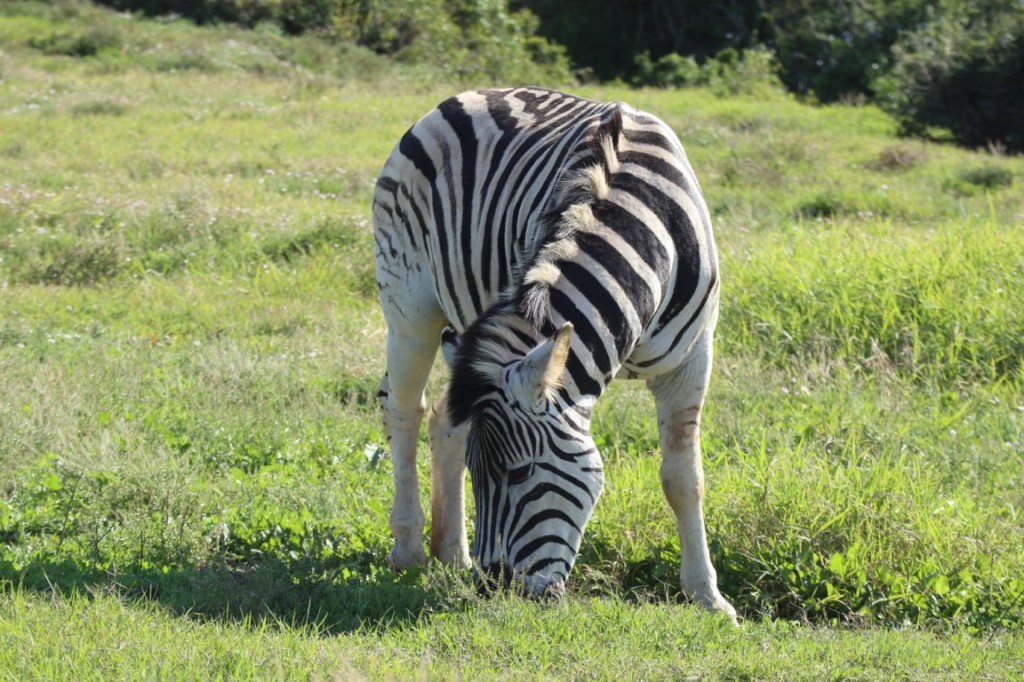
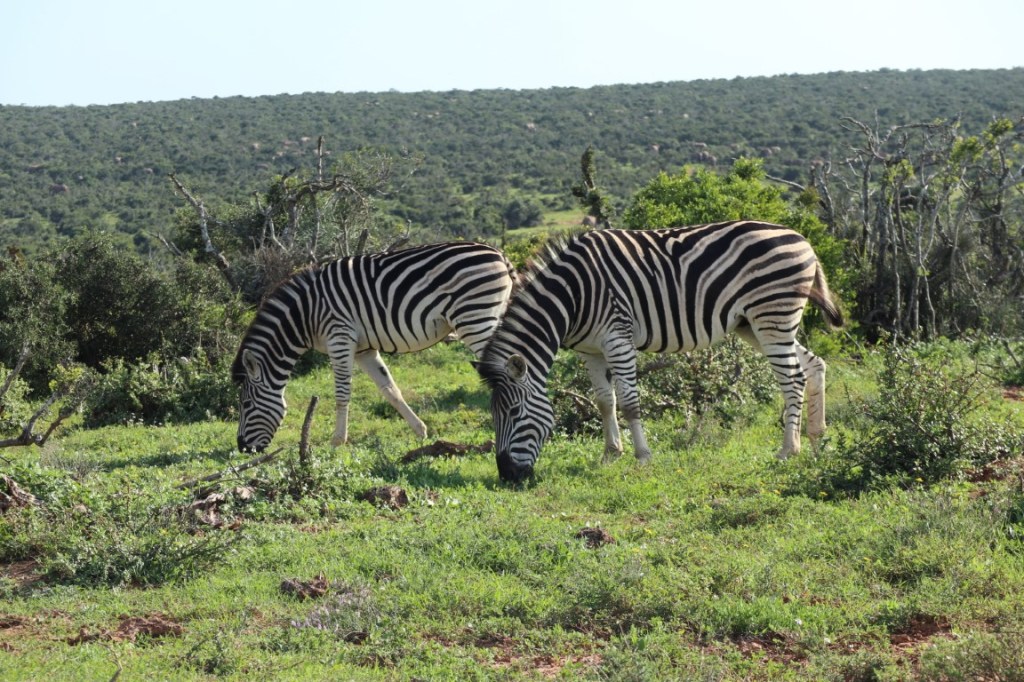
Burchell’s Zebra
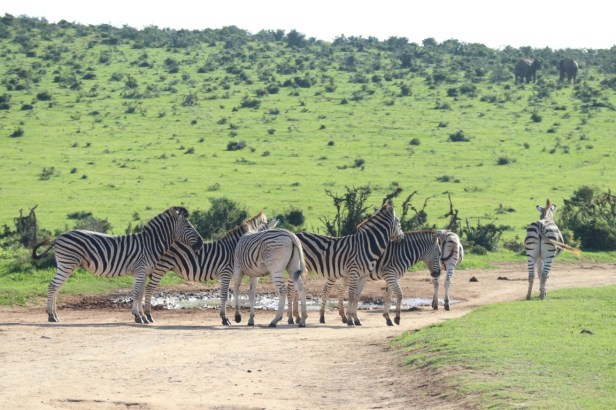
Herd of zebras at one of the water holes
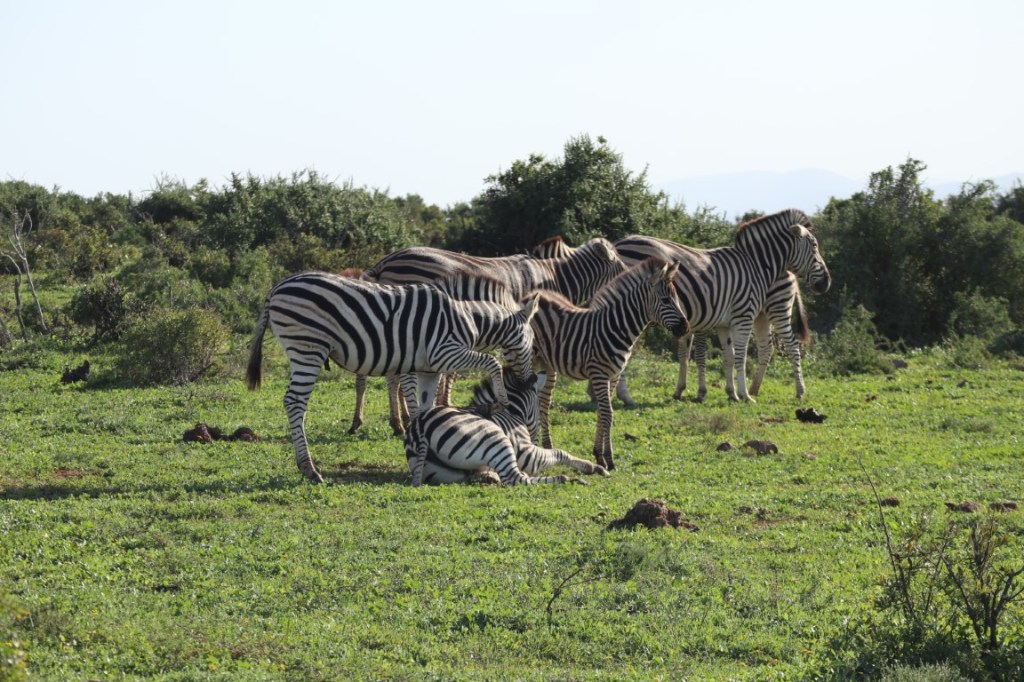
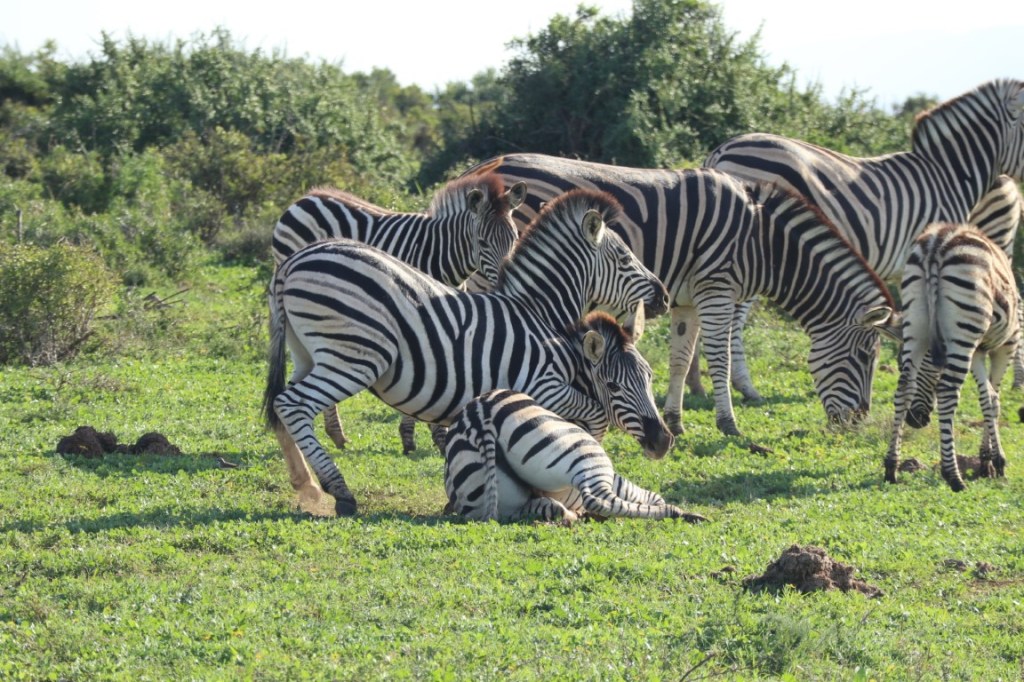
Playful young zebras

Zebra foal
We ended our first day’s sighting of wild animals with a sleeping warthog on the side of the road. It’s the first time they haven’t run away – maybe this one was a bit lazy after digging for roots all day.
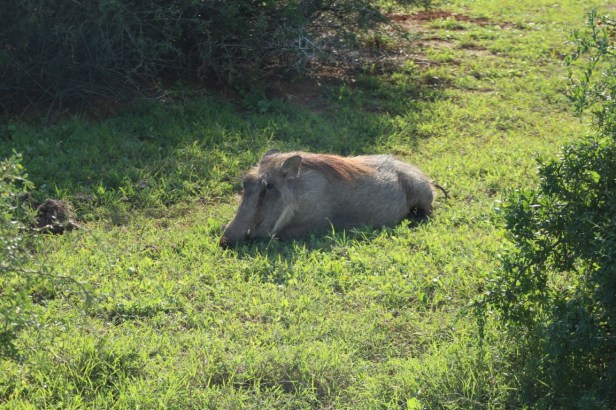
Sleeping warthog
Second day sightings:
If there’s one animal we didn’t think we’d see, it’s the endangered black rhino. But on our second early morning drive in misty weather, we saw an animal in the distance (which we thought was an elephant at first), but as we got closer we found out to our delight that it was a rhino. There were game rangers in a jeep not far from the rhino and they seemed to be checking the fences. It’s sad to think that this beautiful animal has to be protected from humans.
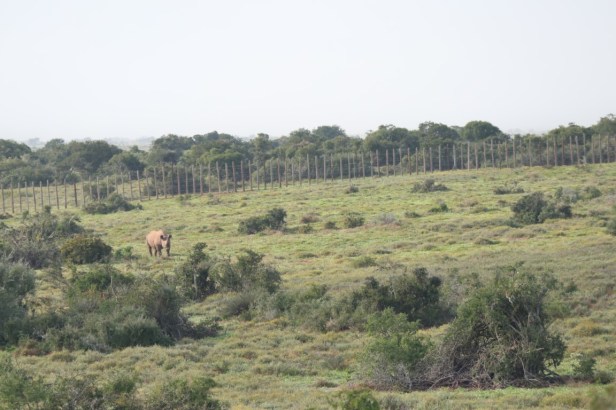
Endangered black rhino
We saw the Cape buffalo up close at Thali Thali Game Lodge near Langebaan in December last year (read here) and have great respect for these strong animals. The buffalo’s only true predators are lions and humans, meaning it has very little competition.

Cape buffalo
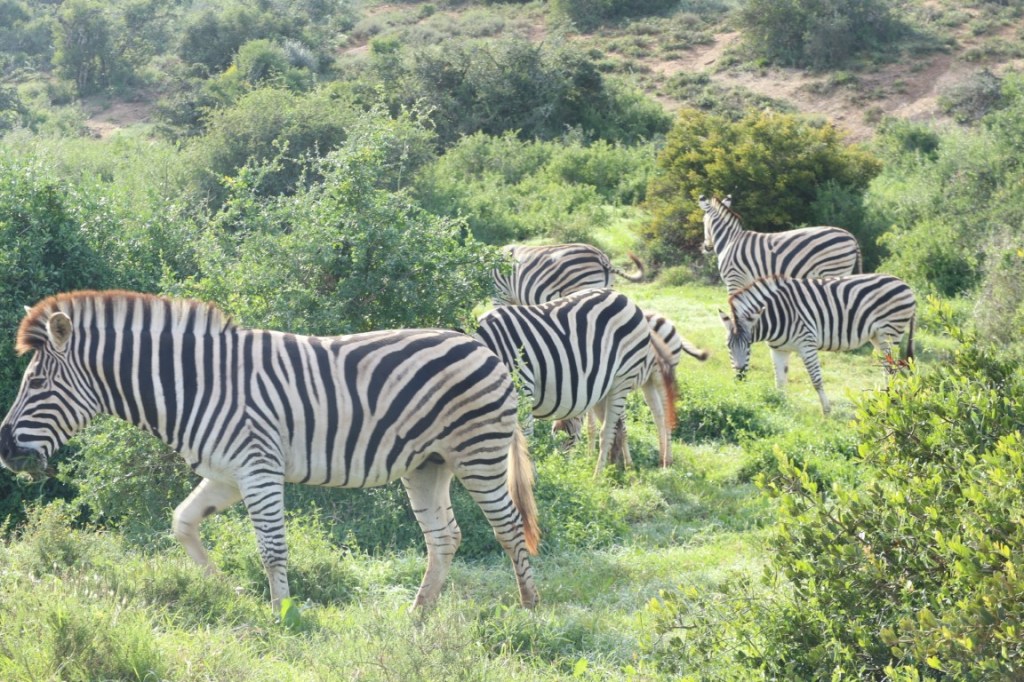
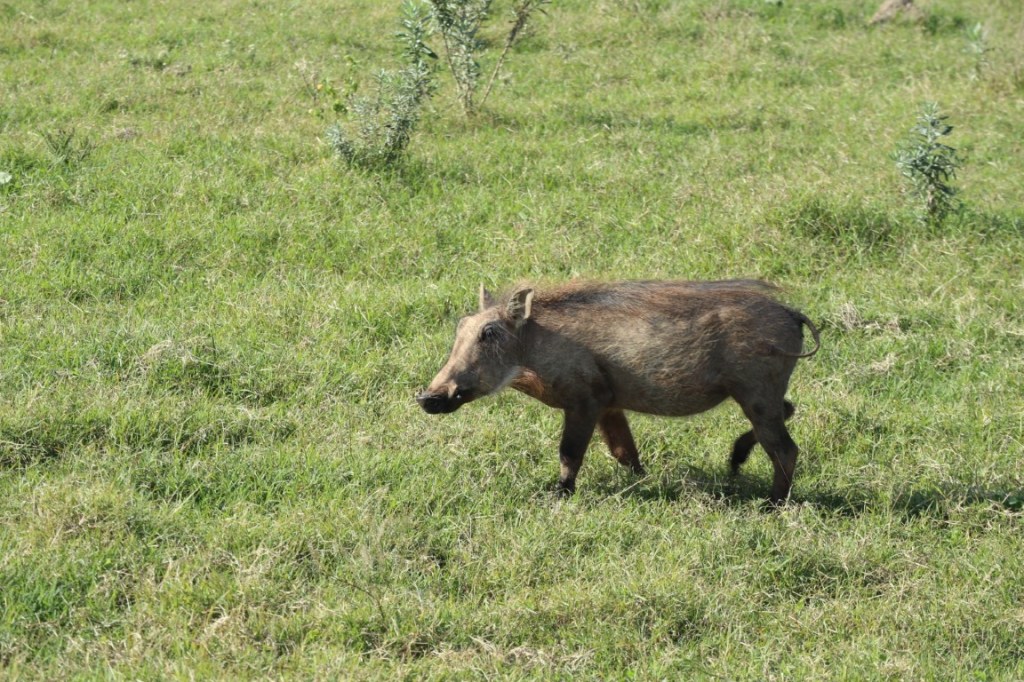
Old friends again – zebras and a warthog
It’s always great to see ostriches. Although this large bird cannot fly, they are considered the fastest running birds in the world.
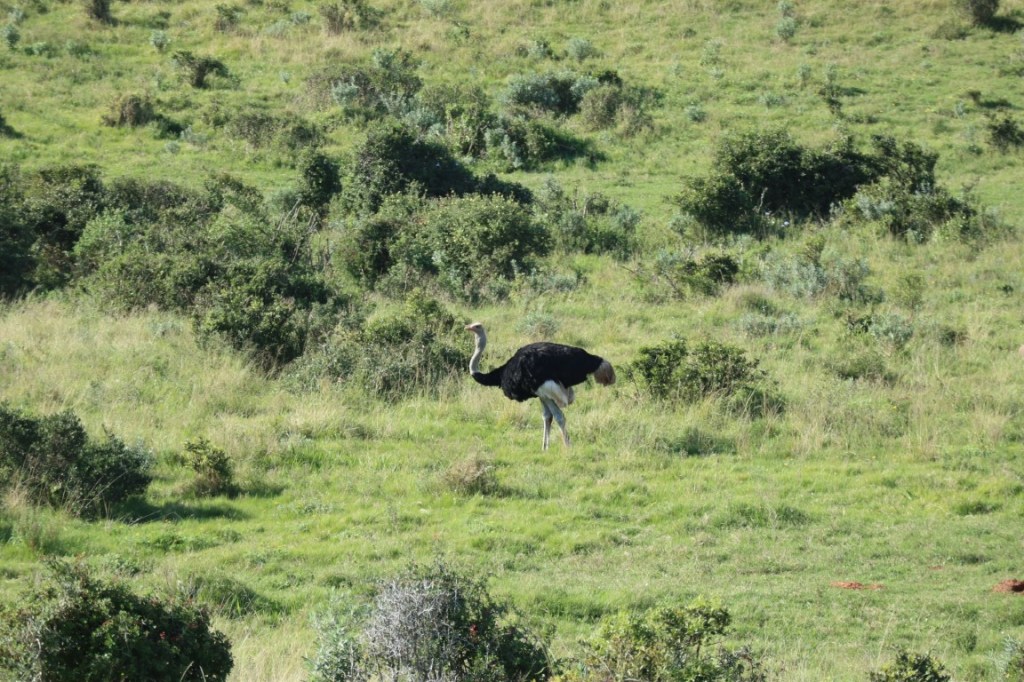
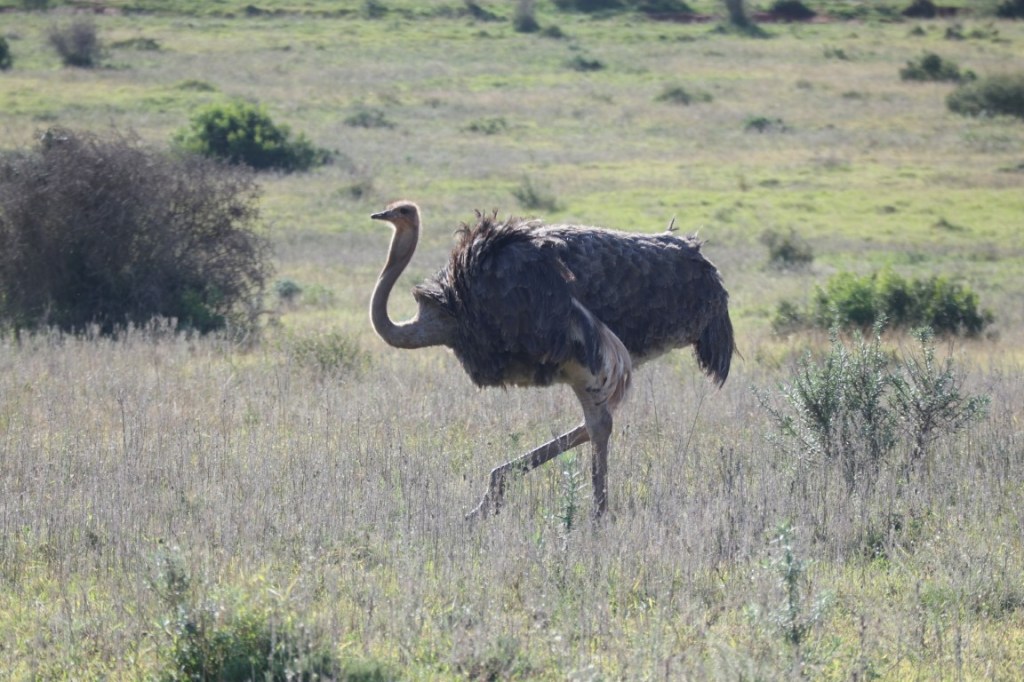
Ostriches
Another antelope that we saw often, apart from kudus, was the red hartebeest. I mentioned in a previous post that these antelopes can reach speeds of up to 65km/h. Fortunately, for us, they were very patient to pose for photos and we were happy to take many photos of them.
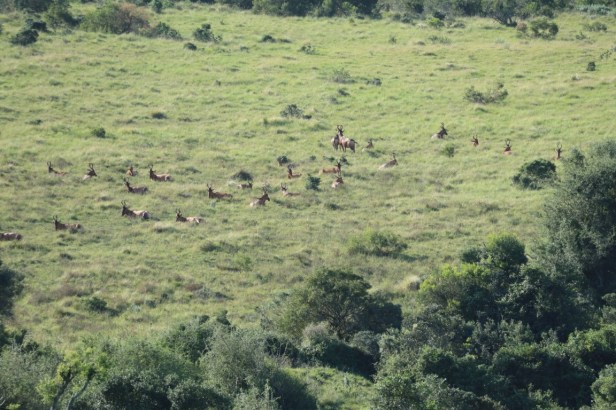
Big herd of red hartebeest
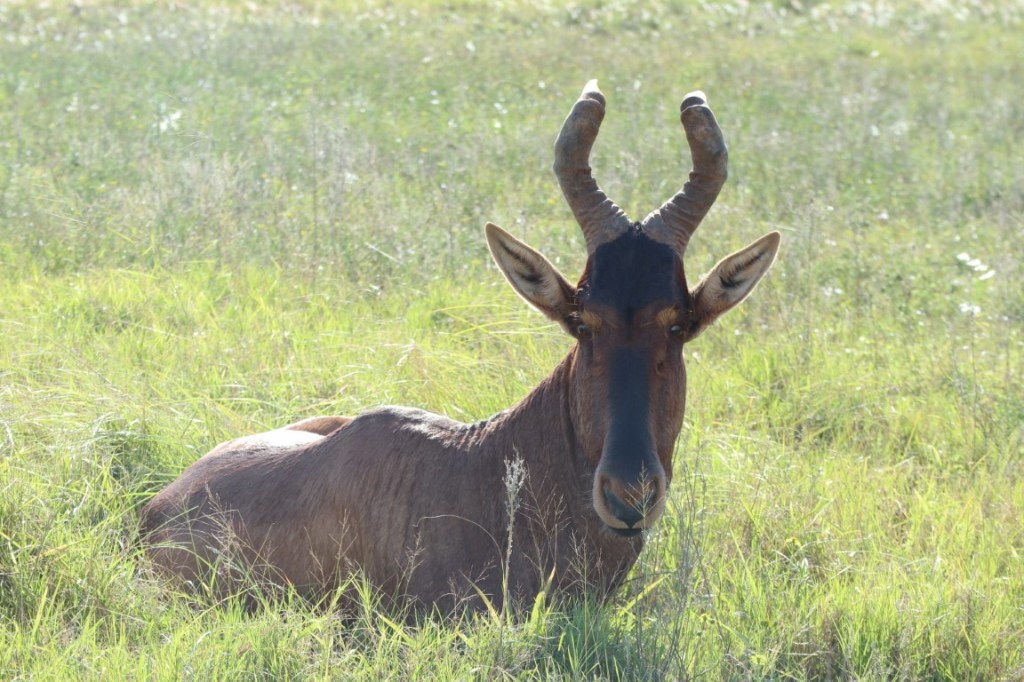
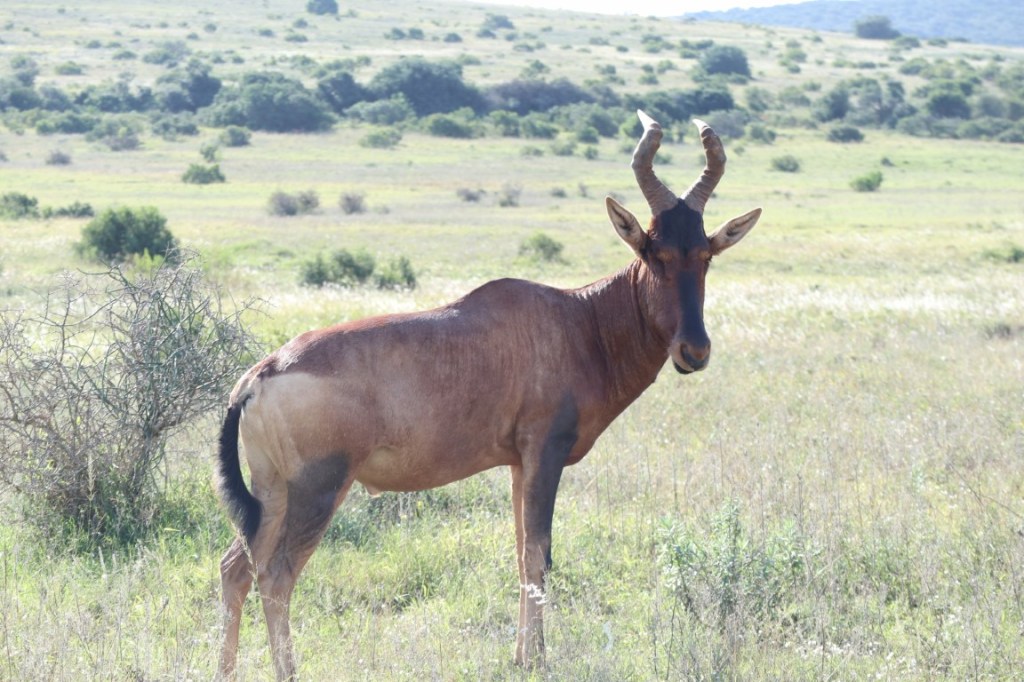
Red hartebeest
Here are a few more photos of animals we saw on this day. We never got tired of seeing different animals quite a few times on one day – it’s always a beautiful sight to spot them in the wild.
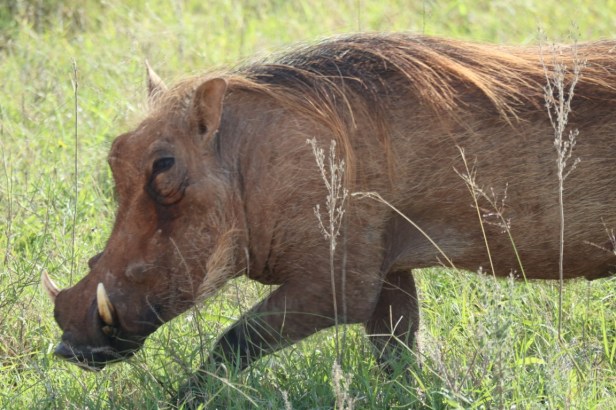
The funny warthog
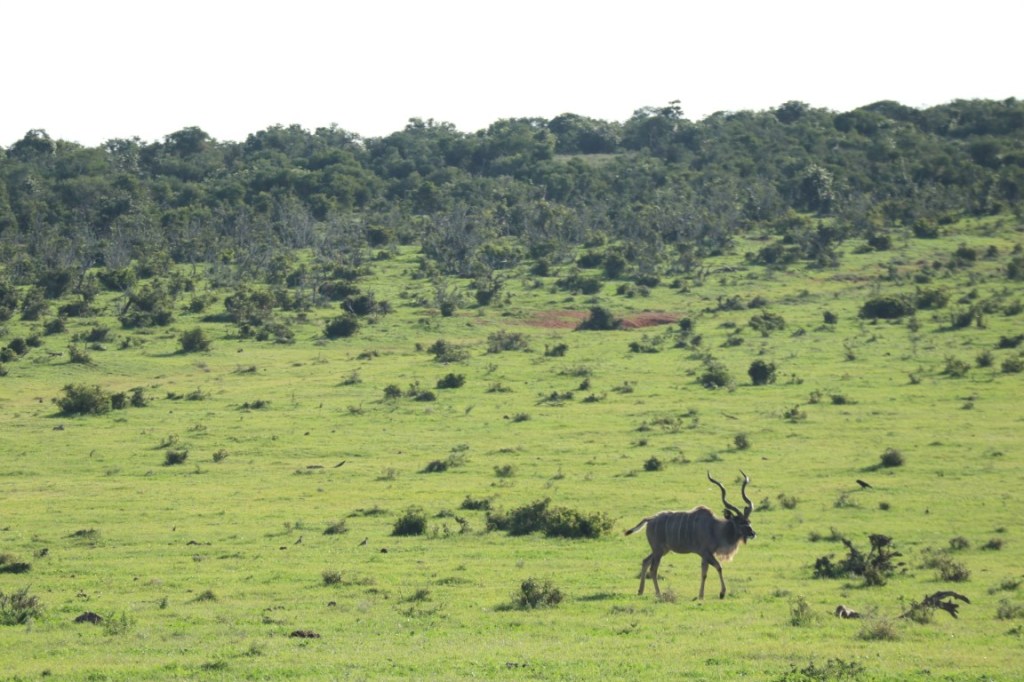
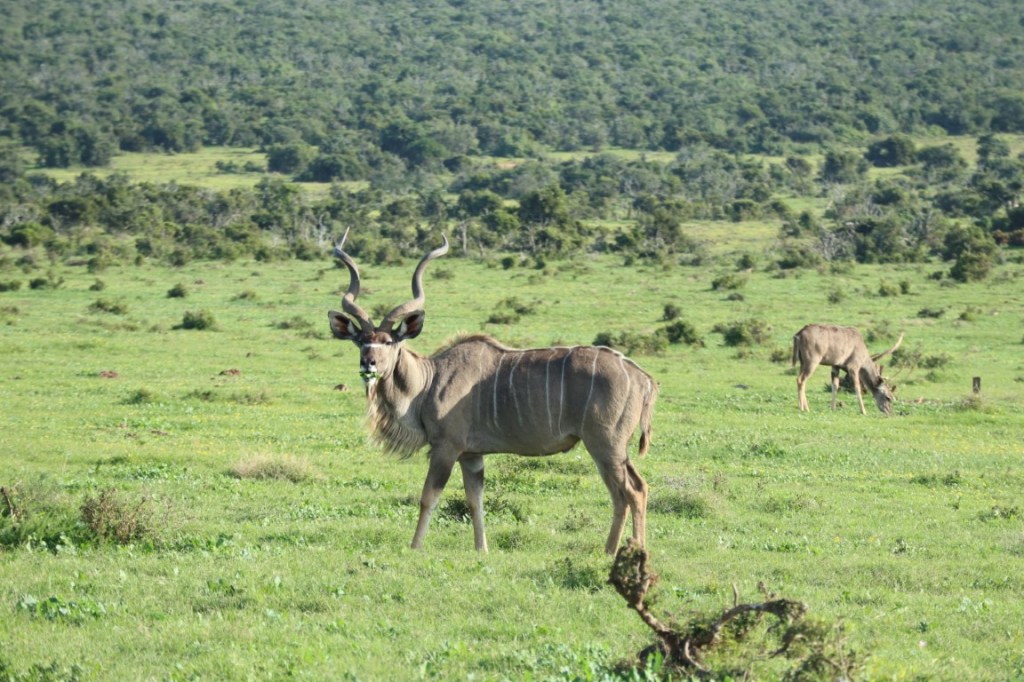
Beautiful kudu
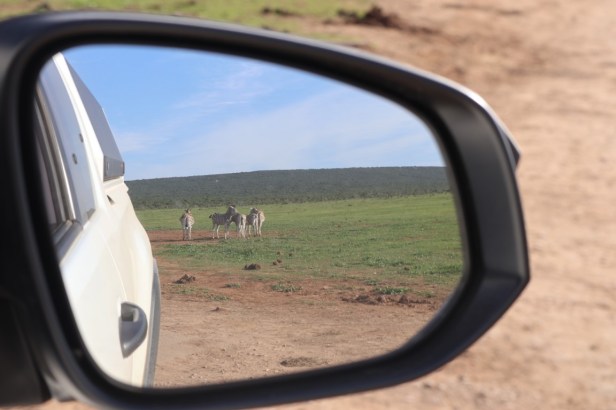
Zebras (yes, it’s sometimes rewarding to look in your rearview mirror)
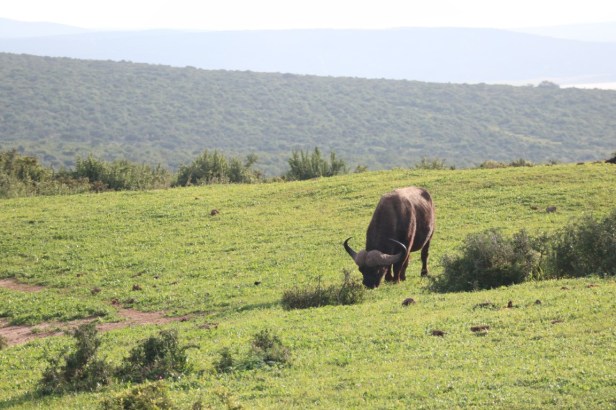
We ended the day with another sighting of the Cape buffalo
Third day sightings:
On our third day we left the park and did not deviate from the main road. So, we didn’t really expect to actually see any animals, but we were surprised to see a herd of elephants walking across the road (we wrote about that in our previous post – read here). But it was not just elephants we saw, the zebras also grazed along the road and we were able to take photos up close.
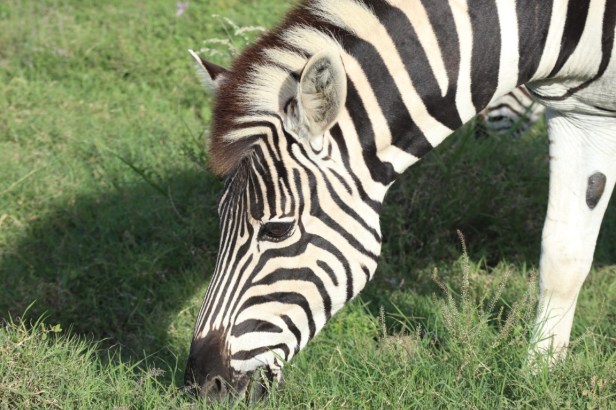
Beautiful face of a Burchell’s Zebra

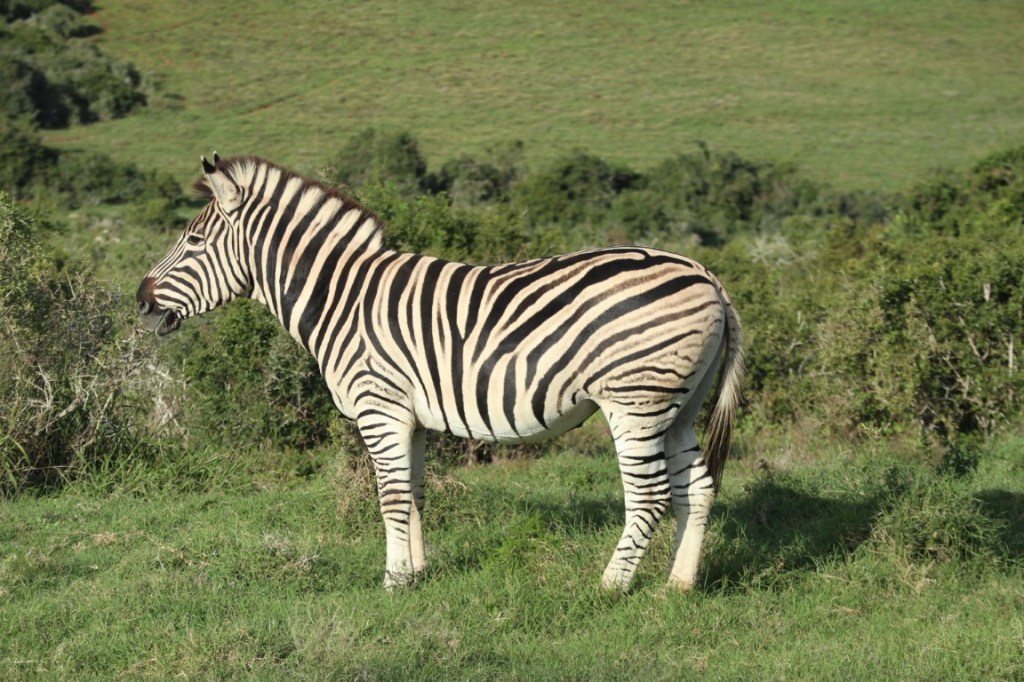
Every zebra has a unique stripe pattern (almost like human fingerprints)
Zebras sleep for seven hours a day, they standing up during the day and lying down during the night. We saw one standing by the side of the road – he was in dreamland and not even us driving past him could wake him up!
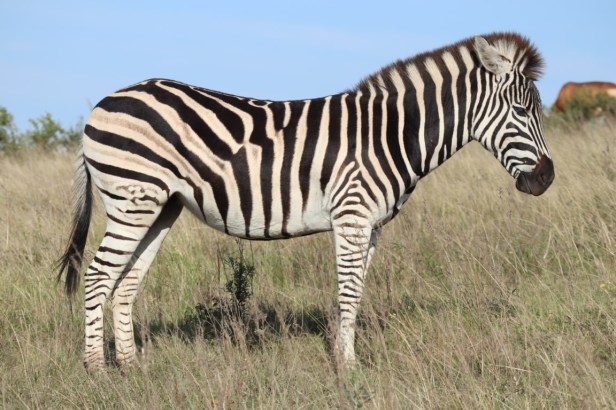
Sleeping zebra
And then the biggest surprise came just before we left the park. On a slope of a hill, zebras, kudus and also elephants stood and grazed together. I’m sure somewhere there might also have been a warthog that we couldn’t see – it was the perfect farewell gift that the Addo Elephant National Park could give us!
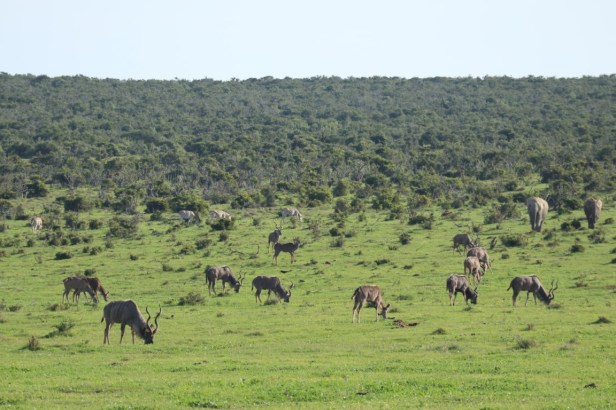
Group of different wild animals in one photo
So, who else thought that the Addo Elephant National Park only had elephants?
All that remains of our visit now is to share with you that amazing event we witnessed at one of the biggest water holes – you can read about that here.
 Wet and Dusty Roads
This park is fabulous! What a great way to let the animals roam free and hopefully not go extinct. Your pictures have all been so beautiful.
LikeLiked by 1 person
The name of the park is very misleading and although the elephants are very prominent here, it was also a big surprise to see such a large variety of wild animals. Yes, Addo Elephant National Park is putting great effort into the conservation of these animals and for that we are very grateful. Thanks Diane, your comment is much appreciated.
LikeLiked by 1 person
Corna, julle het werklik ñ goeie verskeidenheid wild gesien. Die vlakvarke is darem net te oulik. Moes lekker gewees het om die swart renoster te gewaar. Sjoe, heelwat koedoes!
LikeLiked by 1 person
Ja, die baie verskillende wilde diere was ‘n groot verrassing! Ag, ek het die vlakvarke so geniet … hulle lyk tog so parmantig as hulle weghardloop met daardie stertjies wat soos antennas in die lug staan. En jy’s reg, die swart renoster was ‘n bonus en die koedoes was amper soos die olifante – ons het hulle om elke hoek en draai gesien. Pragtige diere!
LikeLike
Those zebra are so pretty! Fallen in love with the foal.
LikeLiked by 1 person
I’m with you on the zebra foal Jo – it’s almost like seeing a miniature horse. He was very curious about us watching them for so long and wanted to walk closer, but his mother stopped him right in his tracks. Shame, the parents in this park seem to have their hands full with their kids 😄.
LikeLiked by 1 person
I think we need to be finding time to visit Addo when we hit South Africa this year…
LikeLiked by 1 person
And I don’t think you’ll regret it. It’s a long way from Cape Town – think it’s about a 9 hour drive (a very beautiful drive may I add). But a flight is just a little over an hour from Cape Town to Gqeberha (Port Elizabeth) … and then it’s only a half-hour drive to Addo. I’m just saying …
LikeLiked by 1 person
Very tempting! By the way, I don’t get emails to tell me when you’ve posted and I have to rely on spotting your posts elsewhere. I can’t see how to get email prompts on your site, can you point me in the right direction please.
LikeLiked by 1 person
I’m afraid I can’t help you Phil. It’s the same on my side as far as your blog is concerned. I have to go search on WP for your blog to see if there are any new posts – that’s why I’m also sometimes so infrequent with my comments on your posts. If it’s going to help … we post a new post every Monday and Thursday.
LikeLiked by 1 person
That’s strange…I’ll look a bit more deeply
LikeLiked by 1 person
Some superb wildlife shots Corna and very interesting to learn about the different breeds of zebra, I had no idea!
LikeLiked by 1 person
On the West Coast where our beach house is, there are many Mountain Zebras and it was nice to be able to see the Burchell’s Zebras now as well (amazing that zebras species can actually vary so significantly). Thank you very much Marion, the Addo is probably the best park to be able to get so close to the animals.
LikeLiked by 1 person
What a thrill to see so many different animals! The Hartebeest is quite majestic looking. I love the close up of the zebra’s face, they truly are beautiful. I’m looking forward to reading about the event at the watering hole!
LikeLiked by 1 person
The Red Hartebeest stands still (or lying down) for long periods of time which makes it a absolute pleasure to photograph them! I told Berto on the day we left the park that I hope we see a zebra so we can take a close up picture of his face … and then it happened exactly like that! Of course I was more than happy with this!
LikeLiked by 1 person
Wow, it looks like there are as many different animals in Addo as there are in the larger, more famous parks. What a great few days you had! Maggie
LikeLiked by 1 person
To be honest, we were very surprised to see so many different wild animals. The most popular national park in South Africa is probably the Kruger National Park, but I think it’s less crowded in the Addo – which of course suits us perfectly!
LikeLike
What a wonderful day, seeing so many animals and many up close. I am fascinated by the twirly horns. I mean, how does one creature get twirls and the others get straight ones? I love that zebra standing there having a snooze. It’s nice that you saw the rhino. I wonder how many more generations will have the privilege. Thank you for all the photos!
LikeLiked by 1 person
Haha, I asked Berto the exact same question regarding those horns as we looked at the kudus. His response was, “You sometimes think of the weirdest stuff” … so I don’t have an answer for you Carolyn! We had a good laugh at the snoozing zebra (maybe he was aware of us after all, but just didn’t consider us dangerous). The rhino was a big highlight – it’s just the second time we see one of them in the wild and it makes me happy and sad at the same time … will there be a next time? I’m glad to hear you enjoyed the photos.
LikeLike
How special to see a rhino 😮 And I love the zebras, especially your close-up!
LikeLiked by 1 person
Oh yes, the rhino was a great find. When we left the park, the staff at the gate asked us what animals we had seen and they were very surprised to hear we had seen a rhino. I’m glad you like the close-up of the zebra Sarah … I was hoping we were going to be able to take a photo like that (and in the end, it was the fourth last photo we took before we left the park)!
LikeLiked by 1 person
Fantastic captures. It’s incredible how much wildlife you saw.
LikeLiked by 1 person
Thank you so much Linda. Yes, we certainly didn’t expect to see so many different wild animals … but what a great trip it was in the end!
LikeLiked by 1 person
Julle was ongelooflik gelukkig om n swartrenoster raak te loop, Corna!
LikeLiked by 1 person
Ek dink ook so. Toe ons die park verlaat het, het die personeel by die hek gevra watter diere ons gesien het en toe ons noem van die swartrenoster, was hulle baie verbaas – die een dame het genoem dat nie baie toeriste so ‘n geleentheid kry nie. Groot voorreg.
LikeLiked by 1 person
For some reason warthogs always make me smile 🙂 And I love your zebra shots, what a special weekend!
LikeLiked by 1 person
That’s exactly how I feel about warthogs too – when they get on the run, I always want to laugh! The zebras are very photogenic and we always take photos of them whenever possible.
LikeLiked by 1 person
Another fabulous day out. So many fantastic animals in your part of the World. Thanks for sharing. Mel
LikeLiked by 1 person
You’re right Mel … it’s amazing that all these wild animals are just around the corner from where we currently live. And although we may see the animals more often than what other people do, we never tire of seeing them in their natural habitat.
LikeLiked by 1 person
We are all privileged to enjoy Mother Nature regardless of where we live. Have a good weekend.
LikeLiked by 1 person
Thanks Mel, you too 🙂.
LikeLiked by 1 person
Another amazing compilation. Great photos, I love the close-ups of the zebras and that funny warthog. Seeing the rhino is a truly special experience! Addo NP is another gem from South Africa. Every time I read your posts, the country climbs higher on my wish list.
LikeLiked by 1 person
Thank you so much Leighton. The warthogs ensure there are enough funny moments in the park. The rhino was a big highlight – we’ve only seen a few rhinos together in the wild once before and it remains a big moment for us! I’m also glad you enjoyed the zebra, because we really wanted to take a close-up photo of them – it’s such a lovely animal. Well, I hope Addo doesn’t stay on your list for too long … and that you guys may one day see it for yourself.
LikeLiked by 1 person
Wow, zebras sleep standing up? That’s so bizarre and must have been strange to witness. What a great collection of photos!!
LikeLiked by 1 person
We couldn’t understand at first why he was standing still for so long … until we saw that he was actually sleeping. After that, we went to read up on the zebra’s sleeping habits and that they like to stand and sleep during the day – I wonder how comfortable that can be. But, it’s probably the life of a zebra when there are hungry lions nearby – they should always be ready to run away if need be. Thanks for your lovely comments Diana!
LikeLiked by 1 person