
June 2024
In our previous post we gave you an overview of the Addo Elephant National Park (read here).
In today’s post there are some fun facts about elephants (*), a short story about a disagreement between a mother and her stubborn calf and just loads of pictures of the largest land mammal on earth.
*We found the fun facts on the website of the World Wildlife Fund (wwf.org.uk).

Herd of elephants – a common sight in the Addo Elephant National Park
This may not be a recognised fact, but it seems that elephants are good posers for photographers. We’ve caught them looking directly at the camera several times (or maybe they’re just curious by nature).
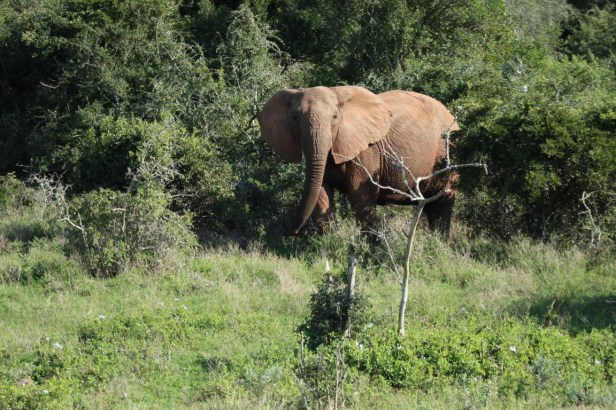
Elephant poses for a photo
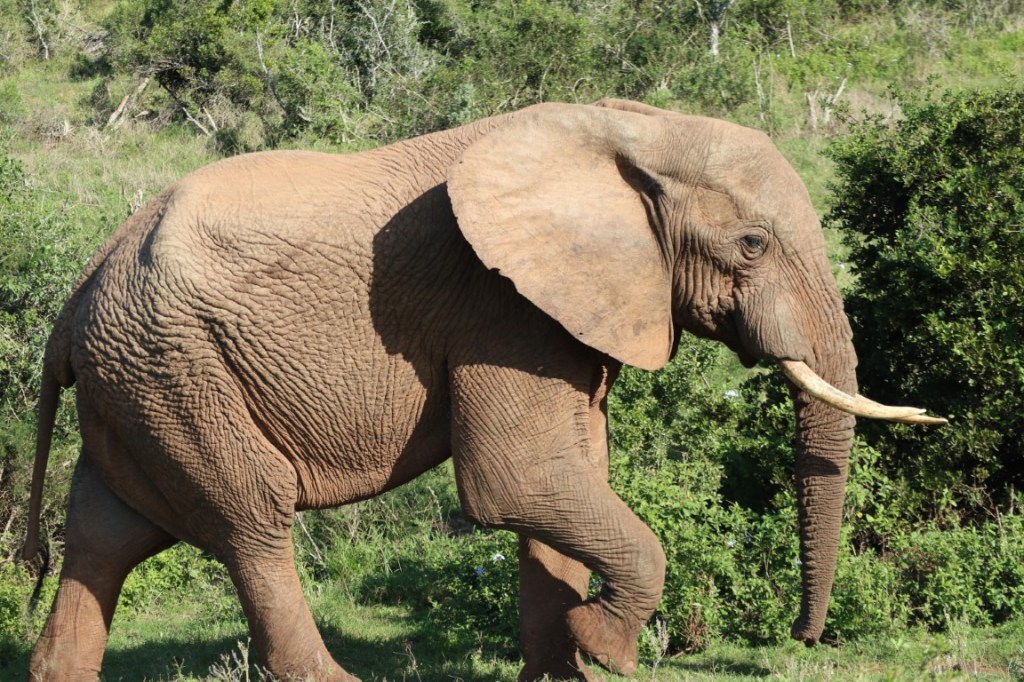

Sometimes it was more like a suspicious look

Elephants may not have the best eyesight, but they have soulful eyes
Fun fact: Elephants can spend up to three quarters of their day just eating. And we can confirm this, because about 80% of the time we saw them, they were eating (or looking for food).
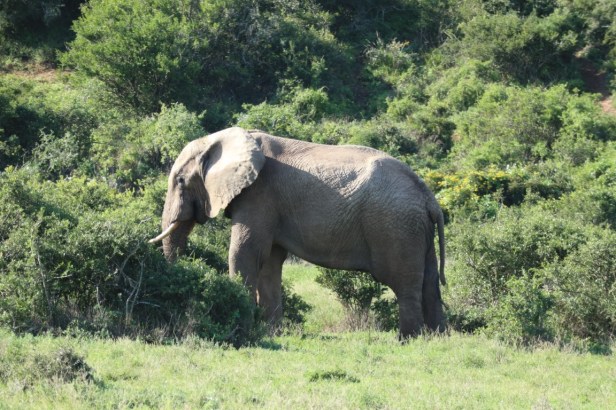
“Now let me see, from which bush shall I eat next?”
Fun fact: They keep their skin clean and protect themselves from sunburn by taking regular dust and mud baths.

Elephant applying ‘sunscreen’
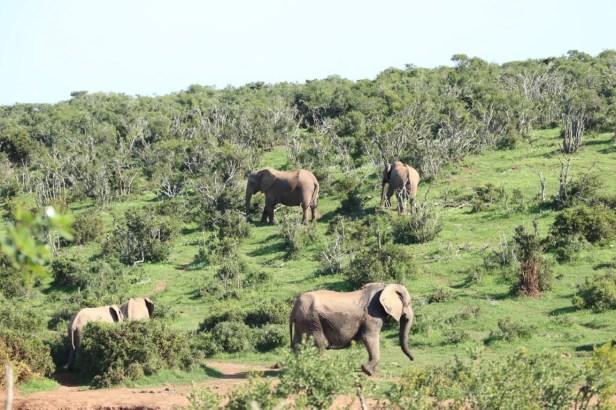
After drinking water, they go in search of their next grazing field
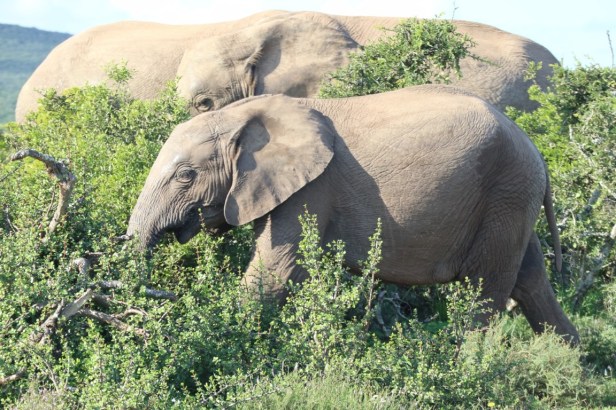
It’s difficult for an elephant to play hide and seek
Fun fact: Elephants do not trot or gallop, but can move smoothly – it’s called kinetic energy.

An elephant on the move
It happened a few times on our visit that we had to stop in the middle of the road because elephants either wanted to walk across the road or simply in the road. We then gave them the space they needed – we didn’t really want to compete over “who’s got right of way”!
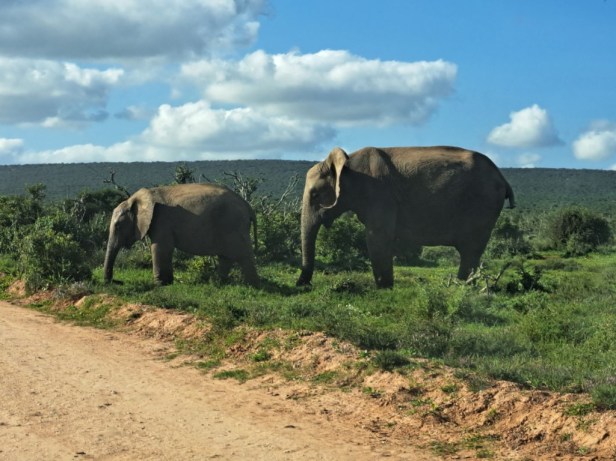
Elephants crossing the road

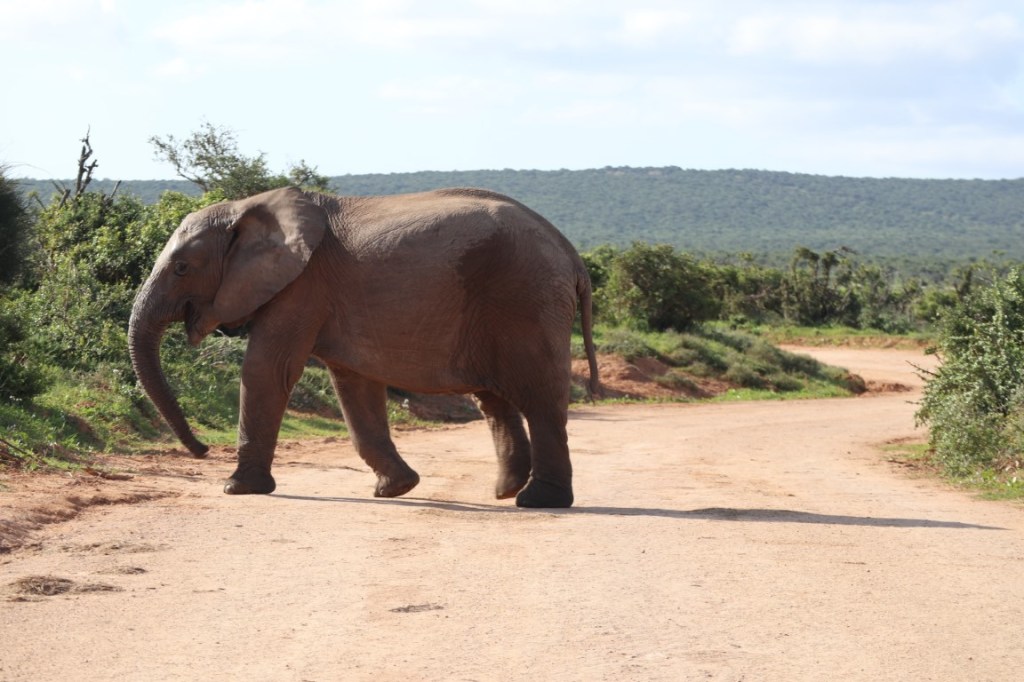
The mother let her little one walk in front
It was at the waterholes that we enjoyed the visits of the elephants the most. Here we could just sit and watch the elephants come and go. It was almost like sitting in the front row of a movie. (It was also here at Rooidam that we saw an amazing spectacle unfold – you can read that story if you click here).

Elephants at the waterhole
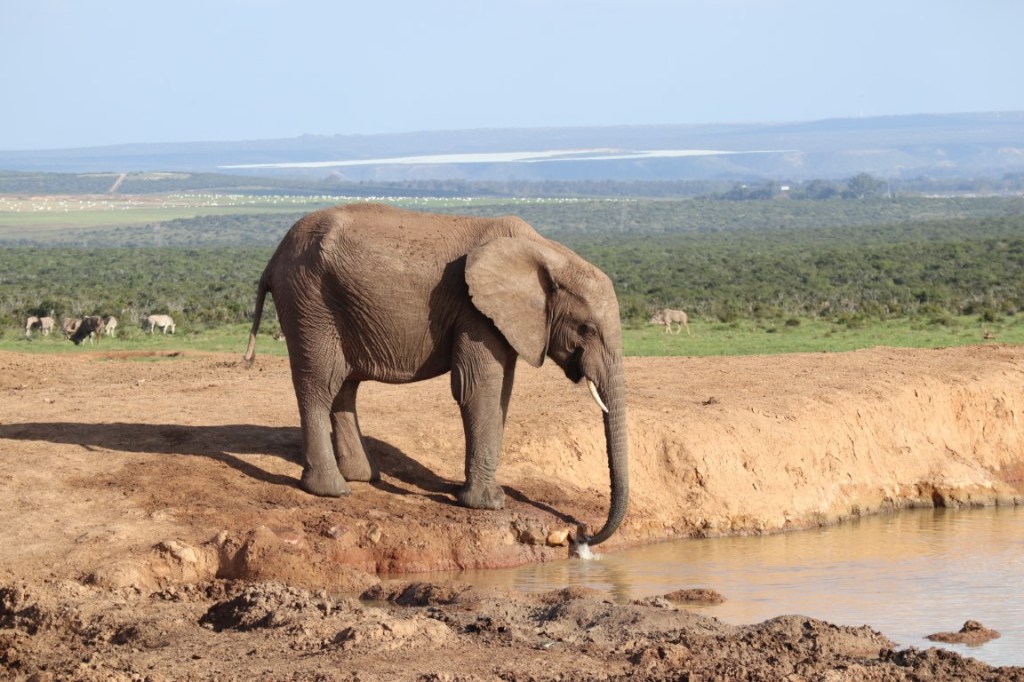

An elephant’s trunk can hold up to 8 liters of water
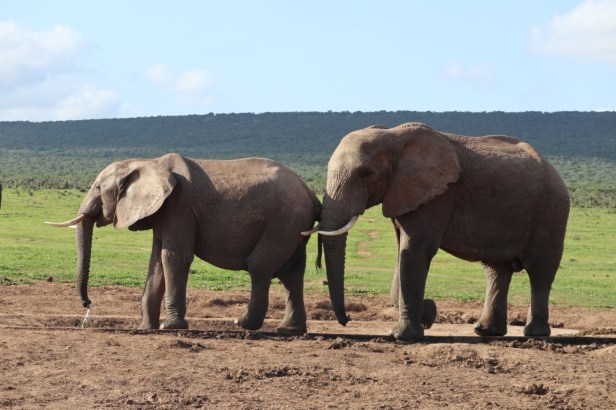
They always seemed so excited to spent time at the waterholes

The waterhole is calling
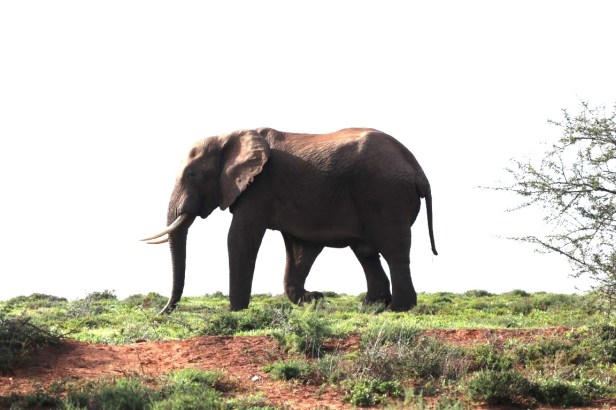
Elephant on a hill in the late afternoon light
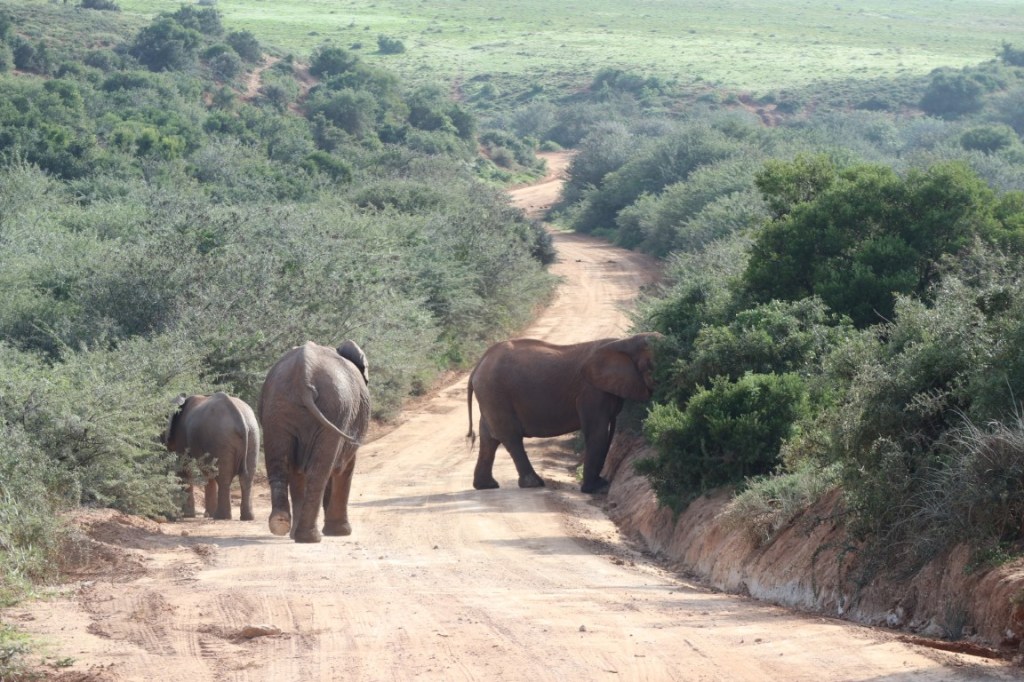

Elephant traffic ahead in the road
Fun fact: The elephant’s temporal lobe (the area of the brain associated with memory) is larger and denser than that of people – hence the saying “elephants never forget”.
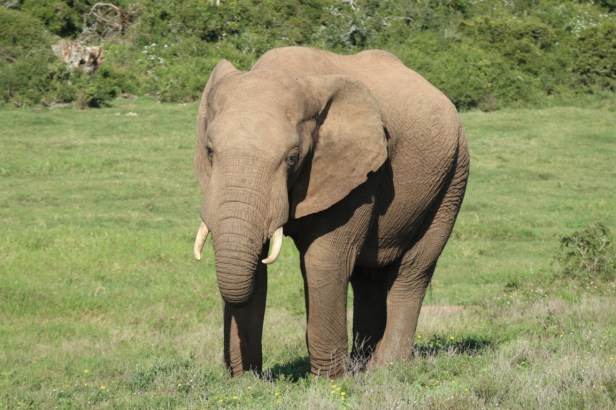
“Hang on, didn’t I see you two at the waterhole earlier today?”
A short story:
(Let’s assume the young calf is a boy/bull, to make it easier to write).
At Lismore waterhole we watched a mother and her calf for some time. After they finished drinking water, the mother started to walk up the hill.
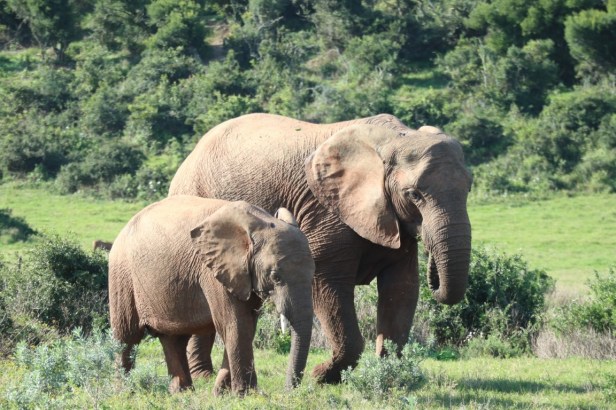
Mother and her calf at Lismore waterhole
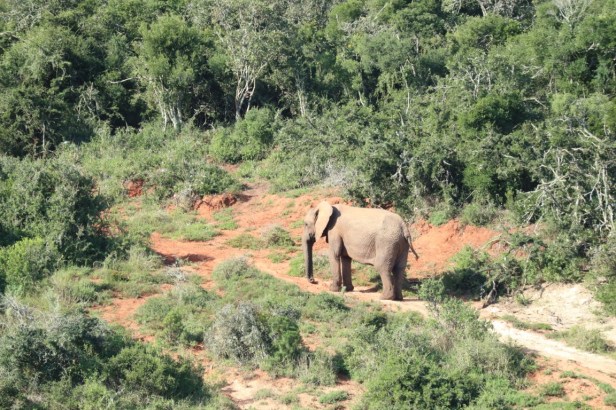
The mother on her way up the hill
The mother must have assumed her calf would follow her and kept walking, but this little guy had other plans. He either didn’t feel like walking up the steep hill or was distracted by something else.
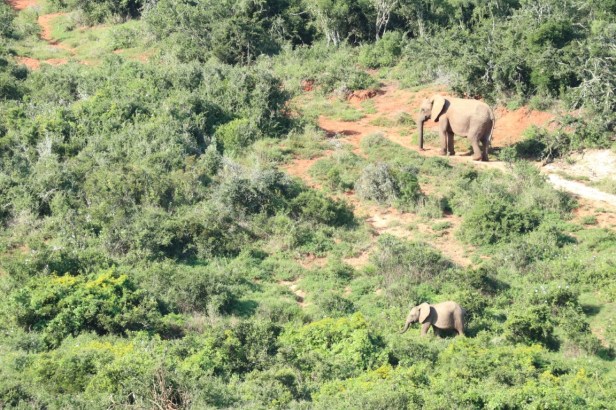
The calf walks in a different direction
At one point, the mother turned around and saw her calf had plans of his own. She uttered a short trumpet and gave him a long stern look.
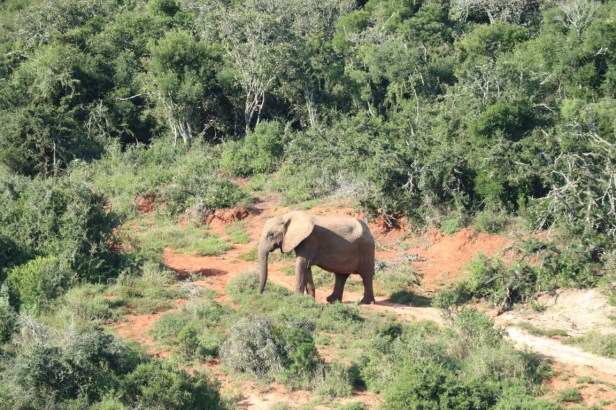
The look of an irritated mother elephant
It was enough to immediately stop the calf in his tracks and he quickly turned towards his mother – oh, the look of a mother, right?
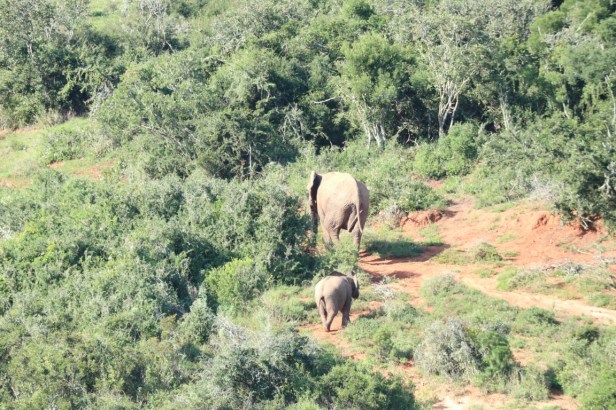
“I’m right behind you Mommy!”
Let’s return to the wonderful waterholes one last time.

While some elephants just finished, others came to drink water
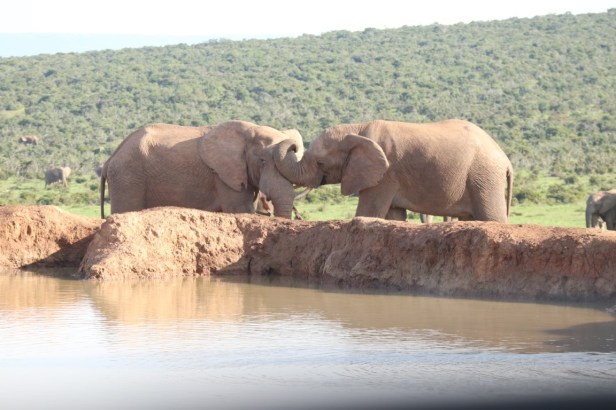
Is this perhaps a way of greeting each other?
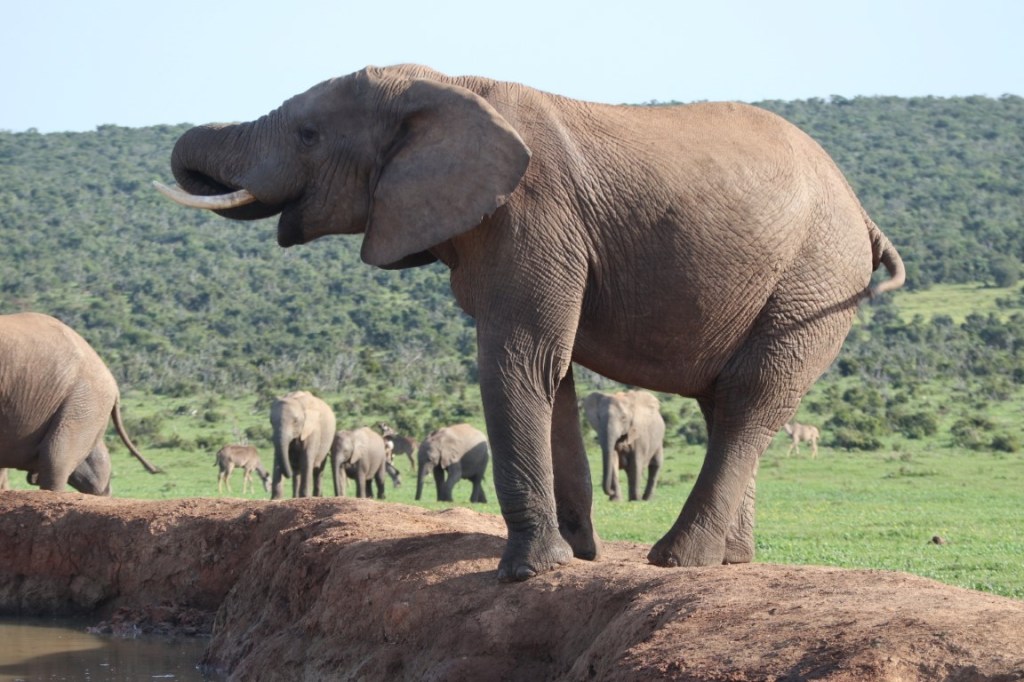
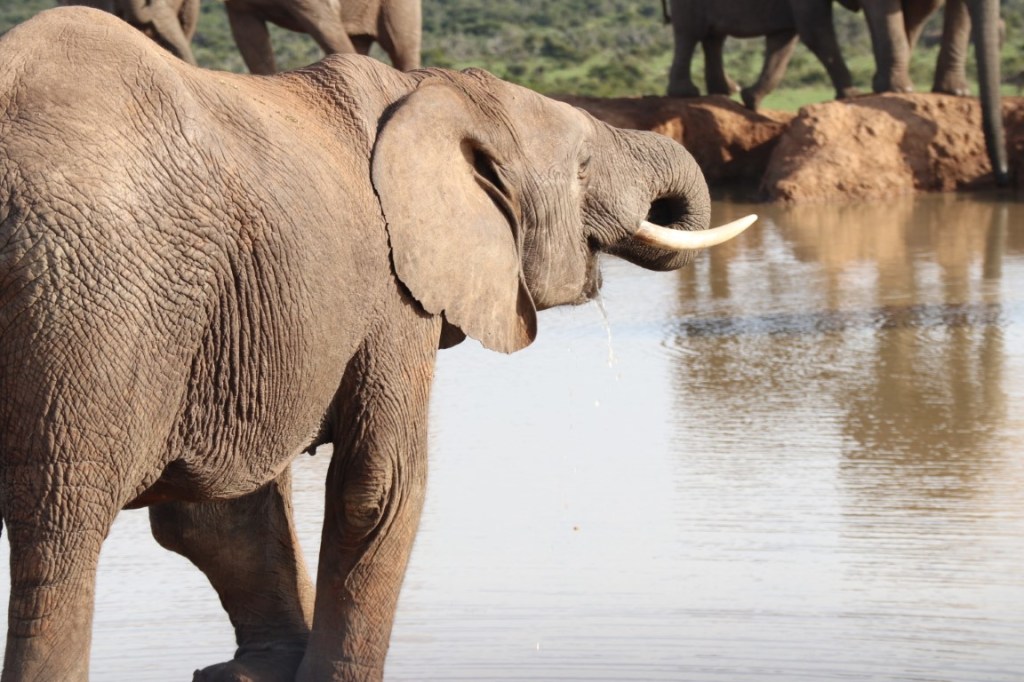
They came thirsty
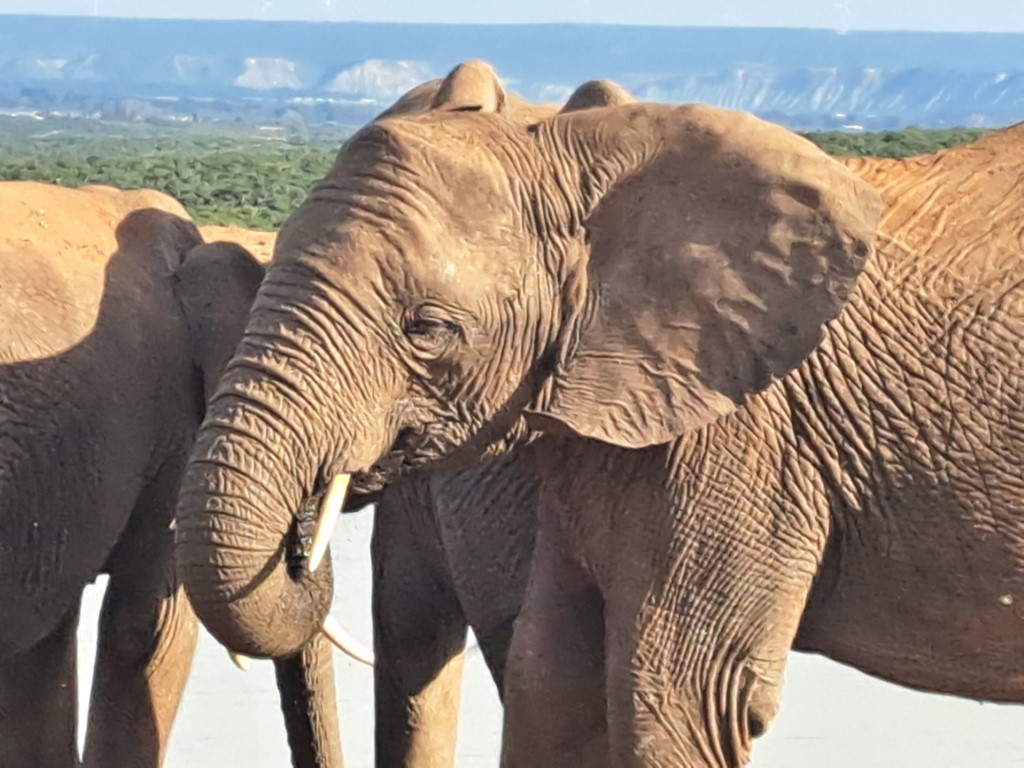
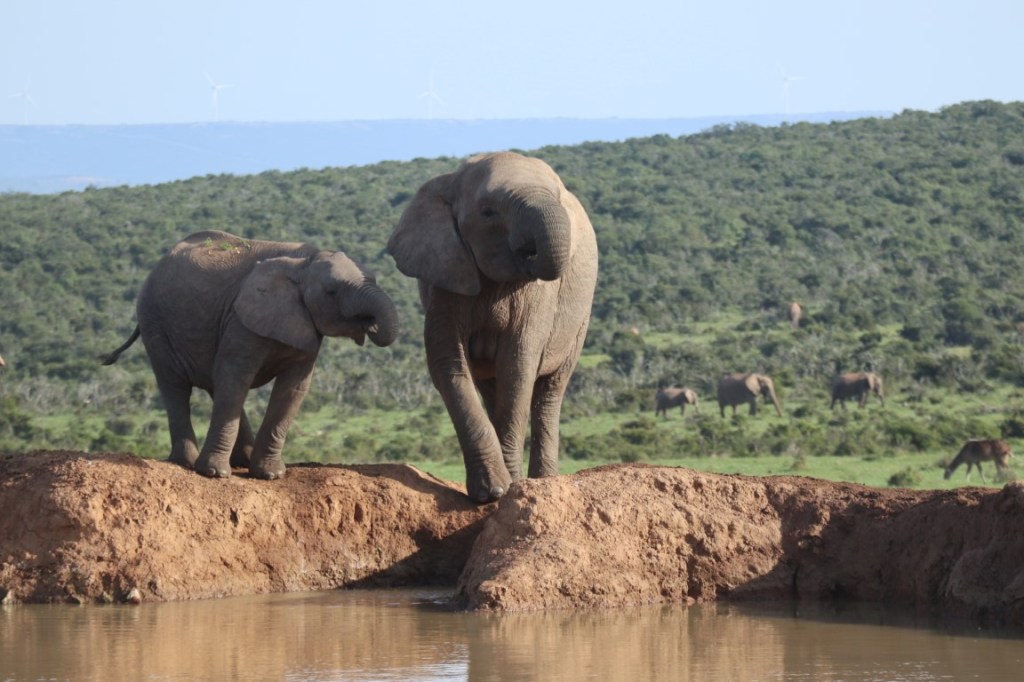
Happy to be at the waterhole
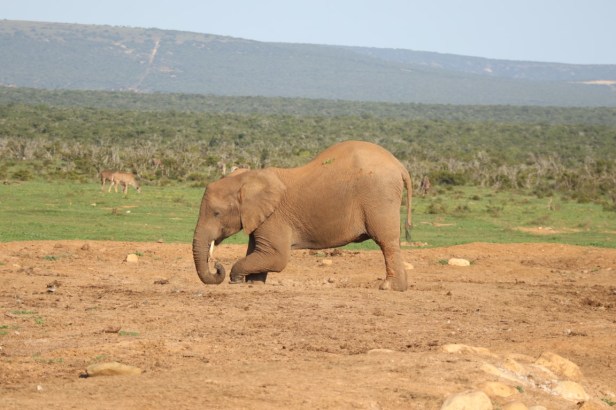
After quenching their thirst, it was time to play in the dust
On the day we left the park, we encountered a large herd of elephants walking across the road. A few vehicles stopped and the elephants walked between them to the other side of the road. For the first time we could really see how big these animals are (and that it is always a good idea to show respect towards them).

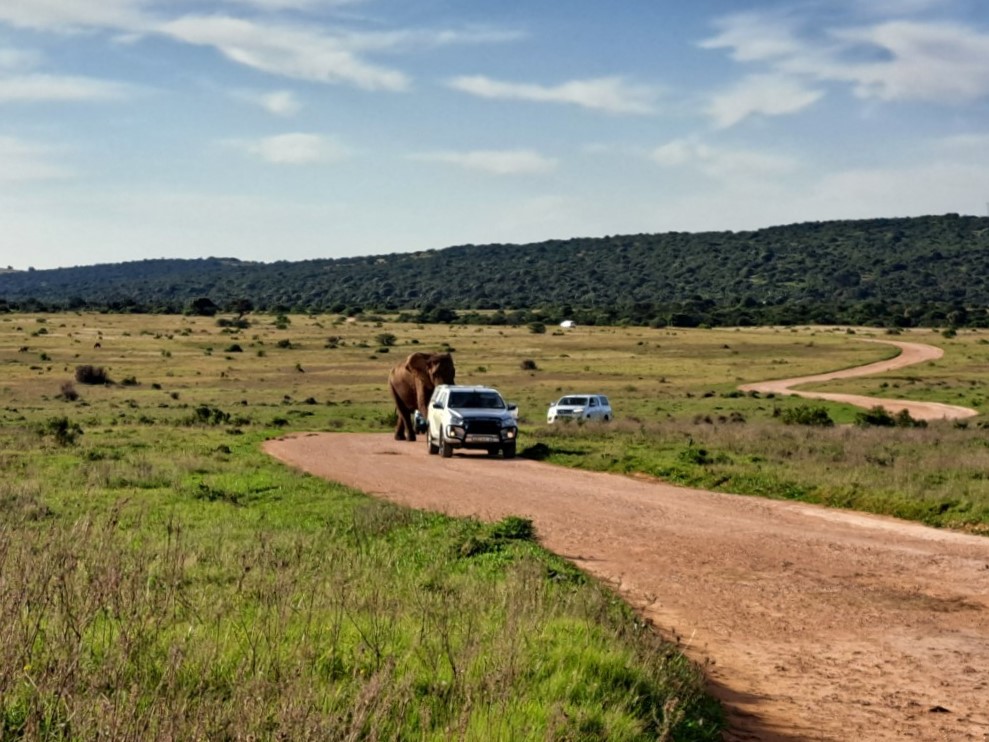
Big bull crosses the road in the Addo Elephant National Park

Unbothered by the vehicles, he continued on his way
Elephant dung:
Just a final thought. If you ever visit the Addo Elephant National Park, try and avoid driving over elephant dung. The dung is used by the endangered, endemic flightless dung beetle for food and reproduction.

Elephant dung
We hope you enjoyed the elephants of Addo. Next week we will have another photo album of our visit to the Addo Elephant National Park – this time of all the other wild animals we saw.
To read about all the other animals we saw, click here.
 Wet and Dusty Roads
Elephants are amazing…we have so much to learn from them! 💕
LikeLiked by 1 person
This is very true! By just looking at them for a few hours, one can see that they really care about each other … definitely a great example for us humans!
LikeLiked by 1 person
Wonderful pictures an great story. As elephants are my favorite animals this park is defivinately on my list.
LikeLiked by 1 person
We’re glad you enjoyed the elephant post – especially since they are your favourite animal! It was a joy to follow them through the park for a few days and we are sure you will enjoy a visit here.
LikeLiked by 1 person
Just fabulous! I really enjoyed the telling, Corna.
LikeLiked by 1 person
Thank you so much Jo 🤗. As you can see, we had a lovely time in this park! Watching the elephants for long periods of time, it is easy to see that they have emotions just like us humans.
LikeLiked by 1 person
Like you I can watch elephants for hours. And yes, those bull elephants are BIG! A lovely post. I will enjoy it more on my computer.
LikeLiked by 1 person
One knows (from books and the internet) that elephants are big animals – I mean, we learn that in kindergarten through rhymes – but when you see these animals up close for the first time, you realise they are truly massive! I’m glad you enjoyed the post Jude … and hopefully it brought you fond memories of your last visit to the Addo.
LikeLiked by 1 person
Oh, yes, great memories. And you really wouldn’t want to annoy a bull elephant. Have you ever been to Chobe? Now that’s a place to see ellies. I look forward to seeing the other animals you found.
My first visit to Addo was way back and I think we only saw elephants as we were leaving the park. My second visit was in the 90s notable because my ex ate a bad borewors roll and was so ill I had to drive his bakkie back to Kenton on Sea. It was pitch black and raining and I was unfamiliar with the car and road. Managed to switch off the headlights thinking it was the windscreen wipers! Terrifying drive.
LikeLiked by 1 person
Chobe is high on our list to visit one day (maybe when we’re fully retired, but we hope we get that opportunity someday). Oh my gosh, your ride to Kenton on Sea sounds like a true nightmare. Yes, it can be quite nerve-wracking if you turn off your lights while driving in the dark (and while it’s raining). That’s probably how it works in life – some memories are wonderful and you won’t mind experiencing them again, but others should be forgotten (not to be repeated again)!
LikeLiked by 1 person
Such an amazing adventure.
LikeLiked by 1 person
It was a wonderful weekend – to be able to see so many elephants (and other wild animals) was amazing. And although we see it often, we never get tired of it 🙂.
LikeLiked by 1 person
So many elephants, reminds me of Sri Lanka. They are so big and clumsy looking but move with such ease. I can’t believe their trunks hold 8 liters of water! Maggie
LikeLiked by 1 person
So many elephants, right? I actually laughed after our visit at my distress that we might not even see one elephant! Seeing how comfortably they lifted those heavy legs and big feet was one of the most surprising things to see.
LikeLiked by 1 person
They’re just such amazing animals! I can only imagine how it must have felt to see so many of them up close.
LikeLiked by 1 person
Beautiful animals! And as Maggie mentioned here in the comments, it’s amazing how easily they move for how big they are. We enjoyed every second of our visit to Addo!
LikeLiked by 1 person
Your pictures are amaaaazing and I enjoyed reading these fun facts about elephants. You’re absolutely right about how they are fantastic models, or at least they were for you and your camera! That story about the mom and baby is super cute.
LikeLiked by 1 person
Thank you so much Linda! It was really easy to take pictures of the elephants – there were just so many of them! If you liked this story, I’m sure you’re also going to really like the waterhole story that I’m going to share with you guys later. I can understand why people write books about elephants – they do not hide their feelings (one can easily tell when they are irritated, happy or anxious).
LikeLiked by 1 person
You know I love elephants 🐘 and to see so many in one place must be a wonderful experience!
LikeLiked by 1 person
It was the best ever Sarah! You’ll have a field day at Addo!
LikeLiked by 1 person
These photos are so great. How lovely to see so many elephants. They are wonderful creatures. A problem has come up on wp comments so the letter “eye” doesn’t regster…so a tad awkward for commentng..(see what “eye” mean!)
LikeLiked by 1 person
Seeing so many elephants has been our highlight so far this year! It’s hard to believe that we waited so long before we finally visited this park. Haha, yes the letter “i” made someone very angry and now it has been taken out of WordPress’ alphabet 🙂!
LikeLike
Oh my Corna; what an amazing adventure! Elephants are truly magnificent creatures and your photos and story have beautifully captured a slice of their most close family interactions. All your photos are truly stunning. Thanks so much for sharing! I’m looking forward to reading more about the watering hole!
LikeLiked by 1 person
I’m really glad you liked this Tricia … it was fun putting this post together! And thanks for the compliment on our elephant photos – it’s not really hard to take good photos of these large animals (they are very patient models)! And you’re definitely going to enjoy the waterhole story — it was our highlight of the weekend!
LikeLiked by 1 person
Your photos are just incredible. Wow. What a way to spend a weekend, it’s just so special. The story of the mother and her calf made me smile 🙂
LikeLiked by 1 person
The mother and her calf made me think that children (human or animal) have much the same attitude … they test their mother’s patience for as long as possible! Thanks Hannah, it was fun to take literally hundreds of photos – and hard to finally have to pick just a few for this post. An amazing weekend indeed!
LikeLike
Such majestic and so weird looking beasts! Thanks for a walk on the wild side. Mel
LikeLiked by 1 person
Although the elephants are in a park, it is a bit on the wild side, isn’t it? Beautiful animals and I’m glad you enjoyed it with us Mel.
LikeLiked by 1 person
Always wonderful to see such amazing creatures. Enjoy your safari! 🐘🐘
LikeLiked by 1 person
What majestic creatures and so many in one spot – you’re so lucky! I’ve only seen a handful in one spot in Zambia, but that was back in 1985.
It saddens me that people still seek elephant tusks and poachers still exist.
LikeLiked by 1 person
Yes, it’s sad that wild animals have to be placed in parks to protect them from poachers. Fortunately, there are large areas in our country where wild animals, especially elephants and rhinos, can be accommodated without having to restrict their movements too much. It was indeed a great privilege to see so many elephants during one weekend – we brought wonderful memories back home.
LikeLiked by 1 person
Sounds so wonderful!
LikeLiked by 1 person
Corna, dis sulke pragtige foto’s die! Hulle is darem maar ongelooflike diere! Ek sal dit ook graag weer beleef!
LikeLiked by 1 person
Dankie Aletta. Ek het my verwonder aan hierdie groot diere – elke keer wat ons hulle gesien het, was daar ‘n storie wat ‘n mens oor hulle kon skryf! Ek is bly ons het tyd gemaak om hierdie park te kom besoek.
LikeLiked by 1 person
Some great facts here Corna and a few I didn’t know. Love the calf story, I can feel mum’s “irritation” coming off the page!
LikeLiked by 1 person
Thanks Leighton, I appreciate your comments (and always look forward to hearing what you think of our attractions in South Africa). The calf made me think so much of human kids … he really wanted to see how far he could go before his mother expressed her displeasure. We really enjoyed this scene. There’s literally a story to every elephant group we’ve seen!
LikeLiked by 1 person
What an amazing experience, you two are so lucky to live there.
LikeLiked by 1 person
We can’t believe we waited so long to visit this park! I’m really happy we had to move unexpectedly to this side of the country (although temporarily), otherwise we may never have seen the Addo Elephant National Park!
LikeLike
Addo se olifante is so kalm en rustig; gee mens lekker kans vir naby foto’s!
LikeLiked by 1 person
Dit is baie waar. Alhoewel ek gister in die nuus gehoor het van ‘n Spaanse toeris wat deur ‘n olifant dood getrap is (maar as ek die berig reg verstaan, het hy ongelukkig uit sy voertuig geklim om nader foto’s van die olifant te neem). Ek dink ‘n mens moet maar altyd onthou dat dit ‘n wilde dier is en een waarvoor jy baie respek moet hê.
LikeLiked by 1 person
Loved the photo of the soulful eye – they are very intelligent beings. How nice to spend a day around them. The interlude between mother and young one was a lucky moment for you to catch!
LikeLiked by 1 person
It feels like one can see into the heart of the elephant when you look into those soulful eyes. Oh yes, we enjoyed watching the little one and his mother – he really didn’t feel like walking up that hill. Another park we left with amazing memories.
LikeLiked by 1 person